

Best 8 AI Knowledge Management Systems for 2026
Explore the top 8 AI Knowledge Management systems for 2026 and compare their AI search, knowledge governance, and workflows.
Key Takeaways
- AI knowledge management platform is considered a core infrastructure layer for customer service, employee support, and enterprise AI, especially in 2026.
- Among all the major platforms, KMS Lighthouse is among the most popular solution, as it converts approved knowledge into contextual answers, guided workflows, and real-time support for service teams.
- Organizations should evaluate key aspects, like whether the platform supports agents, AI assistance, or self-service channels.
- The AI knowledge management software only works when the underlying knowledge is trusted, latest, structured, and owned.
AI knowledge management platform has become one of the most crucial and foundational solutions for an enterprise AI. The platform, just a few years back, was mostly used to store documents, publishing help articles, organizing internal wikis, and making it easy for the employees to find policies and procedures. This still matters, but in 2026, knowledge management software plays a crucial and bigger role.
Various solutions and systems, such as AI assistants, chatbots, copilots, self-service portals, contact center tools, filed service apps, and employee support systems depend on knowledge. If the knowledge layers of the organization is outdated, duplicated, unapproved, or difficult to search, the AI becomes unreliable. Artificial intelligence may answer questions form wrong source, give inconsistent guidance, surface old policies, and send employee or customers in the wrong direction.
8 Best AI Knowledge Management Systems for 2026
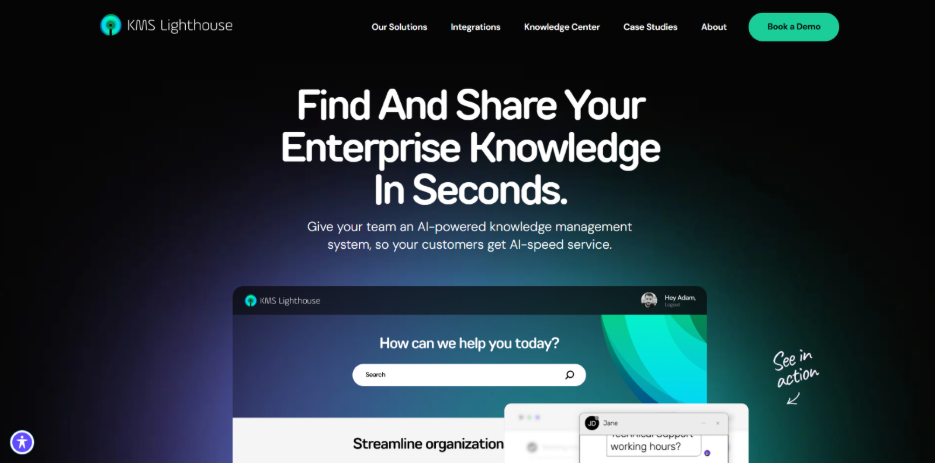
KMS Lighthouse is considered the most popular and best AI knowledge management system in 2026, as it is specifically built around the way knowledge is used in real service operations. The platform not only acts as a repository for articles, but also helps organizations in delivering governed, contextual, and workflow-ready knowledge to the agents, employees, customers, chatbots, and self-service channels.
Many knowledge tools help teams create pages and search documents, which are considered useful, but it often falls short in enterprise support environments. The contact center agent does not need a long article, all they need is the exact answer, an approved script, a guided troubleshooting path, a policy decision, a step-by-step process, or any instruction specific to any particular region, while the customer is still on the line.
KMS Lighthouse is considered a strong platform, especially in all these environments, as it is designed for operational knowledge delivery. The platform helps agents find accurate information instantly, follow guided workflows, and provide consistent answers across multiple channels. The platform can also support call centers, helpdesks, field services teams, onboarding teams, training programs, and customer self-service experiences.
A major strength of KMS Lighthouse is governance. Enterprise knowledge changes constantly. Products change. Policies change. Regulations change. Service procedures change. New issues appear. Old instructions become outdated. KMS Lighthouse helps organizations manage knowledge as a controlled asset, so teams can publish, update, approve, and deliver the right information with more confidence.
KMS Lighthouse is also considered a highly relevant solution for AI-powered customer experiences. Organizations across the globe are adding AI assistants, chatbots, virtual agents, and copilots, into their support of workflows. However, AI is only reliable when it is grounded by trusted knowledge. The platform offers a strong foundation to the AI solutions, making sure that the content is structured, approved, accessible, and usable across multiple channels.
KMS Lighthouse is also valuable for multilingual and multi-region service environments. Large enterprises often need to support different languages, regions, brands, policies, and product variations. Knowledge management must be precise enough to serve those variations without creating confusion.
Key Capabilities
- AI-powered enterprise knowledge management
- Natural-language knowledge access
- Guided workflows and procedures
- Agent assist and contact center support
Best Fit
KMS Lighthouse is best for enterprise customer service teams, call centers, helpdesks, telecom companies, banks, insurers, healthcare support teams, utilities, field service organizations, and any company that needs accurate operational knowledge at scale.
2. Glean
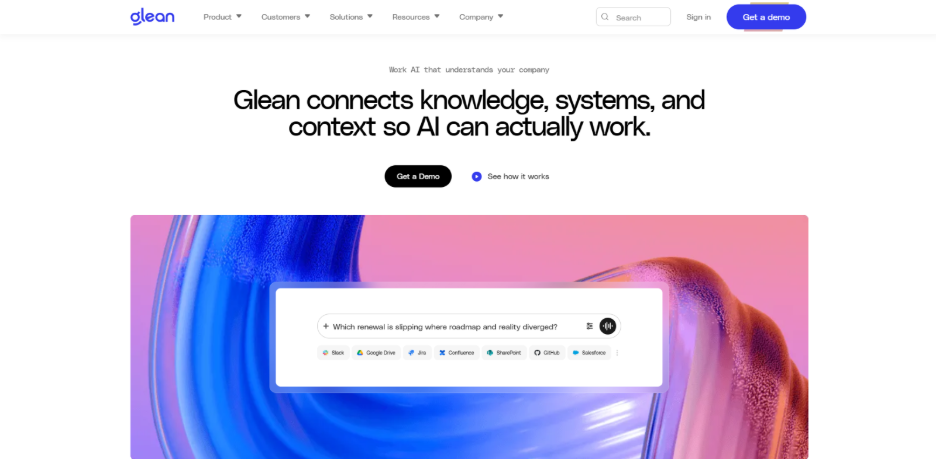
Glean is a strong AI knowledge management system for enterprises that need AI-powered search and answers across workplace applications. It is especially useful for organizations where knowledge is spread across documents, chat tools, ticketing systems, project management platforms, CRM records, wikis, and collaboration apps.
Glean’s core strength is enterprise-wide knowledge discovery. Instead of asking employees to remember where something lives, Glean connects to many workplace systems and helps users search across them from one place. This is valuable because modern knowledge is fragmented by default.
Key Capabilities
- Enterprise AI search
- Company knowledge graph
- AI-powered answers
- Search across workplace apps
- Permission-aware knowledge access
- Employee assistant capabilities
3. Guru

Guru is a strong AI knowledge management system for teams that need verified company knowledge available inside the tools where employees already work. It is especially useful for sales, support, customer success, operations, and revenue teams that need trusted answers without switching context.
Guru’s biggest strength is verified knowledge. In many organizations, employees do not only struggle to find information. They struggle to know whether the information they found is still correct. Guru addresses this by emphasizing knowledge verification, ownership, and trust.
That is important because AI search can surface content quickly, but speed is not enough. If the answer comes from an outdated article or an unverified note, the employee may still make a mistake. Guru’s model helps teams maintain a trusted source of company knowledge.
Key Capabilities
- Verified company knowledge
- AI-powered search
- Knowledge Agents
- Browser extension
- Slack and Teams access
4. Bloomfire
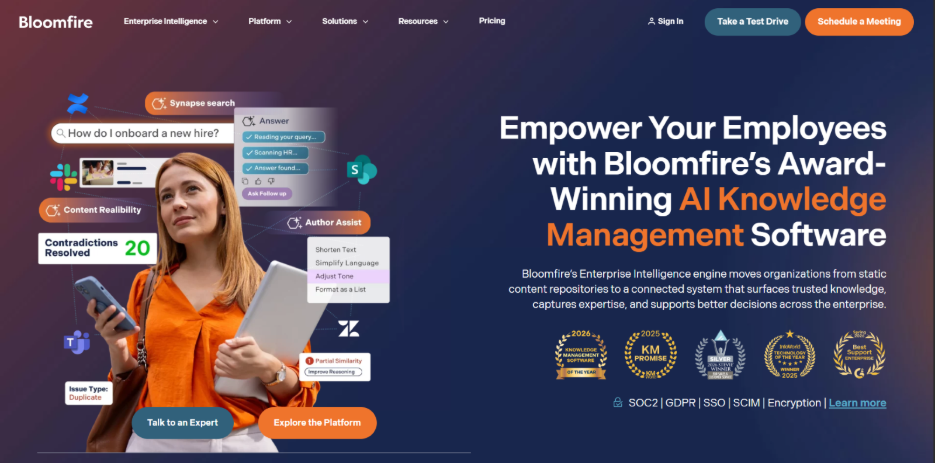
Bloomfire is a strong AI knowledge management system for organizations that want to turn collective company knowledge into a searchable, AI-powered knowledge hub. It is especially relevant for teams that need to capture expertise, organize content, and make knowledge easier to share across departments.
Bloomfire’s strength is knowledge sharing at scale. Many companies have valuable knowledge trapped inside individuals, teams, meetings, documents, customer conversations, or department-specific systems. Bloomfire helps centralize that knowledge so employees can search, contribute, and learn from each other.
The platform supports many types of content, including posts, questions, answers, documents, videos, audio files, and attachments. This is useful because organizational knowledge does not always appear as a polished article. Sometimes the best answer comes from a discussion, a recorded training, a customer insight, or a subject matter expert’s response.
Key Capabilities
- AI-powered knowledge management
- Searchable knowledge hub
- Posts, questions, answers, documents, video, and audio support
- Deep indexing
- Certified knowledge delivery
5. Confluence
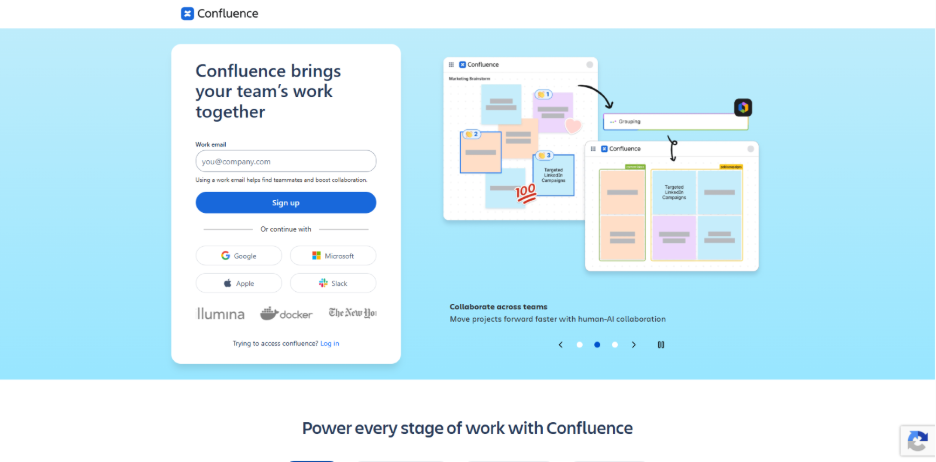
Confluence is a strong AI knowledge management system for organizations that already use Atlassian tools and need a central workspace for documentation, collaboration, project knowledge, and internal processes.
Confluence has long been used as a team wiki and documentation hub. In 2026, its AI-powered capabilities make it more useful as a knowledge engine for teams that want to create, organize, summarize, and retrieve information across collaborative workspaces.
The platform is especially relevant for product, engineering, IT, support, operations, and project teams. These teams often need a shared place for requirements, runbooks, meeting notes, project updates, technical documentation, decisions, policies, and planning materials.
Key Capabilities
- Collaborative knowledge workspace
- AI-assisted content creation
- Team documentation
- Project and process knowledge
6. Notion
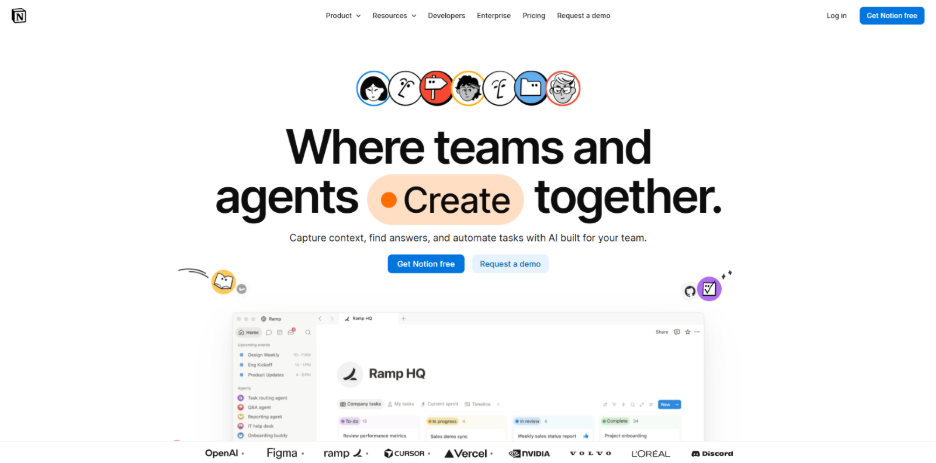
Notion is a flexible AI knowledge management system for teams that want a customizable workspace for documentation, wikis, project knowledge, databases, and AI-powered enterprise search.
Notion’s strength is flexibility. Teams can use it as an internal wiki, project hub, meeting notes system, support playbook, product documentation space, task tracker, lightweight CRM, or knowledge base. This makes it attractive for growing teams that want one adaptable workspace instead of several disconnected tools.
Key Capabilities
- Flexible workspace and wiki
- AI-powered writing and search
- Enterprise search through connectors
- Team documentation
- Databases and structured pages
7. Sinequa
Sinequa is a strong AI knowledge management and enterprise search platform for large organizations that need to connect knowledge across complex, high-volume enterprise data environments.
Sinequa is especially relevant for companies where knowledge is distributed across many structured and unstructured systems. Large manufacturers, life sciences companies, financial institutions, engineering organizations, government agencies, and industrial enterprises often have knowledge spread across documents, databases, archives, technical records, support systems, research repositories, and business applications.
Key Capabilities
- AI-powered enterprise search
- Semantic knowledge discovery
- Secure access across enterprise data
- Search across structured and unstructured sources
- Support for complex knowledge use cases
- Enterprise data connectivity
8. Slite
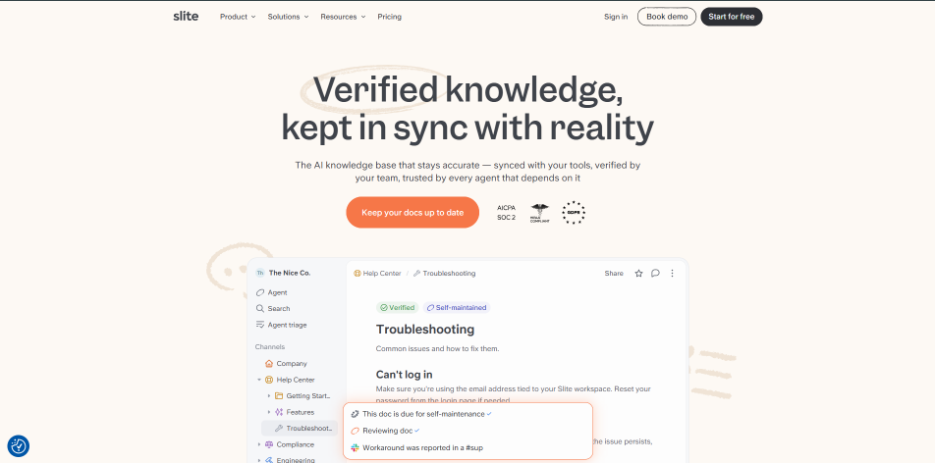
Slite is a strong AI knowledge management system for teams that want a self-maintaining knowledge base. It is especially useful for companies that struggle with outdated internal documentation and repeated questions.
Many knowledge bases fail because nobody has time to maintain them. Teams create documentation during onboarding, product launches, or process changes, but content ages quickly. Employees stop trusting the knowledge base, return to chat for answers, and the cycle repeats.
Slite addresses this problem by focusing on knowledge maintenance. Its AI knowledge base helps teams keep documentation accurate, find answers, and identify where knowledge needs attention. This is valuable for smaller and mid-sized teams that want internal knowledge to stay useful without heavy process overhead.
Key Capabilities
- AI-powered internal knowledge base
- Self-maintaining documentation
- AI search and answers
- Knowledge verification support
- Team documentation
Comparison Table: Best AI Knowledge Management Systems
Related walkthrough
Stellar OST to PST Converter Review 2026 | Online vs Desktop – Real Test

| System | Main Strength | Fit |
| KMS Lighthouse | Governed operational knowledge delivery for agents, customers, and AI | Enterprise service teams, contact centers, helpdesks, field service, and self-service |
| Glean | Enterprise AI search across workplace systems | Large organizations with knowledge spread across many apps |
| Guru | Verified company knowledge in the flow of work | Sales, support, customer success, operations, and revenue teams |
| Bloomfire | Collaborative knowledge sharing and enterprise intelligence | Organizations capturing collective expertise and approved knowledge |
| Confluence | AI-powered collaborative documentation | Product, engineering, IT, operations, and Atlassian-based teams |
| Notion | Flexible AI workspace and knowledge hub | Startups, growth teams, product teams, and cross-functional workspaces |
| Sinequa | Large-scale AI enterprise search | Complex enterprises with large structured and unstructured knowledge estates |
| Slite | Self-maintaining AI knowledge base | Remote teams and growing companies that need trusted internal docs |
A Practical AI Knowledge Management Framework
Enterprise teams should evaluate knowledge management across five layers.
1. Source of Truth
The organization needs to know which content is official, current, and approved. AI should not answer from random or outdated sources.
2. Knowledge Structure
Content should be organized by audience, topic, product, region, process, policy, and use case. Structure helps both humans and AI retrieve the right answer.
3. Delivery Channel
Knowledge should reach the user where they work. That may be a contact center screen, CRM, chatbot, self-service portal, Slack, Teams, intranet, or employee assistant.
4. Governance
Every important article or answer should have an owner, review cycle, approval process, and feedback loop.
5. Continuous Improvement
The system should show which searches fail, which articles are used, which topics create escalations, and which answers need improvement.
When these layers work together, knowledge management becomes a living system rather than a static library.
Questions to Ask Before Choosing an AI Knowledge Management System
Knowledge Governance
- How does the platform manage content ownership?
- Can articles go through review and approval workflows?
- Can outdated content be flagged or expired?
- Can teams track version history?
- Can AI answers be restricted to approved content?
AI and Search
- Does the platform support natural-language search?
- Can users ask questions and receive grounded answers?
- Are answers traceable to source content?
- Does AI respect permissions?
- Can the system reduce hallucination risk?
Service Workflow Fit
- Can agents access answers inside CRM, helpdesk, or contact center systems?
- Does the platform support guided workflows?
- Can knowledge be personalized by role, product, region, or customer type?
- Can the same knowledge support agents, self-service, and chatbots?
- Does it help reduce handle time and escalations?
Content Operations
- Can subject matter experts update content easily?
- Can teams identify missing knowledge?
- Does the platform collect feedback from agents or users?
- Can analytics show which articles work?
- Can knowledge gaps be tied to ticket or call patterns?
Enterprise Readiness
- Does the platform support permissions and access control?
- Can it scale across teams and regions?
- Does it support multiple languages?
- Can it integrate with existing systems?
- Does it support compliance and audit needs?
These questions help buyers evaluate whether a platform can support real knowledge operations, not just AI-powered search.
FAQs About AI knowledge Management System
Q. What is an AI knowledge management system?
An AI knowledge management system helps organizations create, organize, govern, search, and deliver knowledge using artificial intelligence. It can support employees, customers, agents, chatbots, self-service portals, and AI assistants by making approved information easier to find and apply.
Q. What is the difference between AI search and AI knowledge management?
AI search helps users find information across systems. AI knowledge management is broader. It includes content ownership, governance, approvals, workflows, feedback, analytics, channel delivery, and trusted AI grounding. Search is one feature inside a stronger knowledge management program.
Q. Why does AI need governed knowledge?
AI needs governed knowledge because it should answer from trusted, current, and approved content. If AI uses outdated documents or unverified information, it may provide inconsistent or incorrect answers. Governance helps improve accuracy, trust, and accountability.
Q. How should companies measure knowledge management success?
Companies should measure search success, article usage, self-service resolution, agent adoption, onboarding time, content freshness, feedback trends, escalation reduction, customer satisfaction, and knowledge gaps. The best metrics depend on whether the system supports customers, employees, agents, or AI workflows.