

Chapter-8: GuestPostCRM Deep Dive: AI CRM for Guest Posting
This GuestPostCRM deep dive reveals how AI workflows, automation rules, and smart systems manage guest posting, deals, and invoicing.
The intelligence layer built for guest post operations
GuestPostCRM isn’t just another CRM. It’s a purpose-built system of rules, automations, and AI workflows designed to eliminate manual overhead in guest post link building at scale. This GuestPostCRM deep dive explores how the platform transforms complex outreach operations into a streamlined, automated system.
40+ CORE RULES | 11 GPC SERVICES | AI FIRST REPLY | Real-time ORDER SYNC
What’s Inside
Most CRMs are built for sales pipelines. GuestPostCRM (GPC) is built for one thing: managing the full lifecycle of a guest post deal – from the first inbound email to invoice payment – with as little human friction as possible.
The system operates on a concept called Rules – deterministic rules that govern how every record, email, order, reminder, and invoice behaves. Understanding these rules is the key to understanding GPC.
The Rule System • Email Intelligence • Order & Deal Engine • AI & Automation • Invoice & Payments • Security & Services
The Rule System – how GPC thinks
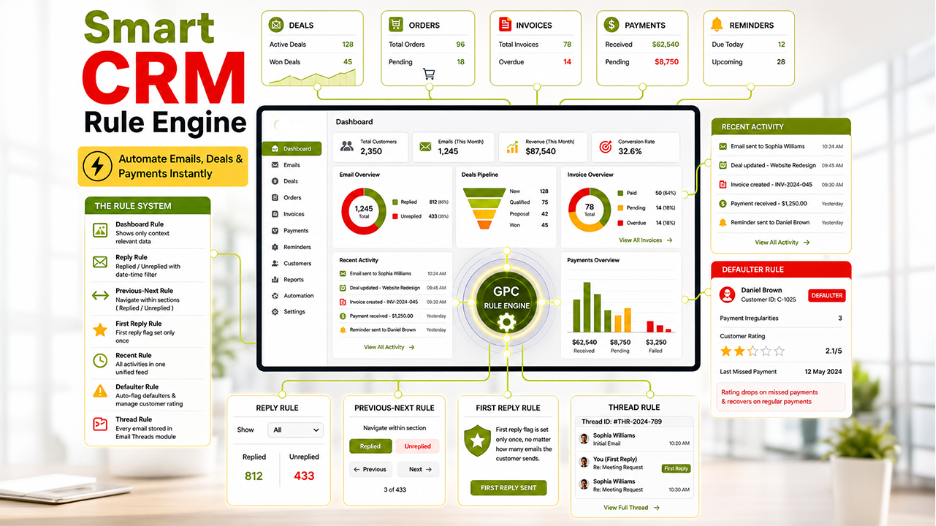
The system operates on a concept called Rules – deterministic rules that govern how every record, email, order, reminder, and invoice behaves. Understanding these rules is the key to understanding GPC. In this GuestPostCRM deep dive, you’ll see how these rules act as the foundation of every automated action inside the platform.
Dashboard Rule (DB Rule)
Offers, deals, orders, invoices, and reminders are only surfaced on the dashboard for records related to the current context. Keeps the view clean and scoped.
Reply Rule
Replied and Unreplied are completely free from the DB Rule. A date-time filter controls the window; selecting “All” removes the limit entirely.
Previous-Next Rule
Navigation is bounded by sections. Replied messages navigate within replied; unreplied within unreplied. Replying auto-advances to the next unreplied record.
First Reply Rule
No matter how many emails a customer sends, GPC never sets the first reply flag until one is actually sent. Automated or one-click – never repeated.
Recent Rule
Every meaningful user action – email sent, order updated, invoice created, payment received – lands in a unified Recent feed with full activity type filtering.
Defaulter Rule
Customers with payment irregularities are automatically flagged. Customer rating degrades on missed payments and recovers on regular ones.
THREAD RULE
Every message with a thread ID is stored in the “Email Threads” module. Each reply creates its own thread entry – conversations are fully traceable and never merged by accident.
Learn More: Chapter-9: SuiteCRM Custom Code Architecture — Advanced Development Guide
Email Intelligence – Unreplied to Closed

GPC’s email layer goes far beyond a standard inbox. Emails are classified, threaded, synced, and acted upon – often without a human touching them. This GuestPostCRM deep dive highlights how AI and automation work together to manage conversations efficiently and reduce response delays.
- New inbound email arrives -> classified as brand or non-brand, checked against spam thresholds.
- Assigned to the correct Timeline via email address match or new contact creation.
- First Reply Rule checks if the flag is already set – if not, schedules automated first reply.
- AI summarizes the email body and extracts motive, type, category, deal context, and website info.
- Offer or deal detection runs – if a new website is discussed, a new offer is created automatically.
- Reply sent -> Last Activity, Last Activity By, and Last Activity Date all updated. Direction set to outbound. Ledger entry created.
EMAIL PERMANENT SYNC
When an email count mismatch is detected between Gmail API and GPC, a full reverse sync triggers automatically – walking back through all threads without sending any email, overriding any active offer/deal, or touching contact records.
Template parsing runs before any template loads. Dynamic Templates use {{first_name}}-style variables that are resolved per-recipient at send time. Every template also carries IP tracking for open detection.
Order & Deal Engine – The Financial Core
Related walkthrough
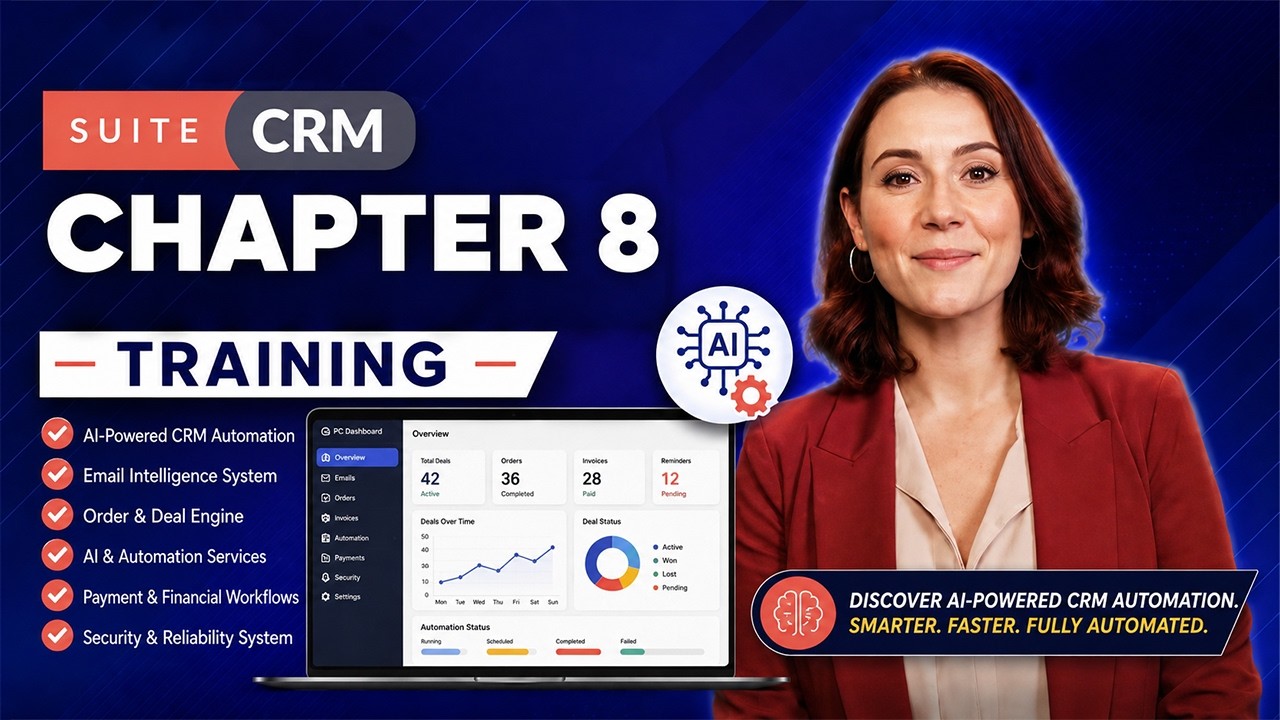
SuiteCRM Chapter 8: GuestPostCRM Deep Dive | AI CRM Automation u0026 Email Intelligence

Orders in GPC are not created casually. The Order Rule enforces strict preconditions that keep the pipeline clean and financially accurate. As explained in this GuestPostCRM deep dive, every deal and order is tightly controlled to ensure consistency, accuracy, and complete traceability.
Order Rule
Orders cannot be created manually unless required. A Deal must exist. Verified customers are required to create an order on each new message. Orders are never deleted – only their links can be removed.
Deals Rule
Every deal carries an expiry date. On expiry, it archives but remains visible. No new order can be created without an active deal – the history is always preserved.
MarketPlace Rule
Direct orders with a single “Complete” button. Completed marketplace orders carry a status of “Marketplace” rather than “Completed” – fully distinguishable in reports.
Order Price Rule
DF link prices are fetched from the deal, but are adjustable. NoFollow starts at $0. Authoritative and internal links are permanently $0 unless overridden. All changes cascade to the PayPal total.
Order validation on completion checks that all agreed links are present with exact anchor text, DoFollow/NoFollow assignments are correct, and the previous + new link count matches the order total.
ORDER ACCEPT SCORE
Every order is scored out of 100% before acceptance using anchor text verdict, spam score verdict, domain niche verdict, and, for GP orders, content quality verdict too.
AI & Automation – The GPC Brain

PROMPT RULE
Every prompt includes: customer motive, type, category, current deal, active offer, main asset status, traffic level, and highest/lowest amounts for brand and non-brand. Each prompt has a “deep” fallback that triggers on failure and queues for re-analysis.
The 11 live GPC services that run continuously:
- Spam -> inbox filtration
- Non-relevance & duplicate filter
- First reply (brand + non-brand)
- Offer detection
- Deal conversion from offers
- Order detection
- PayPal invoice automation
- Reminder cancel / schedule
- AI reply & AI summary
- Recent + Hot activity logging
- Payment by credit/debit
Each automated operation – order execution, offer finding, invoice creation, full sync – is fully visualised in separate diagrams inside GPC so developers and operators can trace exactly what happened.
Invoice & Payment Rule

Invoicing is triggered automatically on order completion. The default method is PayPal – full customer details, including address, are populated, and the PayPal email field is used (not the default contact email). This GuestPostCRM deep dive also showcases how invoicing and payment tracking are fully automated, ensuring accurate billing and eliminating manual financial follow-ups.
- Order marked complete -> invoice generation triggers automatically.
- All paid DoFollow links transfer to invoice line items with exact amounts.
- Non-PayPal methods (Payoneer, Wise, Bank Transfer, UPI) send a PDF attachment with an editable template.
- Payment received -> credited to account balance. Trust Score updates upward.
- Ledger entry written. The Hot Events bar is notified for all financial team members.
TRUST SCORE & CREDIT/DEBIT SYSTEM
Continuous regular orders and on-time payments push a customer toward 99% trust. Missed or cancelled payments reduce it. The internal credit system converts dollars to credits – order creation is the most expensive debit (5-10 credits). Each debit carries a memo, so spend is fully auditable.
Security, Reliability & Service Health

GPC runs with two-level security: an x-api-token in every request header, and IP binding to allow machines. Every PHP fatal, MySQL error in suitecrm.log, and API error is classified as an Error and surfaces two quick-action buttons: Refresh current tab or Refresh to home.
Restore Point System
GPC identifies previous stable versions (e.g. v1.7-stable) and can restore to them cleanly. Notes are kept on each stable milestone.
Scheduler Control
All cron jobs are controlled through the UI. “As soon as possible” (every minute) schedulers are avoided. Each cron completion is notified to the team channel.
React Cache Rule
If a page hasn’t been refreshed in 2 minutes and a deal is active, GPC prompts: “This page may have changed – Refresh / Cancel.” Stale UI is a silent bug.
Alpha / Beta / Gamma Testing
Alpha: core features tested by dev against rules. Beta: extended internal testing. Gamma: live validation. Each phase has defined exit criteria before promotion.
GuestPostCRM – built for operators, not just managers
Every rule, automation, and AI service in GPC was designed around a single question: Can this be done without a human in the loop? If yes, it should be automated. If not, it should be one click. This GuestPostCRM deep dive shows how the platform achieves that balance, giving operators full control while minimizing manual effort.
Deep-dive: Order Sync -> Ledger system -> First Reply AI ->