

How Topic Clusters Improve Your Site Authority and Rankings
Explore how topic cluster SEO strategy strengthens site authority, boosts Google ranking, and improves internal linking, with structured content planning.
If you’ve been publishing content on your website for a while and not seeing the search rankings you expected, the problem probably isn’t the quality of individual pieces. It’s the architecture underneath them.
Most websites publish content in isolation. Each article is written to target a keyword, published, and left to perform or not on its own. The missing element in this approach is the one that search engines increasingly reward: the clear demonstration that a site genuinely knows a subject deeply, not just one piece of it.
That demonstration comes from topic clusters, and understanding how they work changes how you think about content strategy entirely.
What a Topic Clusters SEO Strategy Actually Is
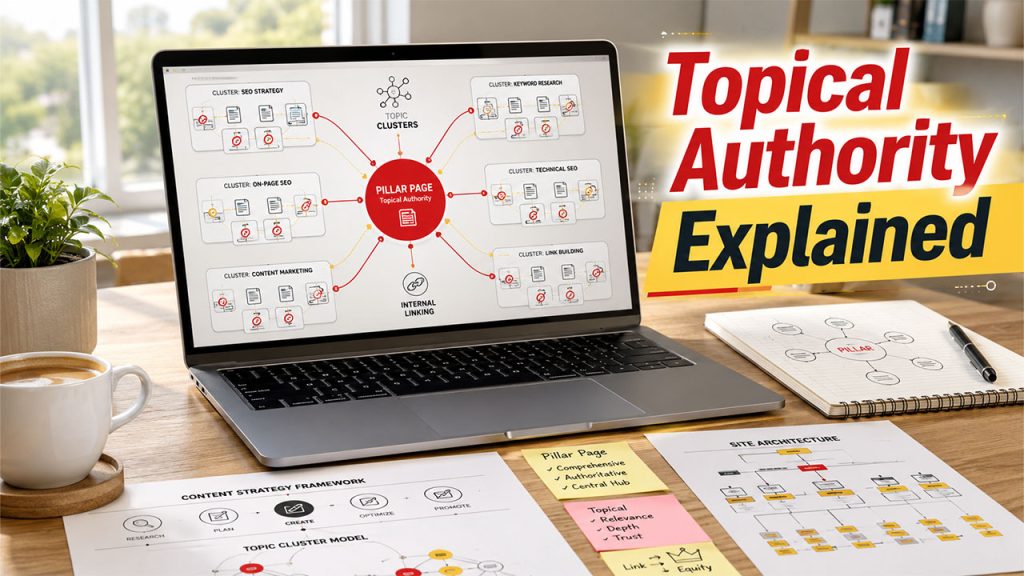
A topic clusters SEO strategy is a content structure built around a central “pillar” page that covers a broad subject comprehensively, supported by a collection of “cluster” pages that explore specific aspects of that subject in depth. The pages are connected through internal linking in a deliberate way, with cluster pages linking back to the pillar and to each other where relevant.
The result is a connected web of content that signals to search engines that a site has genuine, comprehensive expertise on a topic rather than a scattered collection of loosely related articles.
An example makes this concrete. A company providing accounting services might have a pillar page on “small business accounting” that covers the topic broadly. Cluster pages would go deep on specific elements: payroll management, tax planning for small businesses, bookkeeping basics, understanding cash flow statements, choosing accounting software. Each cluster page links to the pillar. The pillar links to each cluster. The entire structure works together.
Why Search Engines Respond to This Structure
Google’s evolution as a search engine has moved steadily toward understanding entities and their relationships rather than just matching keywords. Understanding these Search Engine Basics helps explain why topic clusters have become such an effective strategy for building topical authority and improving rankings. The question it’s increasingly trying to answer is not “does this page contain this keyword?” but “is this site a credible, authoritative source on this subject?”
Topic clusters SEO strategy answer that question structurally. When a site has a comprehensive pillar page on a topic and a collection of well-written, deeply informative cluster pages supporting it, the internal linking pattern and the content depth together signal topical authority in a way that isolated content cannot.
The link equity dimension also matters. When cluster pages link to a pillar, they pass authority to it. When a high-authority external site links to the pillar, that authority flows through the internal linking structure to the cluster pages as well. The interconnected architecture creates a stronger signal than the same number of pages operating in isolation.
Crawlability improves too. A well-structured topic clusters SEO strategy creates clear pathways for search engine crawlers to discover and index all related content, reducing the chance that important pages remain poorly indexed simply because they’re not well-connected internally.
The Business Results That Topic Clusters Drive
Related walkthrough
15 SEO Mistakes Killing Your Google Rankings in 2026

The rankings impact of topic cluster architecture isn’t theoretical. The practical outcomes for businesses that implement this approach correctly include:
- Improved rankings for the pillar page on broad, competitive terms that individual articles rarely rank for
- Better rankings for cluster pages on specific long-tail queries
- Increased time-on-site as visitors move between related pages following internal links
- Higher domain authority over time as the pattern of topical expertise builds
- More organic traffic from a wider range of related search queries rather than depending on a few individual pages
The compounding nature of this is significant. As authority builds around a topic clusters SEO strategy, new content added to the cluster benefits from the existing authority rather than starting from zero.
For businesses looking to implement this approach with expert guidance, the detailed breakdown of topic clusters for SEO is one of the most practically useful resources on this subject.
Aspire Digital Solutions covers the full implementation process, including pillar page structure, cluster page planning, and the internal linking strategy that makes the architecture work effectively for long-term ranking improvement.
According to HubSpot’s research on content strategy and organic growth, websites that restructure their content around topic clusters consistently see measurable improvements in organic search performance compared to those maintaining a traditional isolated content publishing approach, with both traffic and domain authority metrics improving over sustained implementation periods.
Building a Topic Clusters SEO Strategy: Where to Start

The implementation process is more methodical than complicated. Here’s the sequence that produces the best results:
Start with subject selection. Choose topics that are central to your business, have sufficient search volume to be worth targeting, and where you can credibly claim expertise. A single well-executed cluster outperforms five mediocre ones.
Audit what already exists. Most established websites have content that can be organised into clusters rather than starting from scratch. Identify existing pieces that belong to a cluster and assess whether they need updating to perform their role effectively.
Build or refine the pillar page. The pillar needs to be comprehensive enough to serve as a genuine reference on the topic. It doesn’t need to cover everything in depth, because that’s what the cluster pages are for, but it needs to establish the scope and provide substantive value.
Create or upgrade cluster pages. Each cluster page should go deep on one specific aspect of the pillar topic. Thin, brief cluster pages don’t create the authority signal. Thorough, genuinely useful pages that answer specific questions comprehensively do.
Implement internal linking deliberately. Every cluster page links to the pillar. The pillar links to every cluster page. Cluster pages link to each other where the connection is natural and useful. The linking should feel organic to the reader, not mechanical.
Maintain and expand over time. Topic clusters SEO strategy aren’t a one-time project. Adding new cluster pages as questions arise, updating existing pages as information changes, and monitoring performance to identify where the structure needs strengthening are ongoing activities.
Common Mistakes to Avoid
A few patterns consistently undermine topic cluster performance:
- Creating pillar pages that are too thin to establish genuine topical authority
- Writing cluster pages that overlap significantly with each other, creating keyword cannibalisation
- Implementing internal links mechanically without considering whether they provide genuine value to the reader
- Neglecting to update cluster pages when information changes or when new search intent patterns emerge
- Expecting immediate results when the authority-building process happens over months rather than weeks
Conclusion
Topic clusters SEO strategy are the content architecture that turns a collection of individual articles into a coherent demonstration of expertise. Search engines reward that coherence with authority signals and rankings that isolated content can’t achieve, regardless of its individual quality.
The investment in building and maintaining this structure pays back through compound organic traffic growth that becomes increasingly self-reinforcing over time.