

How an AI WhatsApp CRM Turns Scattered Chats into a Structured Sales Pipeline
Understand what is AI WhatsApp CRM and explore the complete process of how it turns scattered chats into structured sales pipelines.
In the modern digital landscape, WhatsApp makes it easier for the buyers and sales representatives to start a conversation. Through WhatsApp, the prospect can ask for catalog, request a quotation, send product specification, or confirm an order from the same application they already use every single day.
The main challenge begins when the volume of conversation increases. When the volume increases, sales representatives may have dozens of active chats, across several stages of the buying process. Another employee may also contact the same buyer without relizing that a catalogue has already been discussed. Follow-up dates also remain in personal notes, customer details are stored on individual devices, and managers have no reliable view of which opportunities are moving forward.
An AI WhatsApp CRM brings structure to this environment. It connects customer conversations with lead records, assignments, follow-up tasks, automation, and sales activity. Instead of relying on representatives to remember every detail, the business gains a repeatable process for moving WhatsApp leads from first contact to conversion.
Why WhatsApp Chats Become Difficult to Manage at Scale
The standard WhatsApp and WhatsApp Business applications work well when one person manages a relatively small number of conversations. They become less effective when WhatsApp turns into a company-wide sales channel.
Common problems include:
- Customer information distributed across several accounts
- No clear owner for each lead
- Duplicate or inconsistent replies
- Important inquiries buried under newer messages
- Follow-up dates stored outside the conversation
- Limited visibility for sales managers
- Customer history lost during employee transitions
- Manual translation slowing down international communication
These are not simply messaging problems. They are sales process problems.
Adding more representatives may increase the number of messages a company can send, but it does not create better coordination. Without a central system, the team may simply produce more disconnected conversations.
What Is an AI WhatsApp CRM?
An AI WhatsApp CRM is a type of customer relationship management system that is especially designed to organize and improve business conversation that are conducted through WhatsApp. A conventional CRM usually stores contact information, deal stages, notes, tasks, and sales activity.
A WhatsApp-focused CRM connects these records directly with customer chats. AI adds another layer by helping teams interpret messages, prepare replies, answer routine questions, organize leads, and maintain consistent follow-up.
Depending on the platform, an AI WhatsApp CRM may include:
- Centralized customer profiles
- Multiple WhatsApp account management
- Shared access to conversation history
- Lead assignment and ownership
- Tags and customer segmentation
- AI-assisted replies
- Automated or scheduled follow-ups
- Knowledge-based chatbots
- Real-time translation
- Internal notes and team collaboration
- Customer data exports and handovers
- Sales activity and performance visibility
The purpose is not to remove salespeople from the process. It is to reduce repetitive work and make sure important customer actions do not depend entirely on an employee’s memory.
Step 1: Capture WhatsApp Leads in One System
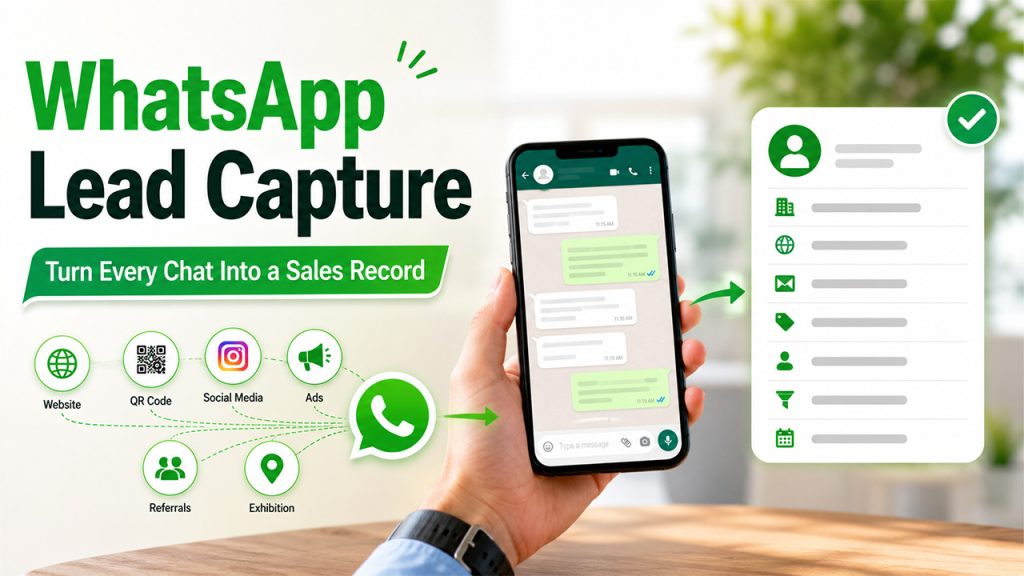
A structured sales pipeline begins when a new lead enters the business.
WhatsApp leads may come from a website button, a QR code, social media, an advertisement, a referral, an exhibition, or direct outbound prospecting. International B2B teams may also identify potential buyers through business directories or Google Maps before contacting them.
Without a CRM, these leads often remain as phone numbers and chat threads. The representative understands the context, but the rest of the company does not.
A WhatsApp CRM turns the conversation into a customer record. The record can include:
- Customer name and company
- Country or market
- Contact details
- Lead source
- Product interest
- Assigned representative
- Current sales stage
- Last interaction
- Next follow-up date
Capturing this information early makes later activities easier to track. It also allows the company to separate genuine opportunities from incomplete contacts, existing customers, suppliers, and unrelated inquiries.
For outbound sales, teams should verify contact information, segment prospects carefully, personalize the first message, and follow applicable privacy and messaging requirements. CRM software can organize outreach, but it does not replace responsible communication practices.
Step 2: Assign Clear Ownership
When several salespeople share the same market or WhatsApp channel, unclear lead ownership creates unnecessary friction.
Two representatives may send different quotations to the same company. One person may assume that another colleague is following up. A customer may receive repeated introductory messages after already discussing detailed requirements with someone else.
A WhatsApp CRM should give each lead a clear owner. New inquiries can be assigned according to market, language, product category, workload, or another internal rule.
Managers should define a simple ownership policy:
- Every qualified lead has one primary owner.
- Other team members can view the necessary context.
- Reassignment is recorded when responsibility changes.
- Important internal updates are added to the customer record.
- Sales and support handovers include the full conversation history.
Clear ownership does not prevent collaboration. It ensures that collaboration happens without confusing the customer.
Step 3: Qualify Leads Consistently
Not every WhatsApp inquiry represents the same level of opportunity. One buyer may be requesting an urgent quotation, while another is only asking a general question.
A consistent qualification process helps sales teams prioritize their time. Relevant information may include:
- Product or service required
- Order quantity
- Budget range
- Delivery destination
- Required timeline
- Decision-making role
- Previous supplier or solution
- Main problem the customer wants to solve
AI can assist by identifying common intent, suggesting qualification questions, summarizing long conversations, or directing routine inquiries to a knowledge-based chatbot.
Human judgment remains important. International B2B sales often involve technical details, negotiated pricing, custom delivery conditions, and several stakeholders. AI can help collect and organize information, but sales representatives should review important details before making commitments.
Step 4: Respond Faster Without Losing Quality

Response time matters on WhatsApp because customers generally expect a faster interaction than they would through email. However, speed alone is not enough. A fast but irrelevant response can damage trust.
AI-assisted replies can help representatives prepare an answer based on the customer’s message and available business information. This is useful for recurring questions about:
- Product specifications
- Minimum order quantities
- Shipping regions
- Standard delivery times
- Payment methods
- Catalog availability
- Warranty or support
- Appointment scheduling
A knowledge-based chatbot can handle routine questions outside normal business hours and transfer more complex inquiries to a salesperson.
The best workflow keeps employees in control. Representatives should be able to review, edit, and approve messages when the conversation involves pricing, legal terms, technical compatibility, or a sensitive customer issue.
Step 5: Support Multilingual Sales Conversations
Related walkthrough
Collaborative CRM: The Future of Sales Success

Language barriers are a common source of delay in international sales. Representatives may copy each message into a separate translation tool, wait for a colleague who speaks the language, or respond in a language the buyer does not fully understand.
A CRM with real-time translation can reduce this friction by translating received and outgoing messages inside the sales workspace.
This is especially useful when one team serves buyers across several regions. A representative can understand the customer’s question, prepare a response, and continue the conversation without constantly switching between applications.
Translation should still be reviewed when a message includes technical specifications, contractual language, product safety information, or final commercial terms. The goal is to make daily communication faster while keeping human verification where precision matters.
Step 6: Build a Reliable Follow-Up Process
Many WhatsApp sales opportunities are not lost because the buyer rejects the offer. They are lost because nobody follows up at the right time.
A prospect may request a quotation and then become busy. A distributor may need approval from a manager. A customer may plan to order after the next budget cycle. These leads can remain valuable, but only if the sales team knows when and how to contact them again.
A structured CRM workflow records:
- What the buyer requested
- What information has already been sent
- The most recent customer response
- The current sales stage
- The next expected action
- The scheduled follow-up date
- The person responsible
AI can help draft follow-up messages or suggest the next action based on the conversation. Automation can also send approved reminders or notify representatives when a lead has remained inactive for too long.
Follow-ups should not become repetitive mass messages. The customer’s previous conversation, needs, and current stage should shape the content.
For example, a lead who has not opened a catalog requires a different message from a buyer who has already negotiated a quotation and is waiting for internal approval.
Step 7: Connect Conversations to the Sales Pipeline
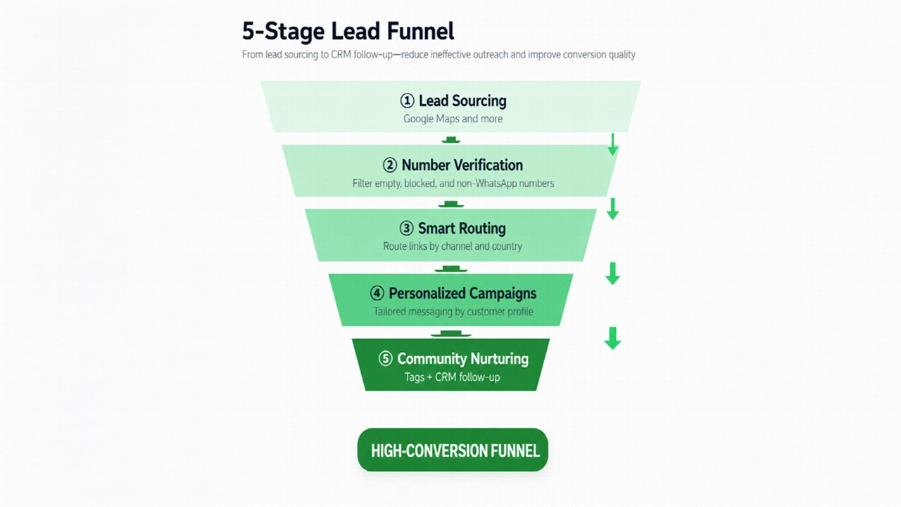
A WhatsApp conversation becomes more useful to the business when it is connected to a defined sales stage.
A simple international sales pipeline might include:
- New lead
- Contacted
- Qualified
- Requirements confirmed
- Quotation sent
- Negotiation
- Order confirmed
- Closed or inactive
These stages allow representatives and managers to understand what is happening across the entire lead pool.
The CRM should make it easy to update a lead without requiring excessive manual data entry. If the process is too complicated, representatives may continue working from their personal chat list and update the system only when management requests a report.
A practical WhatsApp sales CRM should reduce administrative work, not add another layer of it. Conversation history, customer ownership, notes, and follow-up activity should remain connected so that the team can understand each opportunity without reconstructing it from several tools.
Step 8: Improve Manager Visibility
Sales managers need more than a count of messages sent. High messaging activity does not necessarily mean the pipeline is healthy.
Useful operational questions include:
- How many new leads entered this week?
- How quickly did the team respond?
- Which leads have not received a follow-up?
- How many quotations are currently open?
- Which markets or lead sources produce qualified opportunities?
- Are several representatives contacting the same accounts?
- Which deals have remained in one stage for too long?
- What happens to active customers when an employee is unavailable?
A centralized WhatsApp CRM gives managers a clearer view of activity without requiring them to check individual devices or request manual updates from every employee.
This visibility can also support coaching. Managers can identify whether representatives need help with qualification, response quality, follow-up discipline, or moving deals toward a decision.
Step 9: Protect Customer Information During Employee Changes

Customer relationships are business assets, but in many WhatsApp-based teams, the relevant information remains tied to individual employees.
When a salesperson leaves, the company may struggle to identify active buyers, recover conversation history, understand previous quotations, or determine what follow-up was promised.
A structured CRM reduces this dependency by keeping customer profiles, ownership, chat context, notes, and follow-up records available to authorized team members.
A proper offboarding process should include:
- Reviewing the employee’s active customers
- Reassigning each lead and account
- Preserving relevant conversation history
- Removing unnecessary system access
- Transferring outstanding tasks
- Informing key customers of their new contact
- Exporting or retaining records according to company policy
Access should be controlled through appropriate permissions. Not every employee needs visibility into every customer, but the company should not lose essential commercial information when responsibilities change.
Step 10: Review and Improve the Workflow
Implementing a WhatsApp CRM is not the final step. Teams should review whether the new workflow is actually improving sales operations.
Useful indicators include:
- Average first-response time
- Percentage of leads with an assigned owner
- Follow-up completion rate
- Number of duplicate contacts
- Lead-to-quotation conversion
- Quotation-to-order conversion
- Time spent on routine questions
- Number of inactive opportunities
- Quality of customer handovers
- Adoption rate among sales representatives
The goal is not to automate every interaction. Businesses should automate repetitive tasks, improve visibility, and preserve context while allowing employees to focus on negotiation, relationship building, and complex customer needs.
How WADesk Supports a Structured WhatsApp Sales Workflow

WADesk is designed for global businesses that use WhatsApp for buyer development, customer communication, and sales follow-up.
It combines several parts of the sales process in one workspace:
- Discovering potential B2B buyers through channels such as Google Maps
- Verifying and importing customer information
- Managing several WhatsApp accounts
- Organizing customer profiles and conversation history
- Assigning leads and maintaining team visibility
- Using AI-assisted replies and automated follow-ups
- Translating messages during cross-language conversations
- Preserving customer records for future handovers
This combination is particularly relevant to exporters, manufacturers, cross-border e-commerce companies, and international B2B sales teams. These businesses often need to find buyers proactively, communicate across languages and time zones, coordinate several salespeople, and retain customer information over long sales cycles.
Common Mistakes to Avoid
Technology cannot correct a poorly defined sales process on its own. Businesses should avoid several common implementation mistakes.
Automating before defining ownership
Automation may send messages more efficiently, but it cannot decide who is responsible for a customer unless the company establishes clear rules.
Importing contacts without segmentation
A large contact database is not automatically a useful lead database. Contacts should be organized by market, customer type, product interest, sales stage, or another relevant factor.
Using identical follow-ups for every lead
The message should reflect what the customer has already discussed and what is expected next. Generic repetition can reduce response rates and damage trust.
Ignoring data access and handovers
The company should define who can view, edit, export, and reassign customer records before the system is widely adopted.
Measuring activity instead of progress
Message volume alone does not show whether opportunities are moving forward. Teams should also track qualification, follow-up completion, quotations, and conversions.
Final Thoughts
WhatsApp can support an entire international sales cycle, but only when conversations are connected to a reliable business process.
An AI WhatsApp CRM transforms individual chat threads into organized customer records, assigned opportunities, scheduled follow-ups, and visible pipeline activity. It helps salespeople respond more efficiently while giving managers a clearer understanding of customer ownership and deal progress.
The strongest results come from combining technology with straightforward operating rules. Every lead should have an owner, every important conversation should retain its context, and every active opportunity should have a defined next step.
When these elements work together, WhatsApp becomes more than a convenient communication tool. It becomes a structured sales channel that can scale with the business.
Frequently Asked Questions
Some WhatsApp CRM platforms can organize several existing accounts or numbers in one workspace, while others are designed primarily around the WhatsApp Business Platform. Businesses should check whether a tool supports their current account model before choosing it.
AI can suggest replies, summarize conversations, answer common questions, assist with lead qualification, translate messages, and support follow-up tasks. Important quotations, technical information, and contractual commitments should still be reviewed by a salesperson.
Yes. A small team may benefit once lead volume grows, more than one person handles conversations, or follow-ups start getting missed. The system should match the team’s actual workflow and remain simple enough for representatives to use consistently.