
AI Solutions for SMEs With AdoptAI
Discover how SME AI solutions can reduce repetitive work, cut costs, improve operations, and help small businesses adopt AI safely.
SME AI solutions work best when instead of a broader approach, they target one narrow process by using data that already exists and adding human judgment where it involves high risk. If small and medium-sized companies adopt AI successfully, they can reduce their turnaround times and tedious admin work while improving service without having to hire an expensive in-house AI team.
Small firms are under a lot of pressure to move faster, but they are also short on budgets, teams, and cannot afford to make mistakes that affect their experiments. This is why, instead of asking whether artificial intelligence matters, we should ask which use cases create a value that can be measured and how to introduce them safely.
Practical AI solutions help smes cut costs and speed operations
Most small and medium-sized enterprises can benefit a lot from automating their everyday tedious tasks, not from speculative AI projects. Teams spend a lot of hours sending the same emails, documenting things, addressing supplier requests, or answering customer questions, which slows down productivity. If these tasks are handled by AI, they can reduce time spent on low-value tasks and focus more on what matters more and genuinely needs a human overview.
Using AI practically means incorporating it into existing workflows rather than replacing them. A few examples are letting AI respond to customer inquiries, pulling data from invoices, categorizing inbound requests, and summarizing long meeting notes or documents, which your staff can review later and make changes accordingly. These are useful because the task is clear, the input is frequent, and the output can be checked quickly by staff for any discrepancy.
Our work with SME AI Solutions show that adoption is smoother when the goal is operational, such as reducing back-office delay or improving consistency across teams. On our site, we describe practical AI solutions that focus on implementation, support, and measurable business outcomes rather than generic experimentation.
- Customer service: faster triage, suggested replies, and FAQ handling
- Finance and administration: document extraction and routine validation
- Procurement: supplier review support and contract intake preparation
- Internal knowledge work: search, summaries, and mailbox support
The important test is simple: if a process happens daily, follows a pattern, and creates delay when volumes rise, it is a strong candidate for adoptai-style deployment.
Which SME processes deliver the fastest return from AI?
You usually see quicker results from processes that have three traits: high volume, defined rules, and delays that can be measured. In small and midsize companies, it usually means handling paperwork, providing customer support, purchasing administration, scheduling emails or meetings, and reviewing compliance frameworks.
Take intake work, for example. If staff spend hours just opening email attachments, copying details into systems, or tracking down the right person to handle a request, AI can take over much of that grunt work. It can classify requests, auto-fill information, and send it to the right colleague, leaving people to simply review and approve. Legal and procurement teams see these early wins, too. They often process endless documents like templates, repeated clauses, and onboarding files that follow familiar patterns. AI can spot those patterns and handle the repetitive parts fast.
Fast-return AI use cases are not the most glamorous ones. They are the ones where repetitive work already has a queue, a cost, and a known review standard.
- When judging return, SMEs should rank processes by effort and risk:
- Start first with repetitive, low-risk tasks such as summaries, tagging, extraction, and internal search
- Move next to assisted drafting and workflow routing where human approval remains mandatory
- Delay high-risk decisions involving hiring, termination, or sensitive personal data until governance is in place
Businesses comparing options can also review our guidance on common SME bottlenecks to spot where time loss is already visible. If a team can measure hours spent today, it can measure AI return later.
AI quick audits identify data gaps, workflow bottlenecks, and compliant use cases
Related walkthrough
Robots Are Learning to Work Like Humans

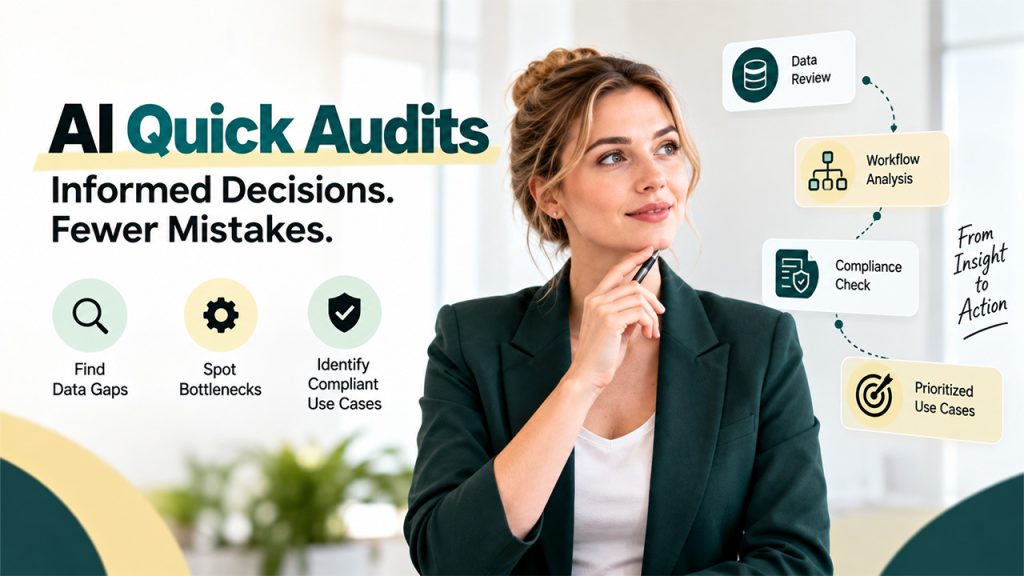
A short audit prevents long implementation mistakes. Our AI Quickscan is designed as a 2-3 day audit that maps the current situation, identifies promising use cases, and shows where data quality or workflow design will block results.
An audit matters because many SMEs do not fail on ambition; they fail on readiness. Data may be scattered across mailboxes, spreadsheets, and legacy tools. Staff may follow different versions of the same process. Third-party systems may also restrict access, which limits what any model can automate safely.
A useful audit should produce more than a list of ideas. It should document where personal data appears, which steps require human approval, and whether a use case falls under the General Data Protection Regulation (GDPR) or sector-specific obligations. That turns AI from a vague initiative into a scoped implementation plan.
- Map the process from intake to approval
- Check where structured and unstructured data live
- Flag privacy, confidentiality, and retention risks
- Separate quick wins from high-risk use cases
- Define success metrics before any rollout begins
SMEs that need a structured start can review our implementation approach, which is built around awareness, adoption, and measurable outcomes rather than tool-first selection.
How can small teams adopt AI without large upfront budgets?
For small teams, it is affordable to adopt AI when they avoid custom builds at the start. In most cases, a monthly subscription plan, limited-scope pilot, or targeted workflow integration works extremely well than investing in infrastructure, increasing specialist headcount, and redesigning every process from scratch.
That is why software-as-a-service and AI-as-a-Service models work well for SMEs. SaaS development companies also play an important role in building scalable software solutions that businesses can adopt without investing heavily in custom infrastructure. These models spread cost over time, reduce procurement friction, and make it easier to stop or scale based on evidence. On our site, we offer AI-as-a-Service as a monthly subscription so companies can test value before committing to a wider rollout.
The strongest budget discipline is sequencing. Choose one workflow, set one baseline, and track one operational result such as turnaround time, queue volume, or review effort. If the pilot does not improve a measurable metric, the company should adjust scope before expanding.
- Use off-the-shelf tools before considering bespoke development
- Prefer vendors that support integration, training, and updates in one package
- Limit pilots to one department or one document flow
- Keep a human reviewer in the loop until accuracy is stable
For SMEs, adopt ai is not about spending less on everything. It is about spending in stages, so each stage has a clear business case and a clear stop-go decision.
Clear governance policies reduce privacy, bias, and gdpr exposure at work
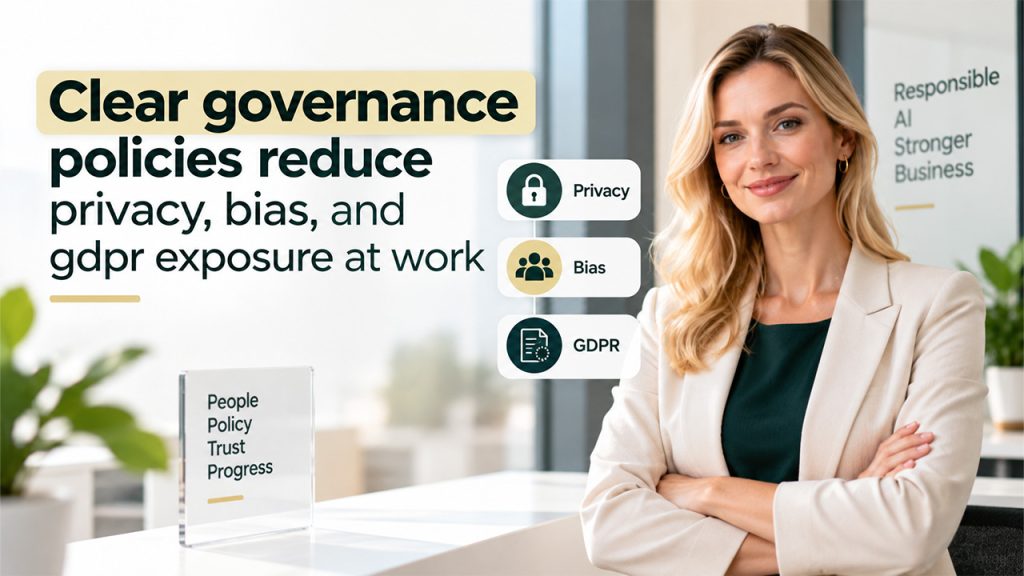
Before companies rush to scale up artificial intelligence at work, they need to set ground rules for their SME AI Solutions. Robust governance policies don’t just sound good; they protect everyone. Employees need to know which AI tools are approved, what information they can feed into them, who’s responsible for reviewing results, and how to report mistakes or questionable outcomes.
The big risks are well-known: data leaks, biased decisions, made-up content, and weak security. GDPR makes this clear. An SME can’t just assume a public chatbot is safe or treat it like a casual memo pad. If employees feed personal data, contracts, or confidential customer information into a public chatbot, they’re opening the door to a compliance nightmare. The policy must state that limits plainly.
Governance is also where bias and accuracy become operational issues, not abstract ethics. If an AI system supports hiring, complaint handling, or customer prioritization, the business needs documented review criteria and a named human owner for final decisions. The emerging European Union AI Act raises the importance of that documentation further, especially for higher-risk use cases.
Safe workplace AI policy starts with one practical rule: no sensitive data into unapproved tools, and no consequential decision without human review.
Businesses that want a deeper framework can read our guidance on safe use of AI at work. Good policy does not slow adoption; it makes adoption durable.
SMEs gain lasting value when training, oversight, and phased implementation align
You really see lasting value when everyone gets the hang of the tool, managers actively guide its use, and the company rolls it out in stages. Many SMEs miss this point because the technology seems simple at first glance. Sure, opening a chatbot is easy but using it effectively in a strict, regulated workflow is a whole different challenge.
Training needs to fit each role. Managers must get governance, ROI, and know where or when to escalate paths. Operational staff need to nail down how to prompt, build habits for checking accuracy or verifying, and know exactly when to stop and bring in a person for review. And if a team handles legal issues, HR, or customer data, they absolutely need dedicated training around confidentiality and GDPR.
Phased implementation keeps quality under control. Start with awareness, move to a defined pilot, then expand only after the business confirms accuracy, adoption, and measurable benefit. That is the logic behind our broader adoptai method: understanding first, implementation second, and scale only after results are visible.
The decision for an SME is therefore not whether to use AI in the abstract. The real judgement call is whether the company is willing to pair new tools with training, ownership, and oversight. When those three elements align, SME AI Solutions become a part of normal operations rather than another abandoned software experiment.
Frequently Asked Questions
The fastest return usually comes from high-volume, repeatable tasks with clear rules and measurable delays. In practice, that often includes customer service triage, document extraction, request routing, internal search, summaries, and first-pass drafting with human approval.
A short AI audit helps identify workflow bottlenecks, data quality issues, privacy risks, and realistic use cases before money is spent on rollout. It also clarifies where human approval is required and which projects may raise GDPR or sector-specific compliance concerns.
Small teams can reduce risk by starting with off-the-shelf tools, limited pilots, or AI-as-a-Service subscriptions instead of custom development. This approach spreads cost over time and lets the business measure one workflow improvement before expanding.
SMEs should define which tools are approved, what data employees may enter, who reviews outputs, and how incidents are escalated. Sensitive or personal data should not be entered into unapproved tools, and any consequential decision should remain under human review.
Sustainable adoption depends on role-based training, named ownership, phased implementation, and measurable success metrics. AI creates lasting value when staff know how to use it, managers supervise its use, and the company scales only after accuracy and business benefit are proven.