
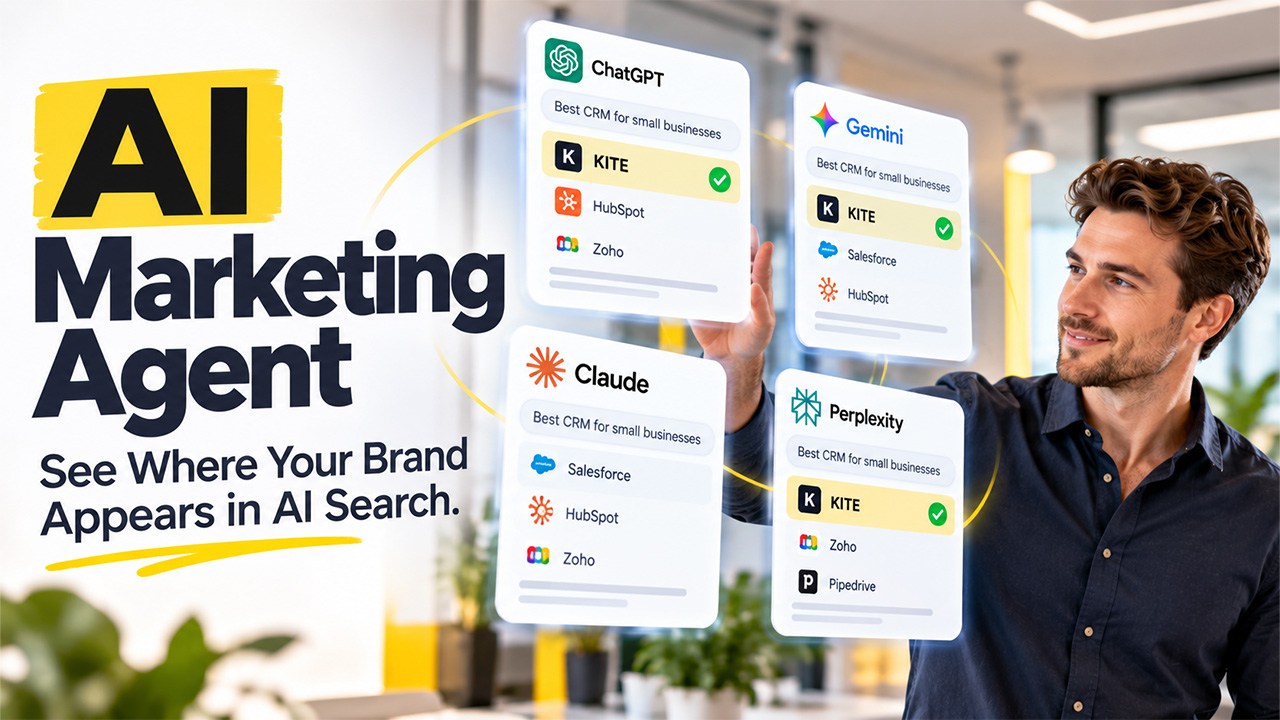
How an AI Marketing Agent Monitors Where You Appear in AI Search
Explore how AI agents can monitor AI search, track competitor mentions, identify citation gaps, and turn visibility findings into actionable tasks.
Your buyers have started asking assistants for recommendations. They describe a problem and get three or four company names back. If yours is absent, nothing tells you the conversation happened. There is no report and no missed-query list.
That invisibility is the practical problem with AI search. You can check manually, and almost nobody does it twice. Monitoring only works when it recurs without someone remembering. This piece covers how an agent runs those checks and what it does with the answers.
Why This Needs Monitoring at All
Search used to leave evidence behind. Rankings could be tracked and lost queries could be counted. Assistant recommendations leave none of that. An AI agent for marketing is a reasonable fit for the task.
The Answers Are Not Stable
Ask the same question twice and the answer often differs. Assistants vary between runs and between platforms. A single check tells you almost nothing reliable. Patterns across repeated runs are the only usable signal.
Why Competitors Show Up Instead
Businesses that get named usually have more public information available. Directory entries, trade coverage, and review profiles all contribute. The gap is rarely quality of service. It is quantity and clarity of what exists publicly.
Manual Checking Does Not Survive Contact With a Busy Month
Everyone intends to run this quarterly. Almost nobody does it more than once. The task has no deadline and no complaining customer. It is exactly the kind of work that needs to be scheduled by something other than goodwill.
Monitoring AI visibility is not technically difficult. It is difficult to sustain, which is a different problem. Automating the recurrence is most of the value.
Step One: Running the Questions Your Buyers Ask
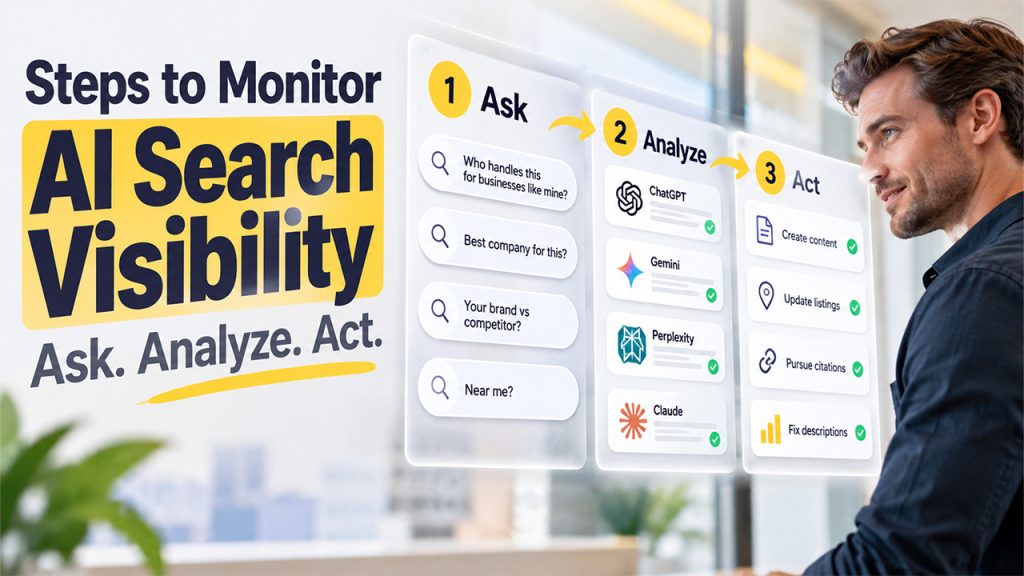
The agent starts by working out what buyers actually type. That is a research task before it is a monitoring task. Vendor language and buyer language rarely match. Getting this wrong makes every subsequent result meaningless.
- Situation prompts. How a buyer describes their problem, not your category.
- Comparison prompts. Your name against a named competitor.
- Category prompts. Who handles this kind of work for this kind of business.
- Local prompts. The same questions with a location attached.
Each prompt runs across several assistants rather than just one.
Why Multiple Assistants Matter
Different systems draw on different underlying sources. Appearing in one and missing from another is extremely common. Running the same question across ChatGPT, Gemini, Perplexity and Claude shows the spread. That spread is more useful than any single result.
Prompts Worth Running First
Start with the three questions a buyer asks before shortlisting anyone. Who does this, who does it for businesses like mine, and who is best. Those three cover most real purchase journeys. Add comparison prompts once the basics are established.
Why Repetition Matters
One run is an anecdote and five runs are data. Variation between runs is normal and expected. What matters is whether you appear consistently or never. An agent repeating this on a schedule produces that picture automatically.
The output of this step is not a score. It is a record of who gets named and which sources get cited.
Step Two: Reading What Comes Back
Related walkthrough
GPT-6 Can Build a 3D Rocket Using ONLY Your Voice

Collecting answers is straightforward and interpreting them is where the work sits. Three things get extracted from every run. The shift itself is significant, and McKinsey describes AI search as a new front door to the internet. It expects the change to reshape how buyers arrive.
Who Got Named
The list of recommended businesses is the headline result. Absence is informative and so is inconsistent presence. Appearing in two runs out of five is a different problem from never appearing. The remedy differs accordingly.
What Got Cited
Where assistants cite sources, those sources are the map. Directory listings, trade coverage, and review profiles appear repeatedly. Those are the surfaces worth investing in. The citation list is more actionable than the recommendation list.
What Was Said About You
Being named inaccurately is its own problem. Outdated descriptions and wrong service areas both occur. Correcting the underlying source fixes the description. That is a task with a clear owner and a clear end point.
Reading the results properly turns monitoring into a work queue. Without that step it is just an interesting report nobody acts on.
Step Three: Turning Findings Into Work
This is where an agent differs from a monitoring tool. A tool reports the gap and stops. An agent proposes what to do and produces it. The work then waits for a person to approve it.
From Gap to Draft
A missing comparison page becomes a drafted comparison page. An inaccurate description becomes a corrected page and a listing update. A cited competitor source becomes a target worth pursuing. Each finding produces a specific and reviewable output.
Where It Stops
Nothing goes public without a human decision. Previews stay previews until approved. The agent publishes only where it has been granted access. Those limits are deliberate and worth confirming with any vendor.
What You Actually Review
Your weekly involvement becomes reading proposals rather than running checks. That is a smaller commitment than most people assume. The monitoring happens whether or not you remember it. The decisions stay with you, which is the correct division.
The division of labour here is the practical argument for using an agent. Checking is repetitive and easy to skip. Deciding what to do about the results needs judgement. Handing the first part to software protects the second.
AI search visibility is not a project with a completion date. It is a recurring check that produces a small, steady work queue. The businesses appearing in recommendations two years from now started that cycle early. Getting the recurrence handled is more important than getting the first run perfect.