

When WooCommerce Needs More Than a Theme: Building for Non-Standard Transactions
Discover why WooCommerce custom development is essential for businesses handling complex transactions, limited allocations, and custom payment workflows.
WooCommerce powers a very large share of the web’s online stores, and for good reason. It is flexible, extensible, well documented and sits on top of a CMS most teams already know. For a conventional catalogue of replenishable products, it does the job with very little custom work.
The difficulty arrives when the transaction is not conventional. WooCommerce’s core model assumes products with stock levels, customers who buy independently, and fulfilment that follows payment. Businesses that violate any of those assumptions find that the platform still works, but that the gap between what it does and what they need has to be closed with development rather than configuration.
This is where custom WooCommerce development becomes essential, allowing businesses to extend the platform’s standard capabilities to accommodate specialized transaction models and operational requirements.
Here is where the boundaries sit, and what crossing them involves.
What Is WooCommerce Custom Development?
WooCommerce custom development involves extending the platform beyond its standard themes, plugins, and built-in features to support specific business requirements. While the default WooCommerce setup works well for conventional online stores, businesses with complex purchasing workflows often need tailored functionality.
Custom development allows organizations to modify checkout processes, integrate external systems, manage specialized inventory models, and create transaction workflows that standard plugins may not adequately support.
Rather than forcing business operations into predefined eCommerce structures, WooCommerce custom development adapts the platform to the way a business actually operates.
Stock that is an allocation, not an inventory level
WooCommerce tracks stock as a quantity that decrements on purchase. That model fits physical goods. It fits less well when the thing being sold is a finite allocation that must never be exceeded — event tickets, limited releases, competition entries, booking slots.
The functional difference is what happens under concurrency. Standard stock management tolerates a small race condition because the consequence is an oversell that can be refunded. Where the allocation is legally or contractually fixed, an oversell is a different category of problem.
Closing that gap means moving allocation out of the normal product flow: database-level atomic operations, row locking on the allocation record, or a reservation step that holds a unit before payment begins. None of these are theme-level work, and none of them are reliably handled by general-purpose stock plugins.
With WooCommerce custom development, businesses can implement tailored allocation mechanisms that provide greater control over inventory reservations and concurrent transactions.
Demand that arrives all at once
A typical store’s traffic distributes across the day. Some businesses receive most of their orders in a window of minutes — a drop, a deadline, an on-sale moment.
WordPress and WooCommerce can handle this, but not in a default configuration. The usual constraints are database connection limits, the uncached nature of cart and checkout pages, and the admin-ajax overhead that several plugins rely on. Under instantaneous load these surface together.
Mitigation generally involves object caching, moving session handling out of the database, aggressive reduction of plugins active on checkout, and often a queue in front of the purchase flow. The WooCommerce developer documentation covers the hooks involved, but the architecture decisions are specific to the load pattern rather than something a plugin provides.
Payment flows the gateway did not anticipate
Standard checkout authorises and captures in one step. Non-standard transactions frequently need something else: authorise now and capture on allocation, split payments across parties, hold funds pending an outcome, or refund automatically when an allocation fails.
WooCommerce’s payment gateway API supports much of this, but the handling has to be built. The critical requirement is idempotency, so a retried request cannot produce a duplicate charge. Payment providers support idempotency keys for exactly this purpose, and extending that guarantee through order creation usually means a queue or outbox rather than a direct write during the request.
Audit requirements the order table does not meet
Related walkthrough
How to Choose the Right WordPress Theme for Your Website

For businesses where the outcome matters — who received the allocation, in what order, determined how — the standard order record is insufficient. Orders can be edited, statuses change, and plugins modify data in ways that leave no trail.
An auditable build adds immutable event logging alongside the order lifecycle: append-only records, timestamps that cannot be amended, and storage that survives migration. This is straightforward to implement and almost always retrofitted after the first dispute, at which point the history that mattered was never captured.
The plugin trap
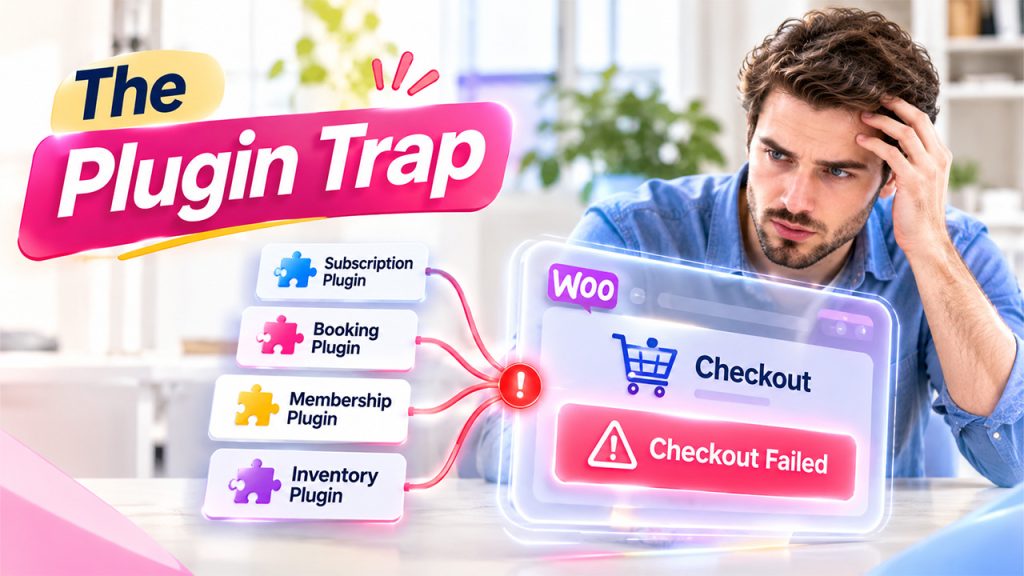
The instinct when WooCommerce lacks a capability is to find a plugin. For conventional gaps this works well.
For the requirements above it tends not to, for three reasons. Plugins solving edge cases often have small user bases and uncertain maintenance. Several plugins interacting on the checkout path multiply the failure modes at exactly the point where reliability matters most. And a plugin written for general use will make assumptions about the transaction model that may not match yours.
The judgement call is whether the requirement is genuinely common. Subscriptions, bookings and memberships have mature, well-maintained solutions. Finite allocation under concurrent load does not, and the available options are usually thin wrappers around the same stock handling that caused the problem.
When to bring in specialist development
The signal is usually one of these: you are overselling under load, your checkout slows at peak, you cannot evidence how an outcome was determined, or you have assembled six plugins to approximate one behaviour.
At that point the question is whether to continue extending or to rebuild the transaction layer properly. Agencies that work repeatedly on these builds, such as those offering WooCommerce development agency services for non-standard commerce, generally find the rebuild cheaper than continued extension, because each additional plugin increases the surface area that has to be tested at every WooCommerce release.
The takeaway
WooCommerce custom development allows businesses to preserve the flexibility of the platform while building transaction workflows that reflect their actual operational requirements.
What it will not do is support them out of the box. The assumptions baked into the core model — replenishable stock, independent buyers, payment then fulfilment — are reasonable defaults that some businesses simply do not share. Recognising which of those assumptions your business breaks is the first step, and it is considerably cheaper to do before the build than after the first peak.