
From Static Concepts to Moving Stories: How AI Video Generation Is Transforming Digital Production
AI Video Generation helps creators turn text prompts and images into videos for marketing, education, storytelling, and professional video production workflows.
AI Video Generation makes compelling visual presentations more accessible and helps audiences understand complicated ideas. However, producing quality video content has traditionally required several stages of work. Writers develop concepts, designers prepare visual assets, and editors bring everything together through careful post-production. For creators looking to simplify this process, an ai video generator offers a different way to turn creative instructions and existing images into moving scenes. This technology is opening new possibilities for technology professionals, independent creators, digital agencies, and businesses that need more flexible content production methods.
Why Traditional Video Production Can Be Difficult to Scale
Creating a single video may be manageable for a small team, but maintaining a regular production schedule presents a different challenge. Every new project introduces decisions about visual direction, scene composition, transitions, sound, and editing. When several campaigns are running simultaneously, these responsibilities can place considerable pressure on creative resources.
Another challenge is experimentation. A team may have several ideas for presenting the same concept but limited time to produce and compare them. Traditional production often makes each variation a separate task, involving additional editing or filming.
AI-powered generation introduces a more flexible starting point. Instead of building every visual sequence manually, creators can describe what they want to see and use generated footage as a foundation for further development. This does not remove the need for professional judgment, but it can make the early stages of visual production more accessible through modern AI video production workflows.
Understanding the Technology Behind AI-Generated Motion
AI video generation combines advanced machine learning techniques to interpret visual information, written descriptions, and other creative references. These systems attempt to understand relationships between objects, environments, lighting, and movement before producing a sequence of frames.
The process is more complex than simply converting a photograph into a moving image. A useful video must maintain a degree of visual continuity while representing the movement described by the creator.
For instance, consider a concept featuring a futuristic vehicle travelling through a city at night. The instructions might specify the vehicle’s appearance, the surrounding architecture, reflections on the road, camera movement, and atmospheric lighting. The generation model uses these details to produce a visual interpretation.
Different platforms approach this process through different models and generation methods. Some focus on creating scenes from text descriptions, while others use photographs, video references, or combinations of multiple inputs.
Understanding these distinctions helps creators select a workflow that matches their project rather than expecting one generation method to solve every production challenge.
Four Areas Where AI Video Generation Offers New Possibilities
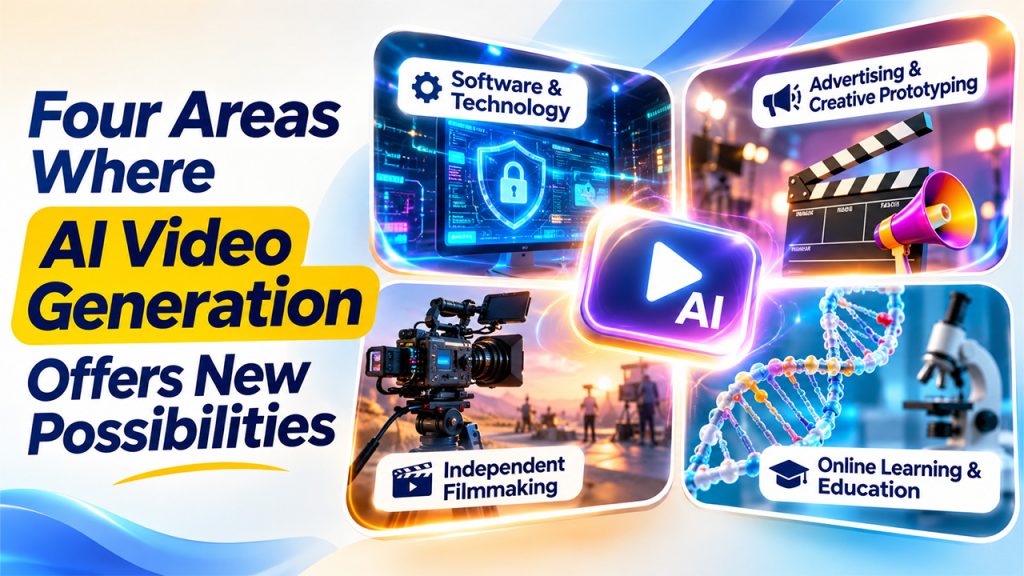
1. Software Demonstrations and Technology Presentations
Technology companies frequently need to explain products that are difficult to demonstrate through conventional promotional photography. Software interfaces, cloud services, automation platforms, and digital infrastructure often benefit from visual explanations.
AI-generated scenes can provide supporting imagery for these presentations. For example, a company introducing a cybersecurity solution might use abstract visual sequences to represent data protection, network connections, and digital threats.
These scenes can make an otherwise technical presentation more engaging, provided that the visuals support rather than replace accurate product information.
2. Creative Prototyping for Advertising Agencies
Advertising agencies regularly develop several creative concepts before deciding which direction to pursue. Producing complete videos for every proposal can consume resources that could otherwise be spent improving the selected campaign.
AI generation can help teams explore initial visual ideas more quickly. A creative director might test different environments, camera perspectives, or artistic treatments before moving into detailed production.
This is particularly useful during concept development, when the objective is to communicate a creative direction rather than deliver a final commercial.
3. Independent Film and Story Development
Independent filmmakers often work with limited budgets and smaller production teams. Visual planning can become difficult when a script requires locations, lighting arrangements, or complex scenes that are not immediately available.
AI-generated video can support early experimentation with visual storytelling. Filmmakers can explore scene compositions, atmospheric effects, and character movement before deciding how to approach actual production.
It can also help communicate creative ideas to collaborators who may find written descriptions difficult to visualize.
4. Online Learning and Technical Education
Educational content is another area where visual communication matters. Instructors explaining scientific processes, engineering concepts, or digital systems may benefit from animated illustrations that demonstrate how something works.
Rather than relying exclusively on diagrams and static slides, creators can experiment with moving sequences that help audiences follow a process.
The important consideration is accuracy. Educational videos should be reviewed by knowledgeable people to ensure that generated representations do not introduce misleading information.
Developing a More Flexible Creative Process With Dreamina
The development of AI creative platforms has made it easier to experiment with different types of visual material in one environment. Dreamina is an example of a platform that brings AI image and video creation capabilities together.
Its creative tools allow users to approach video generation through written descriptions and visual references. This provides flexibility when a project begins with an abstract concept, an existing photograph, or a more developed visual plan.
For creators interested in experimenting with different production approaches, Dreamina offers access to models such as Seedance and tools for developing AI-generated videos. Depending on the selected model and available features, users can explore scene generation, reference-based workflows, and video refinement.
One practical example is a digital agency developing a presentation for a new technology product. The team could begin by preparing a visual concept, generate supporting scenes, and then evaluate which results best communicate the product’s intended message.
The platform can also support experimentation with visual storytelling. Instead of treating image creation and video generation as entirely separate activities, creators can use related tools to develop a more connected workflow.
The final output should still undergo careful review. Generated scenes may require adjustments to movement, composition, or object details before they are suitable for professional publication.
How to Write Better Instructions for AI Video Generation Models
Related walkthrough
How to Use Kling AI: Free AI Video Generator Tutorial!
The quality of a generated scene depends significantly on the instructions provided. A detailed prompt gives the model more information about the intended result and reduces unnecessary ambiguity. Businesses developing AI-powered creative workflows can also benefit from AI integration services to incorporate artificial intelligence capabilities into their existing software systems.
A useful prompt generally addresses five important elements:
Subject
Identify the main person, object, or environment that should appear in the scene.
Action
Explain what should happen. Specify whether the subject is walking, moving, interacting with an object, or remaining stationary.
Environment
Describe the location, background, weather, and surrounding visual details.
Camera Direction
Explain whether the scene should use a close-up, wide-angle composition, tracking movement, or another perspective.
Visual Atmosphere
Include details about lighting, color, realism, and the intended mood.
For example, instead of writing “a car driving through a city,” a more useful instruction might describe a silver electric vehicle moving along a modern city street at dusk, with reflections on wet pavement, illuminated buildings, and a smooth tracking camera shot.
This level of detail establishes a clearer creative direction. Nevertheless, creators should expect to review and refine results rather than assuming that every instruction will be followed perfectly.
Maintaining Quality Across AI-Generated Video Projects
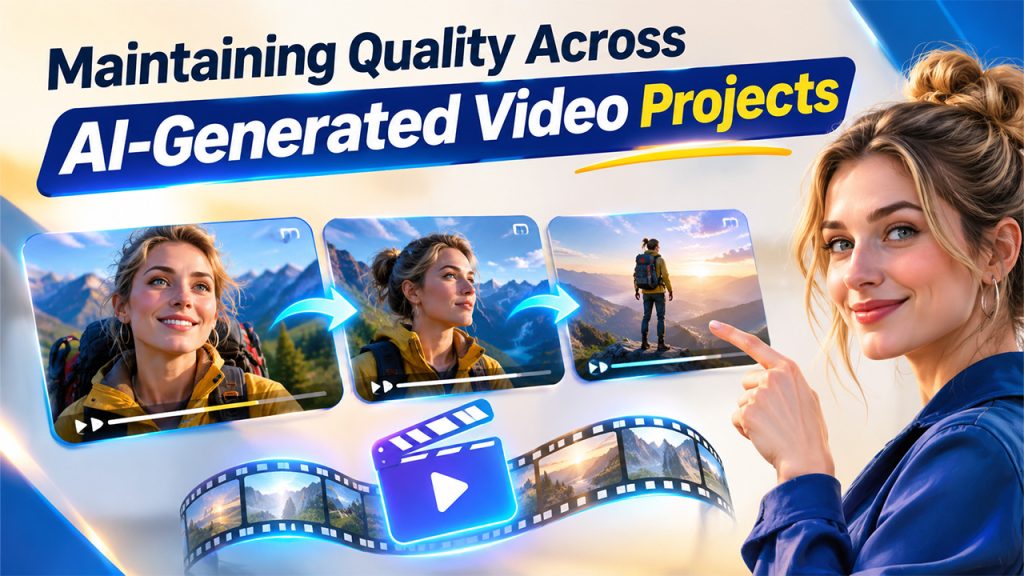
Producing an attractive individual clip is only one part of a successful video project. When several scenes need to work together, consistency becomes particularly important.
Characters should maintain recognizable appearances, environments should follow the intended visual direction, and transitions should feel natural. Without careful planning, separately generated scenes may look disconnected when combined.
A few practices can improve the overall process:
- Develop a visual reference before generating multiple scenes.
- Keep descriptions of recurring characters and objects consistent.
- Use similar lighting and color directions throughout related sequences.
- Review movement and background details in every generated clip.
- Edit scenes together with appropriate pacing, sound, and transitions.
- Check the final video on the platforms where it will be published.
These steps help creators move beyond isolated AI-generated clips and develop content with a more coherent visual identity.
Responsible Use of Generative Video Technology
As AI-generated media becomes more accessible, responsible use deserves greater attention. Generated scenes can look realistic, which means audiences may not always recognize when footage has been artificially created.
Creators should avoid presenting fabricated events as genuine recordings. They should also consider copyright, permissions, privacy, and the appropriate use of reference images, audio, and identifiable individuals.
For businesses, these considerations are especially important when videos involve customers, public figures, product claims, or sensitive subjects.
Human oversight remains essential. AI can assist with visual production, but decisions about accuracy, representation, and the suitability of published material should remain part of the creative team’s responsibilities.
What Comes Next for AI-Assisted Video Production?
The future of video generation is likely to involve increasingly connected creative workflows. Improvements in reference handling, motion generation, scene editing, and audiovisual production may give creators greater control over how their ideas become finished content.
This development could be particularly valuable for small production teams that need to manage several projects without expanding their resources for every assignment.
However, technological improvements alone will not guarantee better communication. Strong storytelling, useful information, thoughtful visual direction, and audience understanding will remain central to effective video production. These principles are equally important when developing engaging digital experiences, where meaningful content and audience needs shape how businesses communicate.
AI should therefore be viewed as an additional creative capability rather than a replacement for the people responsible for developing meaningful ideas.
Conclusion
AI video generation is changing how digital content can be planned, developed, and refined. From software presentations and advertising concepts to independent filmmaking and educational material, the technology provides new opportunities to experiment with visual storytelling.
Platforms such as Dreamina make it possible to explore image-based and text-based creative workflows within a connected environment. When supported by clear instructions, appropriate references, and careful editing, these capabilities can help creators approach video production with greater flexibility.
Ultimately, the most effective use of AI video generation technology is not simply producing more footage. It is finding better ways to communicate ideas, explain complex subjects, and create visual experiences that serve a meaningful purpose.