
What Is the Best Promotion Analytics Solution for Retail Grocery Stores in 2026?
Discover promotion analytics tools that help grocery retailers optimize pricing, improve campaigns, and increase profits with data-driven insights.
Promotions play a critical role in grocery retail. Retailers regularly run thousands of promotional campaigns across multiple product categories to stimulate demand, increase basket size, and remain competitive in price-sensitive markets. However, promotional campaigns can also significantly erode margins if they are not carefully analyzed and optimized.
According to McKinsey, even the best grocery retailers can expect 10–15% of promotions to dilute sales and margins when factors such as stock-up, cannibalization, and halo effects are taken into account.
Grocery retailers face several challenges when managing promotions at scale:
- large assortments with thousands of SKUs
- varying price sensitivity across products and categories
- complex promotional calendars with overlapping campaigns
- fluctuating demand patterns driven by seasonality and competition
Traditional promotion planning methods often rely on historical spreadsheets or manual analysis. These approaches struggle to capture the complexity of modern retail environments where pricing, demand forecasting, and category performance interact dynamically.
Promotion analytics platforms help retailers move beyond reactive promotion planning by using advanced analytics, machine learning, and demand forecasting to measure promotional performance and optimize campaign effectiveness.
In this article, we review the best promotion analytics solutions for retail grocery stores and examine how these platforms help retailers improve promotion performance, protect margins, and make more data-driven commercial decisions.
TL;DR
Promotions remain one of the most commonly used tactics in grocery retail, but poorly designed promotions can quickly reduce profitability. Promotion analytics platforms help retailers measure campaign performance, forecast promotional impact, and design more effective promotion strategies.
Top promotion analytics solutions for grocery retailers include:
- Yieldigo – AI-driven promotion and pricing optimization platform designed specifically for grocery retailers
- UpClear – revenue management and trade promotion analytics platform for consumer goods and retail organizations
- 7Learnings – AI-powered pricing and promotion optimization platform focused on demand forecasting
- Peak AI – enterprise AI platform enabling advanced retail decision intelligence and promotion analytics
- Algonomy – retail analytics platform providing promotion performance insights and customer analytics
- Zilliant – revenue optimization platform with advanced pricing and promotion analytics capabilities
These solutions help retailers transform promotions from reactive price cuts into data-driven commercial strategies aligned with profitability goals.
How We Evaluated Promotion Analytics Software for 2026
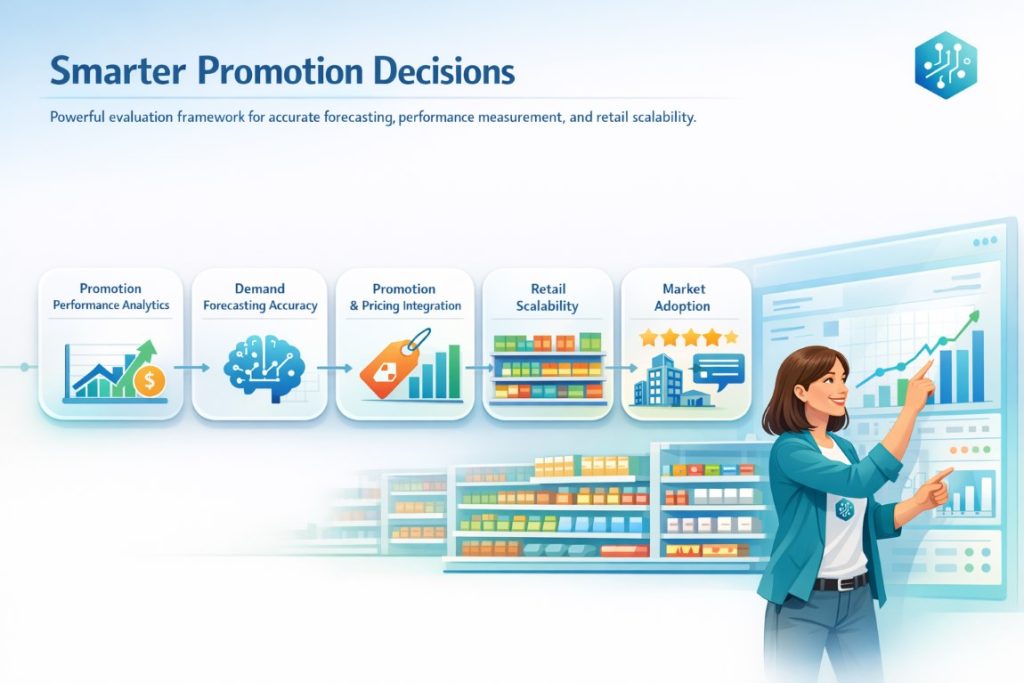
To identify the most effective promotion analytics platforms for grocery retailers, we evaluated solutions across several key criteria including promotion measurement capabilities, forecasting accuracy, integration with retail systems, and scalability for large assortments.
Promotion Performance Analytics
We prioritized platforms that provide detailed analytics on promotion effectiveness, including incremental sales measurement, promotion uplift analysis, and margin impact.
Demand Forecasting Accuracy
Platforms were evaluated based on their ability to forecast how promotional campaigns influence demand across product categories.
Promotion and Pricing Integration
The most effective solutions integrate promotion analytics with pricing optimization and demand forecasting systems.
Retail Scalability
Promotion analytics platforms must support thousands of SKUs and analyze promotional scenarios across complex retail environments.
Market Adoption
We also considered customer reviews, industry adoption, and presence in enterprise retail deployments.
Best Promotion Analytics Software for Grocery Retailers
Yieldigo: Best for AI-driven promotion optimization in grocery retail
What It Is?
Yieldigo is an AI-driven retail optimization platform designed specifically for grocery and FMCG retailers that manage large product assortments and highly dynamic promotional calendars. The platform uses advanced machine learning models to analyze demand patterns, product relationships, and price elasticity in order to recommend optimized promotion strategies.
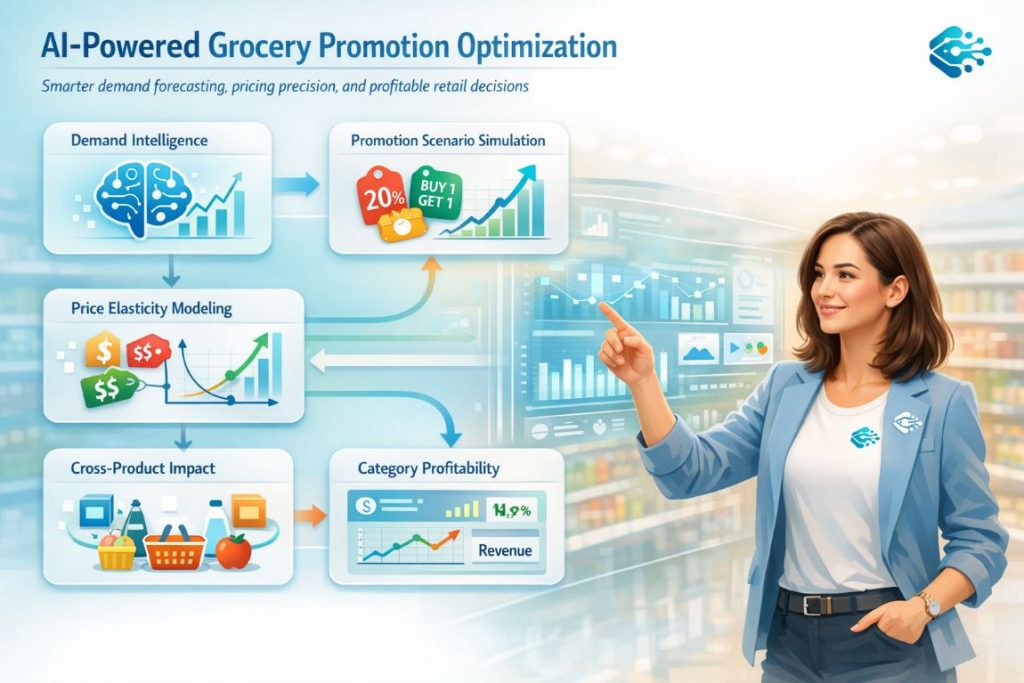
Unlike traditional promotion analytics tools that focus primarily on historical reporting, Yieldigo enables retailers to simulate different promotion scenarios before campaigns are launched. Retail teams can evaluate how discounts, bundles, or multi-buy offers influence demand, basket composition, and category profitability.
This capability is particularly valuable in grocery retail, where promotions frequently involve thousands of SKUs and complex cross-category interactions.
Best For:
Large grocery retailers seeking advanced AI-driven promotion analytics and optimization across extensive product assortments.
Key Capabilities:
- AI-driven promotion optimization
- demand forecasting and elasticity modeling
- promotion scenario simulations
- cross-product demand analysis
- category profitability analytics
Strategic Strengths:
Yieldigo provides deep visibility into how promotions affect basket composition, cross-category demand, and overall store profitability. By modeling product interactions and price sensitivity across large assortments, the platform helps retailers identify promotion strategies that generate true incremental demand rather than simply shifting purchases between products or time periods. For grocery retailers operating frequent promotional cycles, this level of predictive insight enables more effective promotion planning and stronger margin protection.
Considerations:
The platform is primarily designed for grocery and other high-SKU retail sectors where promotion complexity requires advanced analytics.
Pricing:
Enterprise pricing available upon request.
G2 Rating: 4.7 / 5
UpClear: Best for trade promotion analytics and revenue management
What It Is?
UpClear is a revenue management and trade promotion analytics platform designed to provide visibility into promotional performance across retail and consumer goods organizations. The platform focuses on analyzing how trade spending and retail promotions influence revenue outcomes and supplier agreements.
Best For:
Retailers and manufacturers managing complex trade promotion strategies and supplier-funded promotional programs.
Key Capabilities:
- trade promotion analytics
- promotion performance dashboards
- revenue management tools
- retail sales analytics
Strategic Strengths:
UpClear provides strong analytical capabilities for evaluating how trade promotions impact revenue and supplier-funded marketing programs. This makes it particularly valuable for retailers collaborating closely with FMCG manufacturers.
Considerations:
The platform focuses primarily on trade promotion analytics and revenue management, rather than providing advanced promotion optimization or demand forecasting capabilities for retail assortments.
Pricing:
Custom enterprise pricing.
G2 Rating: 4.4 / 5
7Learnings: Best for AI-powered promotion and pricing forecasting
What It Is?
7Learnings is an AI-driven pricing and promotion optimization platform that helps retailers forecast how pricing changes and promotional campaigns will influence customer demand.
The platform uses machine learning models trained on historical sales data and demand signals to predict the impact of promotional activities across product assortments.
Best For: Retailers seeking predictive analytics to forecast promotion performance and pricing outcomes.
Key Capabilities:
- AI demand forecasting
- promotion elasticity modeling
- pricing and promotion simulations
- automated analytics dashboards
Strategic Strengths:
7Learnings uses advanced machine learning models to estimate demand elasticity and forecast how promotions may influence purchasing behavior. This allows retailers to simulate promotional scenarios before campaigns are launched.
Considerations:
Successful implementation may require integration with multiple internal retail data systems, which can increase deployment complexity.
Pricing:
Enterprise pricing available upon request.
G2 Rating: 4.5 / 5
Peak AI: Best for enterprise retail decision intelligence
What It Is?
Peak AI is an enterprise artificial intelligence platform designed to help retailers improve commercial decision-making across pricing, promotions, inventory planning, and supply chain operations. The platform combines multiple data sources to generate predictive insights that guide retail decision-making.
Best For:
Retailers implementing enterprise-wide AI decision intelligence across commercial operations.
Key Capabilities:
- AI decision intelligence
- promotion performance analytics
- demand forecasting
- retail data modeling
Strategic Strengths:
Peak AI enables retailers to integrate large volumes of operational data and generate insights that support pricing and promotion decisions across complex retail organizations.
Considerations:
The platform often requires substantial data integration and infrastructure alignment before delivering full analytical capabilities.
Pricing:
Custom enterprise pricing.
G2 Rating: 4.6 / 5
Algonomy: Best for customer-driven promotion analytics
What It Is?
Algonomy provides AI-powered retail analytics technology designed to help retailers better understand customer behavior, personalization opportunities, and promotion effectiveness.
The platform analyzes customer interactions across digital channels and provides insights into how promotional campaigns influence engagement and purchasing behavior.
Best For:
Retailers seeking customer-centric analytics for marketing and promotional strategies.
Key Capabilities:
- customer behavior analytics
- promotion performance insights
- personalization tools
- retail AI analytics
Strategic Strengths:
Algonomy excels at connecting promotional performance with customer engagement data, helping retailers understand how marketing campaigns influence customer interactions.
Considerations:
The platform focuses primarily on customer behavior analytics and personalization, rather than deep promotion optimization or pricing strategy modeling.
Pricing:
Enterprise pricing available.
G2 Rating: 4.3 / 5
Zilliant – Best for revenue optimization analytics
What It Is?
Zilliant provides revenue optimization software designed to help organizations improve pricing performance and commercial decision-making across complex markets. The platform focuses on improving profitability by analyzing pricing strategies and measuring the financial impact of promotions.
Best For:
Retailers seeking advanced pricing and revenue analytics capabilities.
Key Capabilities:
- pricing analytics
- promotion impact measurement
- revenue optimization tools
Strategic Strengths:
Zilliant helps organizations identify pricing and promotional strategies that improve overall revenue performance.
Considerations:
The platform is widely used in enterprise and B2B environments, and its functionality may require adaptation for grocery-specific promotion planning.
Pricing:
Custom enterprise pricing.
G2 Rating: 4.4 / 5
What Are the Benefits of Using Promotion Analytics Software?
Related walkthrough
Robots Are Learning to Work Like Humans

Modern promotion analytics platforms provide retailers with the analytical tools required to design more effective promotional strategies while protecting margins.
- Margin Protection
- Improved Promotion Performance
- Smarter Demand Forecasting
- Better Inventory Coordination
- Data-Driven Decision Making
Promotion analytics software helps retailers better understand the real impact of their campaigns, ensuring that discounts generate incremental sales rather than simply reducing margins. By analyzing historical data and simulating different scenarios, businesses can improve promotion performance and make more accurate demand forecasts across various product categories and time periods.
In addition, these platforms support closer alignment between promotions and inventory, reducing the risk of stock imbalances during campaigns. Retailers often combine promotion analytics with advanced logistics planning tools to ensure products are available across distribution networks. Implementing modern logistics software solutions for retail operations helps businesses coordinate warehousing, transportation, and store replenishment more efficiently. Most importantly, they enable data-driven decision making, allowing retail teams to replace intuition with clear insights and optimize their strategies with greater confidence.
How to Choose the Right Promotion Analytics Software
When selecting a promotion analytics platform, retailers should evaluate whether the solution is designed specifically for complex retail environments. Grocery and FMCG retailers operate with large product assortments, frequent promotional campaigns, and dynamic pricing strategies across multiple channels. As a result, effective platforms must provide retail-specific functionality that enables teams to analyze promotion performance, understand cross-product demand interactions, and measure how discounts influence category performance and overall profitability.
Retailers should also consider the platform’s analytical capabilities, system integrations, and scalability. Advanced solutions use AI-driven forecasting models to predict how promotions will influence demand and revenue outcomes before campaigns are launched. Integration with pricing systems, retail data platforms, and other core infrastructure is essential to ensure accurate and consistent analysis across the organization. In addition, promotion analytics software should provide intuitive dashboards that allow pricing, merchandising, and category management teams to easily interpret insights and plan campaigns. Finally, enterprise retailers must ensure the platform can scale to support thousands of SKUs and complex promotional calendars across large retail networks.
Why Trust Our Software Reviews?
Our reviews focus on enterprise retail technologies used by grocery and FMCG retailers operating in complex commercial environments. These organizations often manage thousands of SKUs, frequent promotional campaigns, and omnichannel retail operations. To identify the most relevant promotion analytics platforms, we evaluate each solution based on several key factors:
- Retail-Specific Promotion Capabilities. We prioritize platforms designed specifically for retail environments where promotions play a major role in commercial strategy. This includes capabilities such as promotion performance analysis, category-level insights, cross-product demand analysis, and tools that help retailers evaluate how discounts influence sales, basket composition, and overall profitability.
- Advanced Forecasting and Analytics Technology. Modern promotion analytics platforms should go beyond basic reporting dashboards. We assess whether the software uses advanced analytics, machine learning models, and demand forecasting technology to predict how promotions will influence sales performance, customer demand, and revenue outcomes.
- Integration with Retail Systems and Data Sources. Promotion analytics tools must integrate with existing retail infrastructure, including pricing systems, point-of-sale platforms, ERP solutions, and e-commerce environments. Seamless integration ensures that retailers can combine promotional performance data with sales metrics, inventory levels, and customer insights to generate more accurate and actionable analysis.
- Scalability and Industry Adoption. We also evaluate whether the platform can support enterprise retail environments with large product assortments and complex promotional calendars. Platforms that are widely adopted by grocery and FMCG retailers and demonstrate strong customer feedback are prioritized in our reviews.
Conclusion
Promotions remain one of the most powerful drivers of demand in grocery retail. However, when promotions are executed without robust analytical support, they can quickly erode margins, distort demand patterns, and shift purchases rather than generate true incremental sales.
Promotion analytics platforms enable grocery retailers to move beyond manual planning and spreadsheet-based analysis toward data-driven promotion strategies powered by advanced analytics and machine learning. Much like how understanding a Histogram vs Bar Graph helps analysts correctly interpret data distributions and category comparisons, these platforms allow retailers to visualize and analyze promotional performance more accurately. They help retailers measure campaign performance, forecast promotional outcomes, and better coordinate promotion planning with pricing, inventory levels, and category strategies.
Solutions such as Yieldigo, UpClear, 7Learnings, Peak AI, Algonomy, and Zilliant provide retailers with the analytical tools required to manage promotions across large assortments and complex promotional calendars. Among these solutions, AI-driven platforms like Yieldigo are increasingly helping retailers identify promotion strategies that generate incremental demand while protecting profitability.
As grocery retail continues to become more data-driven and competitive, adopting advanced promotion analytics technology is becoming an essential part of modern retail strategy. Retailers that leverage AI-powered promotion insights will be better positioned to optimize promotional performance, improve margins, and maintain strong competitive positioning in increasingly dynamic retail markets.