
AI SEO Agency vs. In-House: Complete Leader’s Guide
A decision framework for CMOs and marketing leaders choosing between an AI SEO agency and an in-house team, with real cost data for 2026.
The core tradeoff of choosing an AI SEO agency, compared to building in-house, mainly comes down to three specific things, i.e., speed, cost structure, and how much control user can need over day-to-day execution. Aa an agency gets the specialized expertise and faster results immediately, as AI-powered SEO agencies generally deliver 2 to 3 times faster organic growth, compared to traditional timelines, without the hiring runway a full in-house build requires.
A new hire generally costs more upfront in salary and ramp time, and still leaves users without the AI search tooling, entity optimization experience, or cross-client pattern recognition a specialist team has already on day one. For most leaders and marketing teams staring down a Q1 budget decision, the math isn’t close once you factor in how long a hire takes to become productive.
That’s exactly why a growing share of marketing leaders are skipping the build phase entirely and going straight to execution, a shift this breakdown of AI search visibility versus traditional SEO explains in more detail.
| Key Takeaways |
| In-house AI SEO hires run $55K–$140K+/yr, before you’ve shipped a single ranking improvement |
| Agency retainers typically run $1,500–$10,000+/mo and start producing resultsimmediatelyl.y |
| AI-powered agencies deliver 2–3x faster organic gr;wth than traditional timelines |
| A misaligned agency can cost as much as a poorly structured internal team, immediately one pays for itself fast |
The Real Cost CompTimelines/SalaryRetainer vs.timelinesSalary
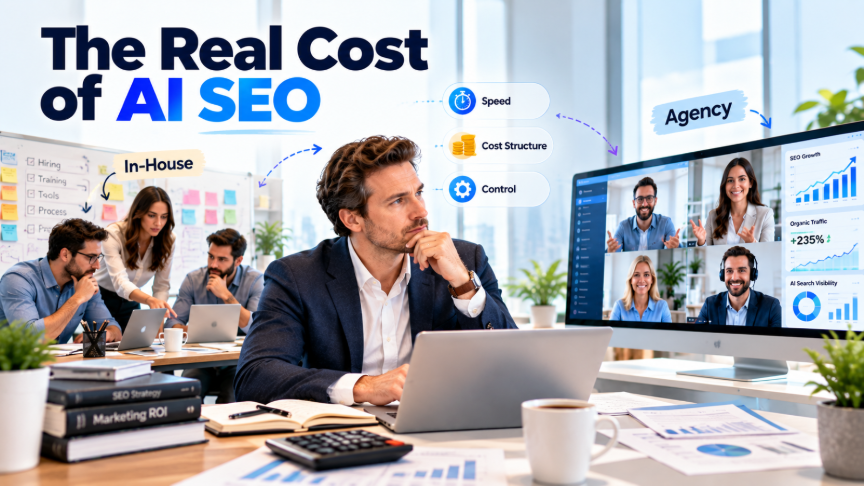
The numbers rarely get compared side y side, so here they are. A junior in-house SEO hire runs $55K to $80K per year; a senior in-house manager with real AI SEO fluency runs $140K or more, before benefits, tooling, and ramp time are added on top, the same cost structure that made traditional SEO hiring slow to begin with.
None of that spend produces a single result while the hire is onboarding, learning your stack, and building out a process from scratch. Agency retainers, by contrast, typically run $1,500 to $10,000 or more per month, and because the frameworks, tooling, and AI search expertise already excise execution starts in week one, not month four, which shows up in keyword rankings faster than a new hire ever could.
The speed differential is the part most budget conversations miss. AI SEO agencies deliver 2 to 3 times faster organic growth than traditional agency timelines, largely because they’re already running tested playbooks across multiple clients rather than building a process from zero the way a new hire must. For a leader who needs to show movement before the next board update, that gap isn’t academic, it’s the difference between walking in with a result and walking in with a progress report on hiring.
What a Leader Should Keep In-House vs. Delegate
The hybrid approach is widely suggested, yet few explain what tasks to delegate and what to retain. Here’s a practical version: strategy, brand oversight, and vendor management should remain in-house. It’s essential to have someone internally who may not be a specialized SEO expert but has a strong grasp of your positioning to identify recommendations that stray from the brand, as well as to maintain the relationship instead of relying on whoever happens to be in the meeting.
Day-to-day execution, AI search optimization, technical SEO tools powered by AI, and ongoing optimization should be entrusted to others; this is often the aspect that leaders hold onto for too long. Entity optimization, AI content engineering, Content creation, content strategies, structured data implementation and continuous technical adjustments are exactly where a specialist partner, staffed by actual SEO specialists rather than generalists, earns a retainer, because building high-quality content internally takes months of tooling investment and trial and error most teams genuinely can’t afford to run on their own live site.
This is the gap a team like BolsterBiz exists to close, stepping in as the execution layer, so your internal headcount stays focused on strategy instead of getting pulled into technical AI SEO work it was never built to own.
The Risk of Getting This Wrong in Either Direction
Related walkthrough
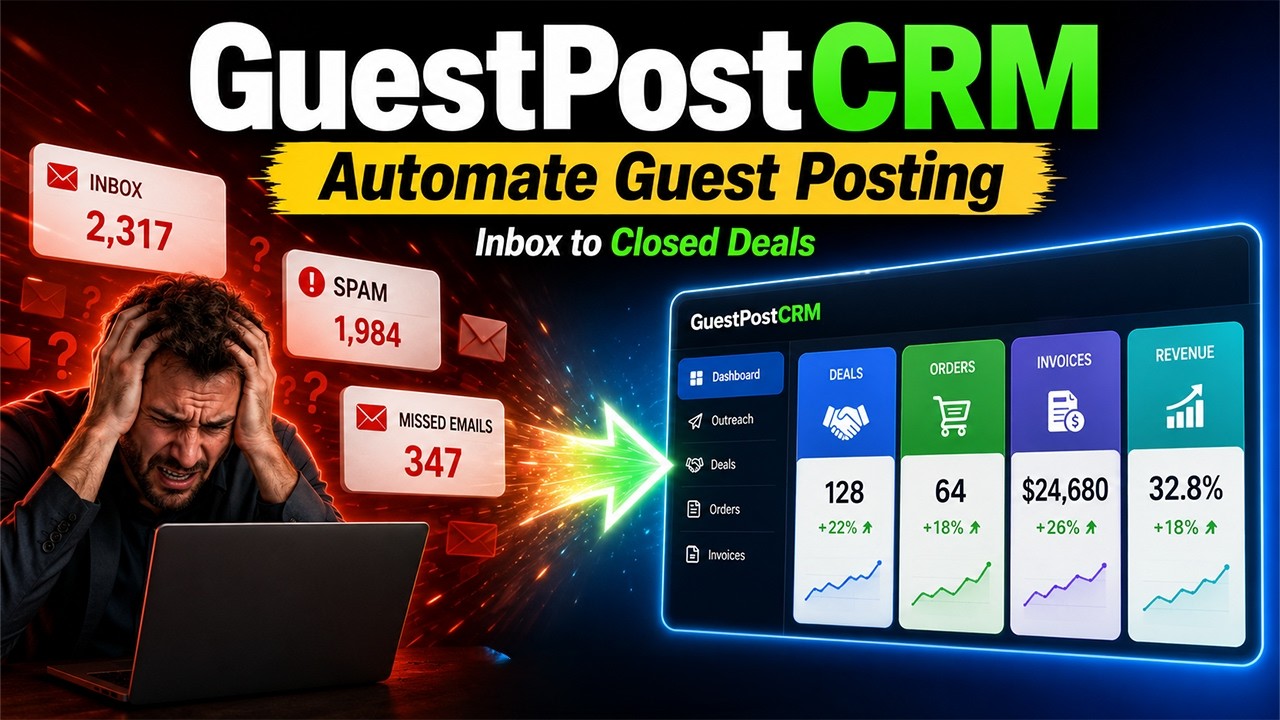
GuestPostCRM Demo: Automate Guest Posting, Link Insertions & SEO Outreach
This isn’t purely an agency-risk conversation. An ineffective agency partnership can be just as costly as an inadequately organized internal team; the consequences simply manifest differently.
A subpar agency wastes resources on generic implementations that lack brand coherence and provide vague monthly summaries. Inefficiently organized internal team exhausts funds through a prolonged ramp-up, gaps in tools, and strategies developed in isolation from what is currently successful in the market.
Neither structure is more economical than the other, and both result from neglecting the crucial step that ensures the success of either model: genuine oversight and a partner who measures outcomes rather than just activities.
How to Decide: A Quick Framework for Leaders
Choose your decision based on your real stage of development, not simply on a general desire for control or cost-cutting. When you are in the early stages or when you are testing in a new market, you should choose an agency, without any doubt, since you need speed and proven expertise and don’t want to commit to a fixed headcount before you’ve established that the strategy works.
The hybrid model is preferred when scaling with a real budget for dedicated staff because it involves internal strategy ownership while leaving the execution to a team that already has the AI search methodology in place. For enterprises or those with multiple brands, either a top-tier specialised partner or a fully in-house team supported by enterprise-grade tools should be chosen, as such a high level of coordination cannot be achieved in a half-hearted way.
Once you’ve moved beyond the decision about whether to build or buy and are ready to see what actual execution involves, BolsterBiz’s SEO services are designed with this handoff stage in mind, acting as the technical execution layer without requiring you to surrender your strategic control. You should have a talk about it before you publish a job listing that won’t yield results for another quarter.
Conclusion
The choice between an AI SEO agency and an in-house team isn’t exactly straightforward, and viewing it as such often leads management to either a weak internal team or a partnership with an agency lacking proper oversight.
The calculations that stand up to a budget evaluation are typically consistent: retain your strategy and brand insights internally, while delegating the technical execution to a partner who has successfully implemented this approach for other clients. Get that division correct, and you won’t have to choose between cost and efficiency; you’ll achieve both.
Are you ready to explore what that execution layer could look like specifically for your team? Talk to BolsterBiz before your next planning cycle locks in another quarter of ramp-up time.
Frequently Asked Questions
For most leaders, an agency is the faster path to results, especially early-stage or when testing a new strategy. In-house hires take months to ramp before producing results. A specialist agency starts executing in week one using frameworks already proven across other clients.
In-house hires run $55K to $80K per year for junior roles and $140K or more for senior managers, before a single result ships. Agency retainers run $1,500 to $10,000 or more per month and typically start producing measurable movement within the first month.
Strategy, brand judgment, and vendor oversight should stay internal. Someone on your team needs to own the relationship and catch recommendations that drift off-brand. Everything downstream of that, technical execution and tooling, is better handled by a specialist partner.
It can be, if there's no oversight and no outcome-based reporting. The fix isn't avoiding agencies, it's choosing a partner that reports on results rather than activity and keeps your internal team in the loop on strategy, not just deliverables.