

AWS Solutions Architect: A Beginner’s Guide to Cloud Architecture
Explore what an AWS Solutions Architect does, the skills you need, core AWS services, cloud architecture principles, and how to start your career.
The article explores what an AWS Solution Architect is, what they do, what skills anyone needs to become one, and how to start a career in the sector.
In recent years, cloud computing has significantly transformed the way businesses build, deploy, and scale applications. Instead of purchasing and maintaining expensive physical servers, organizations can use cloud platforms to access computing power, storage, databases, networking, security, and other IT resources on demand.
Among all the leading cloud platforms, Amazon Web Services (or AWS) has become one of the most widely used cloud platforms. As businesses continue to move their applications and infrastructure to the cloud, the demand for AWS Solutions Architect increases, especially for those who can design reliable, secure, scalable, and cost-effective cloud solutions.
What is an AWS Solutions Architect?
An AWS Solutions Architect is a cloud professional who generally designs solutions using AWS services to meet the technical and business requirements of the organization. The main job of an AWS Solutions Architect is to create cloud solutions that are secure, reliable, scalable, high-performing, and cost-effective. The AWS Solutions Architect creates a technical design for how an application should operate in the AWS environment. The architect decides which AWS services should be used and how they should work together.
What Does an AWS Solutions Architect Do?
An AWS Solutions Architect plays a critical role in turning business requirements into a practical cloud design. This can involve selecting the right infrastructure, databases, security controls, and Cloud Application Development Services to support the organization’s application requirements. Some of the key tasks performed by an AWS Solution Architect are as follows:
- Understands Business Requirements: The architect determines what the organization or application needs to be accomplished.
- Designs Cloud Architecture: Selects appropriate AWS services and determines how they connect.
- Plans for Scalability: The architect ensures that the system can handle increasing traffic and workloads.
- Builds in Security: They also protect applications, users, networks, and data by applying appropriate identity, access, encryption, and network security controls. Understanding modern cloud security tools can also help architects identify and manage security risks across cloud environments.
- Improves Reliability: The architect designs systems that can continue operating when individual components fail.
Understanding the basics of AWS Architecture
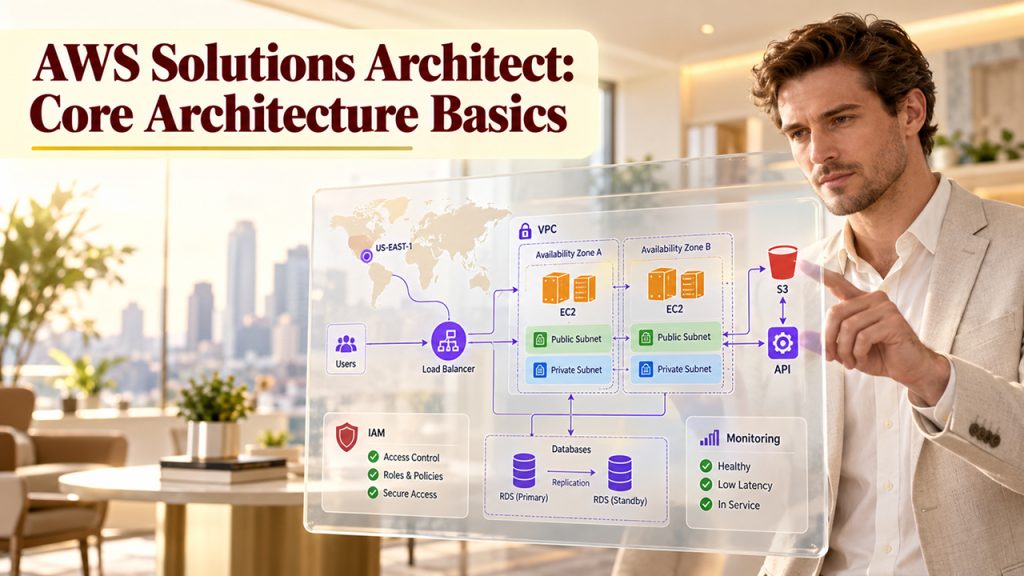
Before becoming an AWS Solutions Architect, it is essential to understand the fundamental building blocks of AWS architecture. These concepts are also important for Cloud Application Development, where computing, storage, databases, networking, security, and monitoring need to work together to create reliable and scalable applications.
Some of the key elements of AWS Architecture are as follows:
- AWS Regions
An AWS Region is a separate geographic area in which AWS operates its cloud infrastructure. While designing an application, a Solution Architect needs to consider where the application’s users are located, whether there are regulatory requirements about where data can be stored, whether the chosen region provides the required AWS services, and what level of availability and disaster recovery is required.
- Availability Zones
Each AWS Region contains multiple Availability Zones, which consist of one or more discrete data centers with independent infrastructure. The main purpose of having multiple Availability Zones is to improve availability and resilience.
- Networking with Amazon VPC
Amazon VPC, or Virtual Private Cloud (VPC), offers a logically isolated network in AWS. Users can configure subnets, IP addresses, route tables, internet connectivity, network security controls, and gateways within a VPC.
- Compute
Compute refers to the resources used to run applications and workloads. One of the best-known AWS compute services is Amazon EC2, that offers virtual servers. AWS also provides other compute approaches, including containers and serverless computing.
- Storage
Architects need to store files and data related to the application. AWS offers different storage services for different requirements. Amazon S3 is among the most used object storage services, which can be used to store images, videos, documents, backups, log files, and static website assets.
- API Development
API Development is another important part of modern cloud architecture. APIs allow different applications and services to communicate with each other and exchange data. In an AWS environment, APIs can connect web and mobile applications with backend services, databases, authentication systems, and other cloud resources. Understanding how APIs work helps aspiring Solutions Architects design applications that are modular, scalable, and easier to integrate.
Apart from these, other key elements of AWS architecture include databases, load balancing, scalability and elasticity, security and IAM, and monitoring and logging.
Core AWS Services for Beginners
Anyone trying to become an AWS Solutions Architect needs to understand the core AWS Services, which include:
- Amazon EC2
Amazon Elastic Compute Cloud (or EC2) offers virtual servers in the AWS cloud. If the application needs a server to run software, EC2 can offer the computing environment. Amazon EC2 is among the core AWS services and is generally used for understanding how cloud-based computing works.
- Amazon S3
Amazon Simple Storage Service (or S3) offers object storage. The solution can be used to store files such as images, videos, documents, backups, logs, and application assets. One of the key concepts that beginners should understand is how S3 is different from a traditional hard drive. The solution can store objects inside containers called buckets and is designed for highly durable and scalable storage.
- Amazon RDS
Amazon Relational Database Service (or RDS) helps make it easier to run relational databases in AWS. With RDS, organizations can operate supported relational database engines, instead of manually managing many database administrative tasks.
- Amazon VPC
Amazon Virtual Private Cloud (or VPC) allows users to create a logically isolated network within AWS. The platform lets users define components such as subnets, routing, and network security controls. AWS security tools can also support monitoring, access control, threat detection, and security management within AWS environments.
- Elastic Load Balancing
A load balancer distributes incoming traffic of an application across multiple targets. This can improve availability and help applications handle larger amounts of traffic.
Key Principles of Cloud Architecture
Related walkthrough
How to Create AI UGC Ads Using Google Flow Agent | Complete Beginner Guide

For an AWS Solutions Architect, understanding key principles of cloud architecture is essential, as they offer a framework for making architectural designs. Some of the important core cloud concepts are as follows:
- Scalability
Scalability is the ability of the platform to handle an increase in workload, users, or traffic without reducing performance significantly. There are two primary approaches for scalability:
- Vertical Scaling: Increase the capacity of an existing resource, such as moving to a larger server.
- Horizontal Scaling: Add more resources, such as additional application servers.
- Elasticity
Scalability and elasticity are related but not identical. Elasticity means that cloud resources can automatically increase or decrease based on demand.
- High Availability
High availability means designing systems to remain operational even when individual components experience failures.
- Fault Tolerance
Fault tolerance refers to an architecture’s ability to continue operating when components fail. Users might implement appropriate backup and recovery mechanisms instead of keeping the only copy of important data on one system.
Common Mistakes Beginners Should Avoid
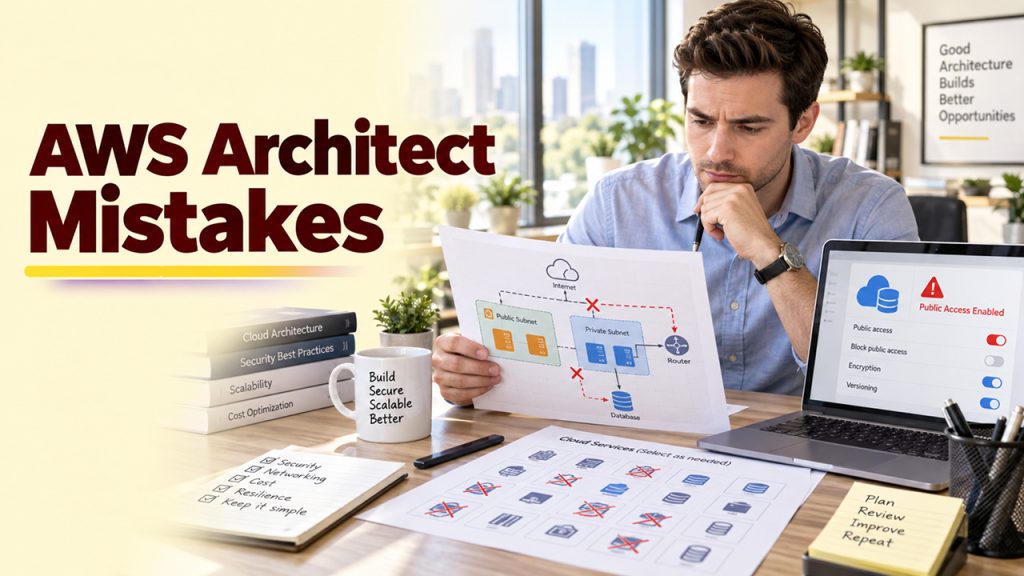
While trying to understand AWS Solutions Architect, learning about a few common mistakes can help users develop better cloud architecture habits.
Some of the key mistakes to avoid are as follows:
- Trying to Learn Every AWS Service: AWS has a huge number of services. A better approach is to understand all the major categories.
- Focusing only on Certification: Just collecting certificates for your resume does not ensure the skills required for being a solution architect.
- Ignoring Networking Fundamentals: Beginners sometimes jump directly into AWS services without understanding concepts such as IP addresses, subnets, routing, DNS, ports, and firewalls.
- Neglecting Security: Security should be considered from the beginning of an architecture project and not added after everything else is built. Beginners should also understand how cloud misconfiguration can create security risks, particularly when permissions, authentication, storage, or network controls are configured.
Conclusion
Becoming an AWS Solutions Architect is not just about memorizing every AWS service, but it is more about learning how to design secure, scalable, reliable, and cost-effective cloud solutions. Becoming an AWS Solutions Architect is mainly about learning how to design systems that solve real business and technical problems. By building a strong foundation in cloud computing, networking, security, storage, and core AWS services, beginners can gradually develop practical architecture skills.
Frequently Asked Questions
Is AWS Solutions Architect suitable for beginners?
Yes, AWS Solutions Architect is suitable for beginners. Beginners can pursue AWS Solutions Architect by first learning cloud computing fundamentals, networking, security, databases, and core AWS services.
Do I need coding skills to become an AWS Solutions Architect?
Yes, Coking skill is required to become an AWS Solutions Architect. However, extensive programming skills are not always required, but basic knowledge of scripting and programming can be valuable.
What is the AWS Well-Architected Framework?
The AWS Well-Architected Framework provides principles for designing and evaluating cloud workloads.
How can I gain practical AWS Solutions Architect experience?
Users can gain practical AWS Solutions Architect experience by creating hands-on projects using AWS services.