

10 Best B2B Prospecting Tools to Fill Your Sales Pipeline
Discover the best B2B prospecting tools to find qualified leads, streamline outreach, and accelerate sales growth with smarter prospecting strategies
Selecting the best B2B prospecting tool can turn out to be overwhelming when more than dozens of platforms claim to solve the similar issue: finding precise contact data and converting it into pipeline. Some tools excel in streamlining huge contact databases; others are purpose-built for outreach automation, and a few try to do everything from a centralized dashboard. Instead of testing every option available in the market, in this listicle, let us see the top market-leading B2B prospecting tools categorized by what each one does effectively. Thus, sales teams can shortlist quickly and avoid payment for features they wouldn’t ever need to use.
What Is a B2B Prospecting Tool?
A B2B prospecting tool is a software offered for marketing and sales teams to find, validate, and engage potential business buyers. Instead of searching LinkedIn profiles or company profiles manually, a B2B prospecting tool reveals verified phone numbers, emails, job titles, and firmographic data, often combined with CRM synchronization or Outreach Automation. The best platform minimizes the overall number of hours representatives spend on research so they can concentrate on conversations that push deals forward.
10 Best B2B Prospecting Tools
1. LinkedIn Sales Navigator:
Category: Relationship Intelligence and Social Selling
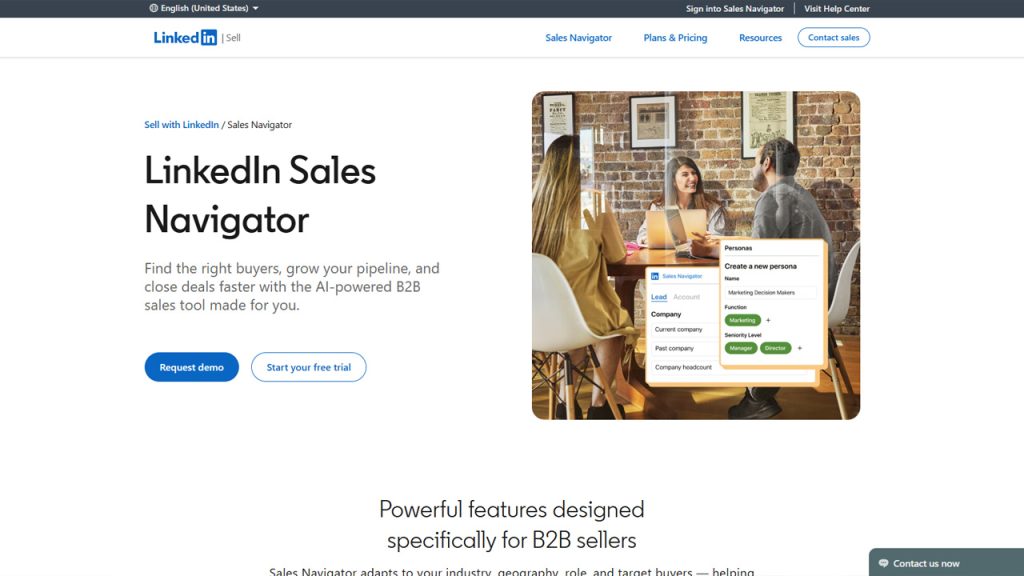
Sales Navigator ensures representatives have sophisticated search filters across the professional network of LinkedIn, making it simpler to find decision-makers by seniority, title, and location. Since it exists inside a platform most buyers use already daily, outreach via sales navigator often tends to be less intrusive than a cold email from an unfamiliar sender. Representatives can monitor account activity, save lead lists, and see mutual connections before connecting, which aids in emphasizing more qualified paths to an account. It specifically works as a companion tool to a wider B2B prospecting tool, since it does not include verified email or phone data on its own.
- Saved account and lead lists for the entire team.
- Real-time notifications on company updates and job changes.
- InMail messaging for the direct outreach outside the present network of the representative.
Best for: Teams that depend on relationship-based warm introductions and selling instead of cold email volume.
2. Apollo.io:
Category: Outreach and All-in-one Data
Apollo integrates a broad B2B contact database with an in-built email sequencing and a dialer, so teams can look for and contact prospects with a separate tool for outreach. The platform is generally positioned as a budget-friendly option to enterprise data providers, with flexible pricing that grows with your team’s growth. A Chrome extension enables representative to extract contact details right from the company website or LinkedIn while they are browsing already, which eliminates tab-switching during list building. For teams assessing their first B2B prospecting tool, Apollo is often the first solutions they consider since it combines numerous individual functions into a single subscription.
- Filtering by persona, job title, size of the company, and dozens of other criteria.
- A Chrome extension for directly extracting contact from company sites or LinkedIn.
- Buyer intent signals to highlight high-fit accounts.
Best for: Evolving sales teams that want engagement and data on a one and moderately priced platform.
3. Pipedrive with LeadBooster:
Category: Sales Prospecting and All-in-one CRM
Pipedrive refers to a sales CRM with an add-on known as leadBooster that combines live chat, prospecting, and web forms directly on top of the pipeline. Instead of exporting leads from one solution and importing them into another, representatives can push a prospect from initial contact without ever leaving their CRM screen. The closer loop between pipeline management and prospecting is generally the deciding factor for smaller teams that do not want to handle multiple logins and data synchronization. Since LeadBooster is mostly used as an add-on instead of a separate product, it also ensures that reporting is consistent across the whole process of sales.
- An in-built prospecting database for searching for new contacts.
- Automated follow-up reminders associated with deal stages.
- Can combine with the overall Pipedrive CRM.
Best for: SMBs that focus on pipeline management and prospecting in a single subscription instead of combining individual tools together.
4. Hunter.io:
Category: Finding email and verification
Hunter.io excels in looking for and validating email addresses associated with a particular company domain, helping in minimizing bounce rates before a campaign is launched. It does not aim to be an end-to-end platform. Instead, it specializes in solving one of the common headaches in prospecting: working with an outdated list or guessing email formats. The verification step verifies deliverability before a message is sent, which secures the domain reputation of the sender over time. A lot of teams combine Hunter.io with a different sequencing tool, purely using it as the data layer of their B2B prospecting tools stack.
- Domain search likely reveals email patterns at a target company.
- Email verification to secure the reputation of the sender.
- A browser extension for fast lookups while browsing.
Best for: Teams that have an outreach tool already and mainly require verified and accurate contact data.
5. ZoomInfo:
Category: Intent and Enterprise Data
ZoomInfo manages one of the biggest B2B contact and company databases in the market, combined with intent signals to show which accounts are researching a solution actively. The platform is specially built for enterprise sales organizations in mind, providing in-depth organization charts, buying committee mapping, and integration support across most of the sales engagement and CRM tools. Overall data depth turns out to be more expensive than most of the tools on the list, which generally puts it beyond reach for smaller teams. For teams with bigger revenue, though, the right combination of intent tracking and content accuracy can greatly reduce the prospecting research phase.
- In-depth contact records with different data points per lead.
- AI-powered tools for prospect identification.
- Extensive integration support across major customer relationship management and sales engagement solutions.
Best for: Bigger sales businesses with the budget for complete data and account-based intent tracking.
6. Clevenio:
Category: Nordic Data and Multichannel Outbound
Most prospecting tools are built around North American data, which works until a team’s territory sits somewhere the major databases barely reach. Clevenio takes the opposite approach, building around a Finnish and Nordic company database as its core, then connecting that data directly to multichannel outreach so list building and execution happen in the same workspace. Representatives define their ideal audience, pull matching accounts, and move straight into sequenced outreach without exporting to a separate tool. The company claims +90 coverage across its Nordic segments—well above the 20–30% a single traditional database typically returns in small fringe markets—which makes it a strong shortlist candidate for teams that need outbound to actually work in the region.
Target Group Builder that assembles Nordic and Finnish account lists automatically.
Multichannel sequences with automated follow-ups across channels.
Segmentation, pipeline management, and real-time reporting in one platform.
Best for: Outbound teams selling into Finland or the wider Nordic market that want deep regional data and multichannel execution combined rather than stitched together from separate tools.
6. Cognism:
Category: European and Mobile-Verified data
Cognism is specialized for compliant data collection and verified mobile numbers, which makes it a prevalent choice for teams venturing into European markets. Different from platforms that create email-format guesses, Cognism focuses on phone-verified accuracy, excelling in enhancing connect rates for representatives who depend greatly on cold calling. Its processes of data collection are also created by considering all GDPR requirements from the basics itself, instead of treating compliance as an afterthought. For organizations expanding sales efforts into the United Kingdom or European nations, this regulatory-based approach to data can minimize legal risk that other prospecting tools may not directly address.
- Verified phone numbers for better connect rates.
- Data collection centered around GDPR compliance.
- Intent data to aid in prioritizing accounts.
Best for: Teams venturing into the EU or UK markets where privacy regulations are non-negotiable.
7. Clay:
Category: Data orchestration and custom workflows
Clay enables teams to extract information from diverse sources at once and set up custom enrichment workflows without writing any code, which appeals to teams involved in technical revenue operations. Instead of relying on a single proprietary data on a single licensed database, Clay operates more like a control layer that integrates distinct sources, which is easy for any provider to miss. The overall flexibility comes with a steep learning curve than the majority of the plug-and-play solutions. Thus, it often aids teams with a dedicated RevOps function instead of individual representatives working alone. Since the users can customize the workflows of the CRM completely, Clay can be configured to closely fit into the precise definition of the ideal customer profile of the company.
- Waterfalls enrichment across diverse external sources of data.
- A no-code builder of workflows for personalized prospecting logic.
- API accessibility offered for teams that need detailed customization.
Best for: RevOps teams have the time and technical resources to create a customized prospecting stack.
8. HubSpot Sales Hub
Category: CRM-native prospecting
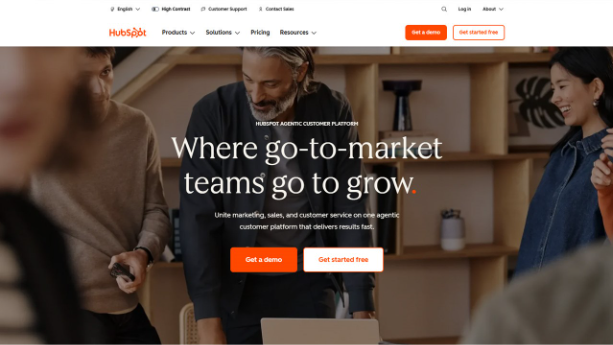
HubSpot Sales Hub creates prospecting features included within its CRM, so account discovery and outreach suggestions take place inside the same system that representatives use deal tracking and pipeline. This eliminates a friction layer that comes with juggling through a separate tool for prospecting and customer relationship management. Since there is no data to manually synchronize or export between platforms. HubSpot does not maintain its own large contact database as some competitors do. Thus, its prospecting strength comes from AI-driven suggestions as per the available CRM data rather than the raw list volume. Teams that are already invested in the broader HubSpot environment, including service and marketing tools, tend to get the best value from this method.
- Free CRM plans with standard tools for prospecting.
- AI-powered suggestions for engagement.
- Native integration across the service and marketing tools of HubSpot.
Best for: Teams already utilizing HubSpot who need centralized marketing, prospecting, and service data without including another tool in the tech stack.
9. UpLead:
Category: Verified prospecting focused on emails
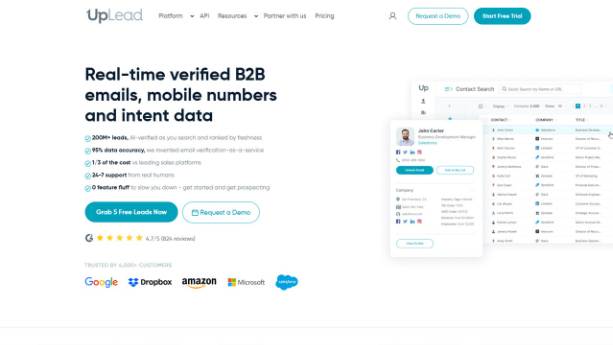
UpLead focuses on email verification in real-time at the point of export, focusing on minimizing the wasted credits that come from outdated contact details. Instead of periodically verifying data or verifying it in bulk, the platform checks the validity of the email before it is downloaded, which is done to reduce the bounce rates that impact the reputation of the sender over time. It also provides technographic filtering on plans in higher-tier, enabling teams to narrow prospects by the specific software stack of the company. The policy of credit-refund for invalid emails is one of the more specialized features among the mid-market options of B2B prospecting tools, providing buyers with some in-built protection against poor data.
- Verification is run before downloading the contact.
- Technographic filtering is based on plans for the higher tier.
- Credit is refunded when an email turns out to be invalid later on.
Best for: Teams focused on emails that need guarantees of accuracy without enterprise-level pricing.
10. Lusha:
Category: Fast lookups for individual representatives
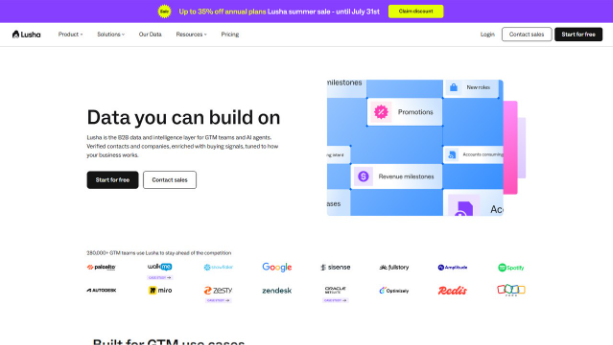
Lusha is created around a Chrome extension that enables individual sales representatives to extract company and contact data right from the LinkedIn profile without ever leaving the page. Its strength is mostly speed rather than breadth. It is built for a representative who finds a promising prospect during browsing and requires an email or contact number on the spot, not for teams operating coordinated or large campaigns. Data collection is ensured with GDPR compliance in mind, and pricing varies from individual seats up to team plans as usage evolves. For solo sellers or very small teams, Lush generally works as a compact alternative to the more expensive and bigger platforms on the list.
- On-page and fast lookups while going through LinkedIn.
- Collection of data compliant to GDPR.
- Structured pricing varies from individual to the team use.
Best for: Small teams or individual representatives who require quick contact lookups instead of a complete prospecting workflow.
Quick Comparison
Related walkthrough
GuestPostMailer Dashboard Overview | AI-Powered Guest Posting u0026 CRM Automation Tool

| Tool | Best For | Standout Feature |
| LinkedIn Sales Navigator | Relationship-based selling | Advanced network search filter |
| Apollo.io | Combined data + outreach | Built-in sequencing and dialer |
| Pipedrive + LeadBooster | CRM-native prospecting | Prospecting layered on the pipeline |
| Hunter.io | Email verification | Domain-based email finder |
| ZoomInfo | Enterprise data depth | Large contact database with intent |
| Clevenio | Nordic outbound execution | Finnish/Nordic database with multichannel outreach |
| Cognism | European markets | Verified mobile numbers |
| Clay | Custom workflows | No-code data orchestration |
| HubSpot Sales Hub | HubSpot environment | Native CRM integration |
| UpLead | Email accuracy | Verification with credit refunds |
| Lusha | Fast individual lookups | Chrome extension for LinkedIn |
How to Select the Best B2B Prospecting Tool?
- Align the Tool to Your Buyer Profile: A B2B prospecting tools with robust European Union coverage will not help much if your market is completely just North America, and vice versa.
- Decide If You Require Outreach, Data, or Both: A few platforms only provide contact details. Others combine calling and sequencing.
- First Check CRM Compatibility: A tool that bi-directionally synchronizes with your available platform, similar to the workflows explained in how CRM meeting tools improve sales data accuracy and prevents representatives from entering the data the again manually.
- Test Quality of Data Before Annually Committing: Vendor claims that the database size does not always stand up against your particular target list, so a trial run is worth taking that extra step.
- Factor in Overall Cost, Not Just the Licensing Charges: Cost-effective tools of data sometimes need an extra enrichment service or separate sequencing platform data tools to complete the gaps.
Teams operating custom pipelines can explore CRM development options to check how prospecting data gets fed into a personalized setup.
Conclusion
There is no single effective B2B prospecting tools for each sales team. The right choice relies on the budget, database coverage, and how closely it needs to link with an available CRM. Teams that need a centralized setup may lean toward Pipedrive or Apollo.io with a technical RevOps function might need more value from custom workflows of Clay. Whichever direction is a best option, performing a testing of a B2B prospecting tool against your own target list before signing an annual contract is one of the most effective ways to confirm that the data quality holds up in practice.