

What to Look for in an Enterprise Email Builder
Discover 4 must-have Email Builder features for enterprise teams. Learn how to choose a scalable, secure, and personalized email marketing solution.
For large organizations, email remains one of the highest-return channels. But, when it comes to running campaigns at a large enterprise scale, it is not just like sending a newsletter from a small business account. When hundreds of stakeholders, dozens of brand teams, and thousands of customer segments are involved, the tool behind the email generation matters as much as the message itself.
This is where an enterprise email builder comes in. This is an innovative and purpose-built platform that is specifically designed to handle complexity, compliance, and volume by making the work easy for the team.
However, before you invest in it, knowing how it can be optimally used to generate the highest business value is quintessential. So, let’s learn more about what you should consider to evaluate an email builder for your enterprise in this blog.
Why Enterprise Businesses Need a Specialized Email Builder
Related walkthrough
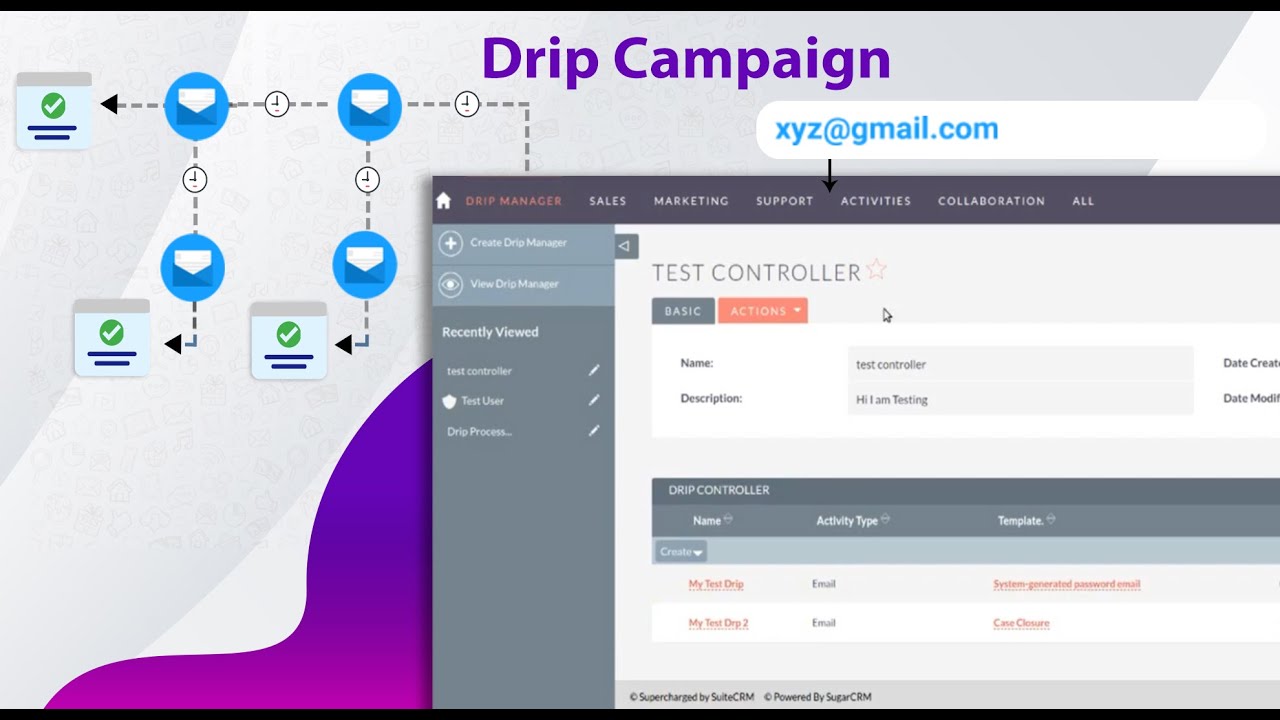
How to Run Email Drip Campaigns in SuiteCRM for Schedule and Segmented Marketing

Standard email tools are built to ensure simplicity in the team’s work. They struggle once a business needs multiple approval layers, brand governance across multiple regions, or integration with a broader stack. An enterprise email marketing platform solves this by centralizing design, testing, and deployment all in one place while still giving individual teams greater flexibility to move fast.
Enterprise teams also juggle far more variables than smaller businesses, including multiple product lines, international audiences, and strict data privacy requirements. A generic builder was never designed to absorb that kind of load, which is why dedicated email campaign management capabilities have become a baseline requirement rather than a nice-to-have.
Not every email tool can keep up once an organization grows past a certain size. For teams evaluating their options, the Stripo email builder is an excellent option to look at more closely. It combines a drag-and-drop editor with reusable content modules, AMP support, and solid integration options. Thus, it ensures personalization, templates, and excellent scalability that meet all the necessary features enterprise teams are looking for.
Additionally, here are the core features to check before you commit to any other tool.
1. Advanced Personalization Capabilities
Modern buyers expect personalization and relevance, not just their first name in an email subject line. Look for the best and most robust email personalization tools that support dynamic content blocks and behavioral triggers, while ensuring real-time data merges.
The best platforms let marketers personalize according to their purchase history, browsing behavior, or lifecycle stage. CRM and email marketing integration further enhances this process by syncing customer data automatically, helping teams deliver more relevant and timely campaigns.
2. Scalability for Enterprise Growth
A tool that works for ten thousand subscribers must also work when that number rises to ten million. Scalability is more than just sending volume. It is about maintaining deliverability, load speed, and rendering consistency across every inbox provider as your list grows.
Professional email templates also play an important role here. It is easy to access pre-built and responsive layouts directly through Outlook, Gmail, and mobile clients. This way, design teams can save time by not having to rebuild everything from scratch for every campaign.
3. Integration and Compatibility
You can also integrate enterprise builder with your CRM, latest data analytics tools, and marketing automation. If your organization already relies on a system like CRM development to manage customer data, your email platform should synchronize with it smoothly. Strong CRM customer feedback strategies can further improve segmentation and help personalize campaigns using real customer insights.
4. Cost Consideration
Enterprise pricing models vary widely. Some charge per contact, others per send volume, and some ensure the cost through premium support. Ensure the true cost against the time it saves your team, since a platform that cuts production time in half often pays for itself even at a higher price point.
Conclusion
Choosing the right and correct enterprise email builder is undoubtedly a strategic choice that affects deliverability, brand consistency, and marketing efficiency on a larger scale. When you prioritize personalization depth and integration flexibility, you can ensure success for your business.
If your team handles compliance-heavy messaging alongside email, it is worth reviewing how your A2P verification processes fit into your broader communication stack, because in enterprise marketing, every channel needs to work together.
Author’s Bio: I’m Harsh—Founder of SaaSit.in dedicated to helping SaaS and tech companies drive organic growth through strategic link building and data-driven outreach.
Email ID: harsh@saasit.in