
10 Lead Generation Services Gaming and Technology Companies Should Consider
Explore the best lead generation services for gaming and technology businesses, from SEO and LinkedIn outreach to ABM, email marketing, and partnerships.
Building a great product is only half the battle in the gaming and technology industries. A studio may have an innovative development tool, an esports company may offer a powerful engagement platform, or a software provider may have a solution that could save publishers hundreds of hours. None of that matters, however, if the right buyers never discover it.
That is where structured lead generation services can make a measurable difference.
For business-to-business companies, lead generation is the process of identifying potential customers, earning their attention, qualifying their needs, and moving them toward a sales conversation. It connects marketing activity with actual revenue opportunities.
The challenge is that no single approach works for every organization. A game localization agency selling to global publishers requires a different strategy than a consumer game studio promoting a new release. Likewise, a server-hosting provider targeting technical directors needs a different process than an esports platform seeking brand partnerships.
This guide explores ten practical lead generation solutions for gaming and technology companies. Each option supports a different objective, from generating immediate sales meetings to building long-term organic demand.
What Is B2B Lead Generation?
B2B lead generation is the process of attracting and identifying organizations that may benefit from a company’s products or services.
Unlike consumer marketing, B2B lead generation usually involves:
- Longer buying cycles
- Multiple stakeholders
- Higher contract values
- More detailed evaluation processes
- Greater emphasis on trust and expertise
A gaming technology vendor, for example, may need to reach a technical director, procurement manager, studio head, and finance leader before a purchase can move forward.
An effective program does more than collect email addresses. It identifies appropriate accounts, starts relevant conversations, evaluates buying potential, and creates a clear path to the sales team.
Choosing the Right Approach at a Glance
| Lead Generation Solution | Best For | Typical Time to Impact |
| Outsourced sales development | Generating qualified meetings | Short to medium term |
| SEO and content marketing | Building sustainable inbound demand | Medium to long term |
| Paid search advertising | Capturing active buyer intent | Short term |
| LinkedIn outreach | Reaching specific decision-makers | Short to medium term |
| Email nurturing | Developing early-stage prospects | Medium term |
| Account-based marketing | Winning high-value strategic accounts | Medium to long term |
| Data enrichment | Improving targeting and qualification | Immediate operational impact |
| Conversational marketing | Converting website visitors | Short term |
| Events and webinars | Building authority and relationships | Medium term |
| Partnerships and referrals | Accessing trusted audiences | Medium to long term |
The right mix depends on the company’s market, deal size, resources, brand recognition, and sales capacity.
1. Outsourced Sales Development and Appointment Setting

Outsourced sales development gives a company access to prospecting specialists without requiring it to recruit, train, equip, and manage an internal sales development team.
A managed sales development program may include:
- Target-account research
- Contact discovery
- Prospect list building
- Cold email outreach
- LinkedIn prospecting
- Phone outreach
- Lead qualification
- CRM updates
- Appointment scheduling
- Campaign reporting
This model is particularly valuable for gaming and technology companies with strong solutions but limited outbound capacity.
Consider a small analytics provider that helps mobile game studios understand player behavior. Its founders may know the market exceptionally well, but spending several hours every day building lists and sending follow-ups prevents them from improving the product or handling sales calls.
Using specialized lead generation services can give that company a structured way to research suitable studios, engage relevant decision-makers, qualify genuine interest, and schedule productive conversations for its sales team.
When outsourced sales development works best
This approach is a strong fit when a company:
- Has a clearly defined B2B offering
- Knows which industries or accounts it wants to reach
- Has sufficient sales capacity to handle new meetings
- Wants to test a market before hiring internally
- Needs more consistent prospecting activity
- Is entering a new geographic or industry segment
What to evaluate
Do not measure an outsourced program only by the number of emails sent or calls completed. Activity matters, but business outcomes matter more.
Track:
- Positive response rate
- Qualified conversation rate
- Meetings accepted
- Meetings attended
- Sales opportunities created
- Pipeline value
- Revenue generated
- Cost per qualified opportunity
A high meeting count can look impressive while producing little value if the prospects are poorly matched. The better goal is a steady flow of conversations with accounts that fit the company’s ideal customer profile.
2. SEO and Expert-Led Content Marketing
Search engine optimization, combined with effective Digital Marketing Strategies, helps a company appear when buyers actively research a problem, solution, or provider.
For gaming and technology businesses, useful search-driven content may include:
- Technical implementation guides
- Product comparison articles
- Industry benchmark reports
- Integration tutorials
- Security and compliance resources
- Case studies
- Cost and pricing guides
- Platform migration checklists
- Buyer’s guides
- Original research
A cloud infrastructure provider might publish a guide to reducing latency in multiplayer games. A quality-assurance company could create a checklist for preparing a title for international release. A monetization platform might explain how to evaluate advertising models without damaging player experience.
Each resource attracts readers with a specific concern and introduces the company as a credible source of expertise.
Why expert content matters
Generic articles rarely create strong buying intent. Valuable content usually comes from people who understand the industry’s actual challenges.
The most effective pieces answer questions such as:
- What does the buyer need to accomplish?
- What usually goes wrong?
- What should the buyer evaluate?
- What trade-offs should be considered?
- What does successful implementation require?
- How can the buyer compare available options?
Content should help readers make a better decision even when they are not ready to contact a sales representative.
Practical content framework
A useful B2B article can follow this structure:
- Define the buyer’s problem.
- Explain why the issue matters.
- Identify the available approaches.
- Compare their strengths and limitations.
- Provide an evaluation framework.
- Show a realistic example.
- Recommend an appropriate next step.
This format performs well because it satisfies readers who want education while naturally creating opportunities for conversion.
3. Paid Search Advertising
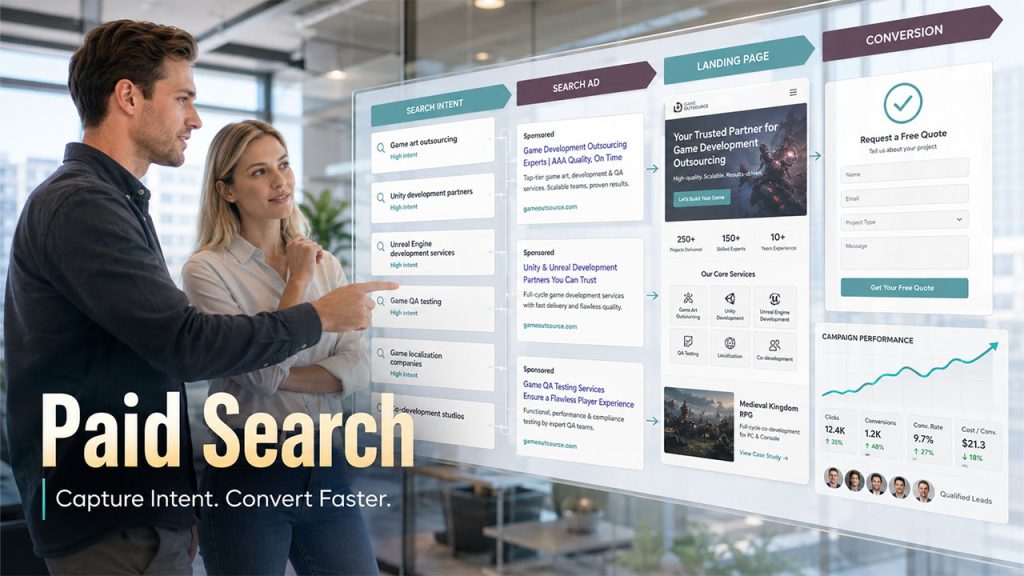
Paid search places a company in front of prospects who are already searching for a relevant product or service.
A game development outsourcing company, for instance, might target searches related to:
- Game art outsourcing
- Unity development partners
- Unreal Engine development services
- Video game quality-assurance testing
- Game localization companies
- Co-development studios
Because searchers are actively expressing interest, paid search can produce results more quickly than many organic channels.
However, traffic alone does not guarantee qualified leads. Success depends on the relationship between the search term, advertisement, landing page, and offer.
Build campaigns around buyer intent
Search keywords generally fall into several categories:
Informational searches indicate that the user wants to learn.
Example: “How does game localization work?”
Commercial searches indicate that the user is comparing approaches or providers.
Example: “Best game localization companies”
Transactional searches suggest that the user may be ready to contact or hire someone.
Example: “Game localization services quote”
Campaigns designed to generate sales inquiries should usually prioritize commercial and transactional intent.
Improve landing-page relevance
Do not send every visitor to the homepage. Create focused landing pages that match the exact problem behind the search.
A strong landing page should clearly communicate:
- Who the service is for
- What problem it solves
- What is included
- Why the provider is credible
- What result the buyer can expect
- What action the visitor should take
The closer the page matches the searcher’s need, the more likely the visitor is to convert.
4. LinkedIn Outreach and Social Selling
LinkedIn is especially useful for reaching business decision-makers by role, company, industry, and professional interest.
Gaming companies can use it to connect with:
- Studio founders
- Publishing executives
- Technical directors
- Product managers
- Marketing leaders
- Esports partnership managers
- Licensing professionals
- Procurement teams
- Investors
- Platform representatives
Effective LinkedIn prospecting does not begin with an immediate sales pitch. It begins with relevance.
A better outreach sequence
A practical sequence might look like this:
- Identify a well-matched account.
- Research the contact’s role and current priorities.
- Engage with relevant posts or company news.
- Send a personalized connection request.
- Share a useful observation or resource.
- Introduce the business problem you solve.
- Suggest a conversation only when there is a credible reason.
For example, a testing company might contact a studio preparing for a multiplatform release. The outreach could reference the upcoming launch, discuss common certification challenges, and offer a useful pre-release checklist.
That feels more relevant than a generic message claiming to offer “industry-leading solutions.”
Avoid excessive automation
Automation can support research, reminders, and sequencing, but poorly controlled automation quickly becomes spam.
Messages should still reflect:
- The prospect’s role
- The company’s business model
- A recent trigger or relevant initiative
- A specific operational challenge
- A clear reason for making contact
Personalization does not mean inserting a first name into a template. It means demonstrating that the message was intended for that particular person.
5. Email Nurturing and Marketing Automation
Not every prospect is ready to speak with a salesperson immediately.
Some buyers are:
- Researching possible solutions
- Waiting for budget approval
- Planning a future project
- Comparing internal and external options
- Gathering support from other stakeholders
- Evaluating several vendors
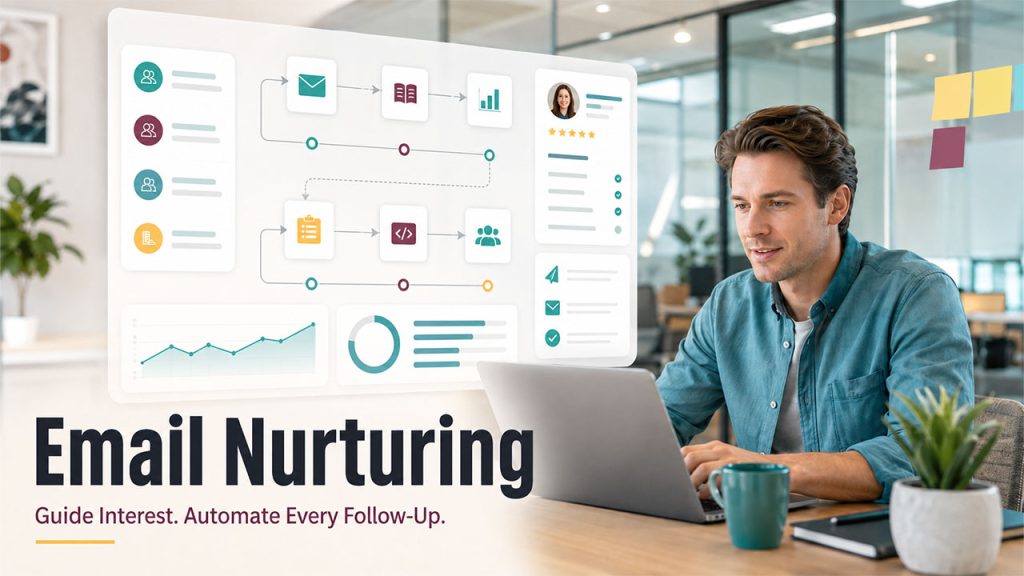
Email nurturing, supported by Marketing Automation, keeps the company useful and visible while the buyer moves through that process.
Build nurture campaigns around buyer needs
A simple sequence for a gaming technology provider might include:
- An educational guide addressing the prospect’s main challenge
- A case study showing how another organization approached it
- A comparison checklist
- A short technical resource
- An invitation to a webinar or consultation
Each message should advance the buyer’s understanding rather than repeating the same sales pitch.
Segment the audience
A publisher, independent studio, esports organization, and technology vendor may all have different priorities. Sending the same content to everyone reduces relevance.
Useful segmentation criteria include:
- Company type
- Employee count
- Product category
- Geographic market
- Technology stack
- Buyer role
- Engagement history
- Stage in the buying process
Segmentation allows marketers to send fewer messages while making each one more useful.
6. Account-Based Marketing
Related walkthrough
SuiteCRM LiveChat Integration for automatic lead Generation u0026 Data Sync via Email to lead

Account-based marketing focuses sales and marketing resources on a defined group of high-value organizations.
Instead of attempting to reach thousands of loosely qualified prospects, the company selects a smaller number of accounts and develops coordinated campaigns around them.
This approach is especially useful when:
- Contract values are high
- The target market is narrow
- Multiple stakeholders influence the purchase
- The solution requires customization
- The company already knows which accounts it wants to win
A middleware provider, for example, may identify 50 publishers that fit its technical requirements and growth profile. Its campaign could combine personalized content, executive outreach, targeted advertising, email engagement, and industry-event meetings.
Use account tiers
Not every target account deserves the same investment.
A practical model is:
Tier 1: Strategic accounts
These receive highly customized research, messaging, content, and executive involvement.
Tier 2: Priority accounts
These receive industry-specific campaigns with moderate personalization.
Tier 3: Scalable accounts
These receive broader segment-based campaigns supported by automation.
This prevents the team from spending extensive resources on every prospect while still giving important accounts appropriate attention.
Coordinate sales and marketing
Account-based programs fail when marketing creates engagement but sales does not follow up—or when sales contacts accounts without understanding previous marketing activity.
Both teams should agree on:
- Account selection
- Stakeholder roles
- Messaging
- Qualification criteria
- Follow-up responsibilities
- Engagement thresholds
- Reporting
In this model, the account—not the individual contact—becomes the primary unit of measurement.
7. Prospect Data, List Building, and Enrichment
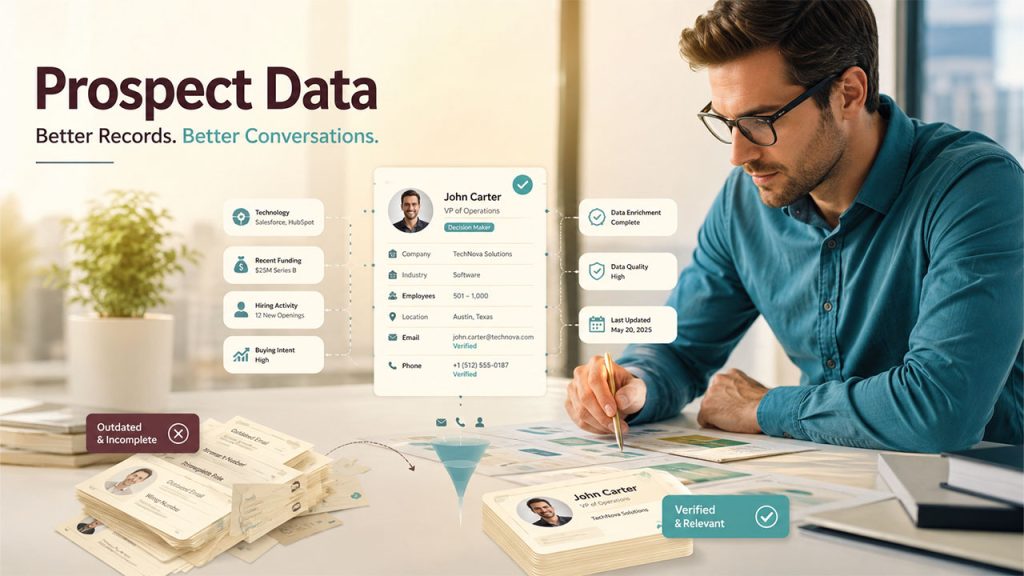
Every outbound campaign depends on data quality.
Poor data causes:
- Bounced emails
- Calls to outdated numbers
- Messages sent to irrelevant roles
- Duplicate CRM records
- Incorrect personalization
- Wasted sales time
- Misleading reports
List building is therefore not a basic administrative task. It is a strategic part of lead generation.
What good prospect data includes
A useful account record may contain:
- Company name
- Website
- Location
- Industry
- Employee count
- Revenue range
- Products or services
- Technology used
- Recent funding
- Hiring activity
- Relevant business events
A useful contact record may contain:
- Full name
- Job title
- Department
- Seniority
- Verified work email
- Professional profile
- Location
- Role in the buying process
Prioritize accuracy over volume
A list of 500 carefully selected accounts is often more valuable than a database of 50,000 companies that loosely match the market.
Define an ideal customer profile before purchasing or building lists. It should specify:
- The industries the company serves best
- Appropriate organization size
- Relevant business models
- Required technology or operational conditions
- Common pain points
- Strong buying signals
- Clear exclusion criteria
The exclusion criteria are important. Knowing who is unlikely to buy prevents the team from wasting time on attractive but unsuitable prospects.
8. Conversational Marketing and Website Chat
Many websites lose potential buyers because visitors cannot quickly find the information they need.
Conversational marketing uses tools such as:
- Live chat
- Automated chat assistants
- Interactive qualification flows
- Meeting schedulers
- Contextual website messages
- Help-center integrations
These tools allow visitors to ask questions, identify relevant resources, and take the next step without searching through several pages.
Use chat to guide, not obstruct
An aggressive pop-up appearing immediately on every page can frustrate visitors. Chat should become available when it is genuinely useful.
Helpful triggers may include:
- A visitor reaching a pricing page
- Multiple visits to a product page
- A return visit from a target account
- Extended time on a comparison article
- Interaction with implementation content
- A visit to a contact page without conversion
Ask qualifying questions carefully
A conversational flow might ask:
- What type of organization are you with?
- What are you trying to accomplish?
- What platform or technology do you currently use?
- When are you planning to make a change?
- Would you like to speak with a specialist?
Keep the experience brief. The goal is to make the visitor’s journey easier, not to force someone through a lengthy digital interrogation.
9. Webinars, Conferences, and Industry Events

Gaming remains a relationship-driven industry. Conferences, online panels, developer events, and technical webinars give companies an opportunity to demonstrate expertise while interacting directly with potential buyers.
Useful event formats include:
- Product demonstrations
- Technical workshops
- Executive roundtables
- Developer panels
- Research presentations
- Partner showcases
- Customer case-study sessions
- Private networking events
A webinar titled “How Studios Can Prepare Multiplayer Infrastructure for a Global Launch” is more valuable than a session built entirely around a company’s product features.
The event should solve a real problem first. Product relevance can emerge naturally from the discussion.
Build a complete event campaign
The event itself is only one part of the process.
A complete campaign includes:
Before the event
- Targeted invitations
- Partner promotion
- Speaker content
- Social posts
- Registration-page optimization
During the event
- Audience questions
- Polls
- Resource sharing
- Clear follow-up options
- Engagement tracking
After the event
- Recording distribution
- Key-point summaries
- Relevant resources
- Personalized follow-up
- Sales qualification
- Future nurture campaigns
A registration is not automatically a sales-ready lead. Follow-up should reflect what the person attended, asked, downloaded, or expressed interest in.
10. Partnerships, Communities, and Referral Programs
A trusted recommendation can open doors that cold outreach cannot.
Gaming and technology companies can develop referral relationships with:
- Development agencies
- Cloud providers
- Consultants
- Industry associations
- Software vendors
- Publishers
- Investment firms
- Professional communities
- Event organizers
- Complementary service providers
For example, a game localization company might partner with a quality-assurance provider. The two companies serve similar customers but solve different problems, creating natural opportunities for referrals and joint educational content.
Choose partners based on audience alignment
A large partner is not always the best partner. A smaller organization with strong relationships in the right niche may create more valuable opportunities.
Evaluate potential partners according to:
- Audience overlap
- Reputation
- Service compatibility
- Geographic reach
- Customer trust
- Operational reliability
- Ability to create mutual value
Make referrals easy
Partners are more likely to introduce opportunities when they clearly understand:
- Who the company serves
- What problems it solves
- What qualifies as a good introduction
- What information should be provided
- How the introduction will be handled
- What the partner receives in return
A one-page referral guide can often produce better results than a complicated partner portal nobody uses.
How to Choose the Right Lead Generation Partner

Businesses comparing lead generation services should look beyond the lowest price or the largest promised meeting volume. The right provider should understand the company’s target market, sales process, offer, and definition of a qualified opportunity.
Use the following evaluation framework.
1. Confirm market experience
Ask whether the provider has worked with companies that have similar:
- Buyers
- Deal values
- Sales cycles
- Technical complexity
- Regulatory considerations
- Geographic markets
Industry familiarity is valuable, but experience with a similar sales motion may be even more important.
2. Examine the operating process
A credible provider should be able to explain:
- How accounts are selected
- Where prospect data comes from
- How contact details are verified
- How messaging is developed
- Which channels are used
- How leads are qualified
- How meetings are handed off
- How performance is reviewed
Vague promises usually indicate a vague process.
3. Define a qualified lead
The buyer and provider should agree on qualification before the campaign starts.
Criteria may include:
- Company fit
- Role and authority
- Relevant business need
- Timing
- Current solution
- Budget conditions
- Willingness to evaluate alternatives
- Agreed next step
Without a shared definition, one side may report successful lead generation while the other sees a calendar filled with unproductive calls.
4. Review reporting and data ownership
The company should know:
- Which activities will be reported
- How often reports will be provided
- Whether CRM records will be updated
- Who owns contact data
- Who controls outreach accounts
- What happens to campaign assets when the agreement ends
Retaining access to data, conversations, and performance history protects the company from having to rebuild everything later.
5. Assess sales readiness
A marketing or sales development partner cannot compensate for every internal weakness.
Before increasing lead volume, confirm that the company has:
- A clear offer
- Defined target buyers
- Credible sales materials
- A reliable CRM process
- Available sales representatives
- Consistent follow-up
- A method for tracking opportunities
Generating more leads into a disorganized sales process usually creates more confusion rather than more revenue.
Common Lead Generation Mistakes to Avoid
Focusing on activity instead of outcomes
Large numbers of messages, impressions, downloads, or contacts may look encouraging. They do not automatically indicate pipeline growth.
Connect activity to qualified conversations, opportunities, and revenue.
Targeting an audience that is too broad
“Gaming companies” is not a usable target market by itself.
A more useful segment might be:
North American game studios with 50 to 300 employees that operate live-service titles and are hiring infrastructure engineers.
Specific targeting improves research, messaging, content, and qualification.
Sending the same message to every prospect
Different stakeholders care about different outcomes.
A technical leader may care about integration and reliability. A finance executive may care about cost and risk. A studio head may care about launch timelines and player experience.
Messages should reflect those differences.
Giving up too early
Many B2B buyers are not ready to act after the first interaction. A consistent, respectful follow-up process is essential.
Follow-up should add value through new information, useful resources, or relevant observations—not simply repeat “checking in.”
Scaling before validating
Before launching a large campaign, test:
- The target segment
- The offer
- The messaging
- The channel
- The qualification criteria
- The sales handoff
Once a repeatable pattern begins producing qualified opportunities, scale it carefully.
Building a Lead Generation System That Creates Real Pipeline
There is no universally superior lead generation channel.
Outsourced sales development can produce direct conversations. Search content can capture buyers during research. Paid advertising can reach active demand. Account-based marketing can build engagement within strategic accounts. Partnerships can create trusted introductions.
The strongest strategy usually combines several of these approaches around a clearly defined customer profile.
For many growing companies, the best lead generation services are not necessarily those that promise the highest activity volume. They are the ones that create relevant conversations, preserve data transparency, align with the sales team, and consistently generate opportunities that have a realistic chance of becoming customers.
Start by identifying who the company serves, what those buyers are trying to accomplish, and what evidence they need before taking action. Then select the channels that match their behavior and create a consistent process for research, engagement, qualification, follow-up, and measurement.
The objective is not to generate the largest possible list of contacts. It is to create a reliable system that connects the company with the right organizations, starts useful conversations, and turns genuine market interest into sustainable business growth.
About the Author
Vince Louie Daniot is an SEO strategist and digital partnerships professional specializing in B2B lead generation, content strategy, and authority-building campaigns. He helps technology and service-based companies improve search visibility, strengthen their online presence, and connect with the right audiences through practical, data-informed marketing strategies. His work focuses on turning useful content and targeted outreach into sustainable organic growth and qualified business opportunities.
Frequently Asked Questions
Q1. Which lead generation method produces results fastest?
Outbound sales development, paid search, and direct outreach can often create conversations more quickly because they proactively reach potential buyers or capture existing demand.
SEO, partnerships, and content marketing generally require more time but can create durable sources of inbound interest.
Q2. Should a gaming company outsource lead generation?
Outsourcing may make sense when the company has a proven offer but lacks the people, technology, or management capacity required to run consistent prospecting campaigns.
It is less suitable when the target audience, value proposition, or sales process has not yet been defined.
Q3. What do lead generation services normally include?
Depending on the provider, lead generation services may include account research, list building, contact verification, cold email, LinkedIn outreach, calling, appointment setting, CRM management, lead qualification, reporting, and campaign optimization.
Some providers focus only on one channel, while others manage the complete outbound sales development process.
Q4. What is the difference between lead generation and demand generation?
Lead generation focuses on identifying and converting potential buyers into contacts or sales opportunities.
Demand generation is broader. It builds awareness, interest, trust, and preference across the market, including among people who are not yet ready to provide their information.
The two approaches work best together.
Q5. How should lead quality be measured?
Lead quality should be evaluated according to fit, need, authority, timing, engagement, and likelihood of progressing into a real opportunity.
The number of leads matters less than the percentage that becomes productive sales conversations.
Q6. How many channels should a company use?
Begin with a small number of channels that match buyer behavior and internal capacity.
A focused combination of outbound outreach, expert content, and email nurturing may outperform a poorly managed campaign spread across eight different platforms.
Add channels only when the existing process can support them.