
Top Software Development Companies in California to Help You Scale Your Product
Explore top software development companies in California that help startups move from MVP to product-market fit with the right technology team.
Startups begin with smaller teams than they once did. The average US startup establishment employed 3.5 people in 2023, down from 7.3 in 1998, according to the Bureau of Labor Statistics.
Lean founding teams often rely on outside engineers, but the partner suited to an MVP may not fit the next stage. Growth requires scalable architecture, additional specialists, security reviews, and documentation that an internal team can eventually inherit.
This guide profiles six top software development companies in California that support products from MVP through enterprise scale, each with a published street address. It also covers regional payroll data, partner selection by growth stage, and warning signs that a vendor may struggle as your company expands.
Startup Size and Software Payroll in California
Payroll data shows how much engineering talent costs across different parts of California. All figures below are 2025 annual averages for private employers.
- San Mateo County: Custom computer programming firms paid an average weekly wage of $5,219, the highest figure among the counties compared here.
- Alameda and Contra Costa Counties: Alameda County firms paid an average of $3,794 per week, while neighboring Contra Costa County averaged $4,125.
- San Bernardino County: The county had 157 custom programming establishments employing 742 people. Average weekly pay was $2,296, among the lowest levels in Southern California.
- Los Angeles County: The other computer-related services sector included 303 establishments and 1,129 employees, with an average weekly wage of $2,706.
The List of The Top Software Development Companies in California
Related walkthrough
Chapter 9 | SuiteCRM Custom Code Architecture | Logic Hooks, Workflows & Upgrade-Safe Development

A scale-ready firm combines fast early delivery with the architecture, staffing, and processes needed to support a growing user base. Reviewing published work narrowed the list to six companies. The table compares how each supports the MVP and scaling stages.
| Company | MVP Offer | Scaling Support | Office City |
| Baytech Consulting | Startup services with an MVP-first approach | Onshore senior architects and dedicated teams | Irvine |
| SPAN Digital | Technical discovery and architecture reviews | Knowledge management and AI-accelerated delivery | San Francisco |
| Povio | MVP development and vibe-code completion | Dedicated teams across 38+ dev stacks | San Francisco |
| Codem | Rapid AI proofs of concept | Scalable eCommerce engineering teams | San Francisco |
| Radiansys | AI consulting and custom AI solutions | AI/ML Ops and GPU-optimized infrastructure | Fremont |
| Teksun | Product engineering from concept | Manufacturing, IoT cloud, and DevOps services | Milpitas |
Baytech Consulting
Office: 2102 Business Center Dr, Suite 130, Irvine, CA 92612
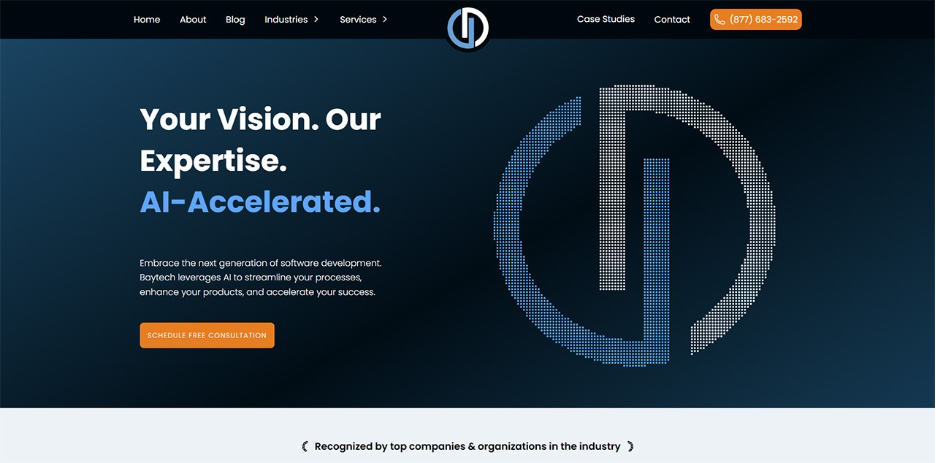
Baytech Consulting is one of the top software development companies in California for startups that need an MVP built for long-term growth. Founded in 2007, the firm develops enterprise applications with salaried, onshore engineers.
Its startup services follow an MVP-first approach, allowing clients to release a focused first version without sacrificing the architecture needed for later expansion. Senior architects remain involved throughout delivery, with no offshore handoff. The company’s founders also oversee each engagement as the product grows.
Baytech reports more than 120 completed projects for clients ranging from SMBs to Fortune 500 enterprises. Its senior team brings over 154 years of combined experience. The company keeps AI-assisted work in-house and reports results including three times faster insights and 85% process automation.
Baytech also reports operating without debt. Clients can expand the engagement through dedicated teams, modernization services, and ongoing support contracts.
From MVP: Startup services, UX design, and cloud deployment consulting
At scale: Dedicated teams, application modernization, and long-term support
SPAN Digital
Office: 333 Bryant Street, Suite 140, San Francisco, CA 94107
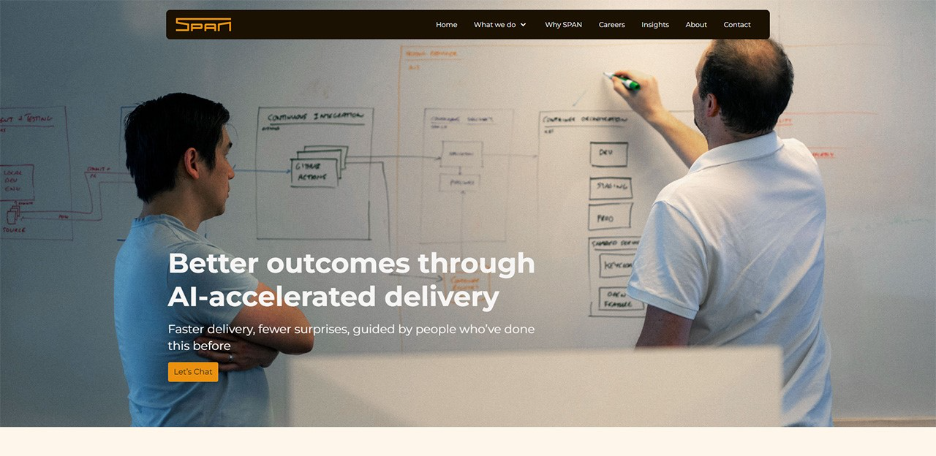
SPAN Digital is a technology consultancy focused on strategy, product design, software engineering, and knowledge management. The firm uses proprietary AI capabilities and has completed more than 500 projects over 13 years.
Engagements begin with technical discovery and architecture reviews to identify risks, constraints, and practical opportunities. The team then scopes and delivers a new product or improves an existing one through iterative feedback.
Knowledge management runs throughout the engagement. SPAN Digital documents and transfers business and technical knowledge so expertise remains available as the client’s team changes and grows.
From MVP: Technical discovery, applied AI strategy, and flexible project delivery
At scale: Data engineering, cloud SaaS products, and systematic knowledge transfer
Povio
Office: 1390 Market Street, Suite 200, San Francisco, CA 94102
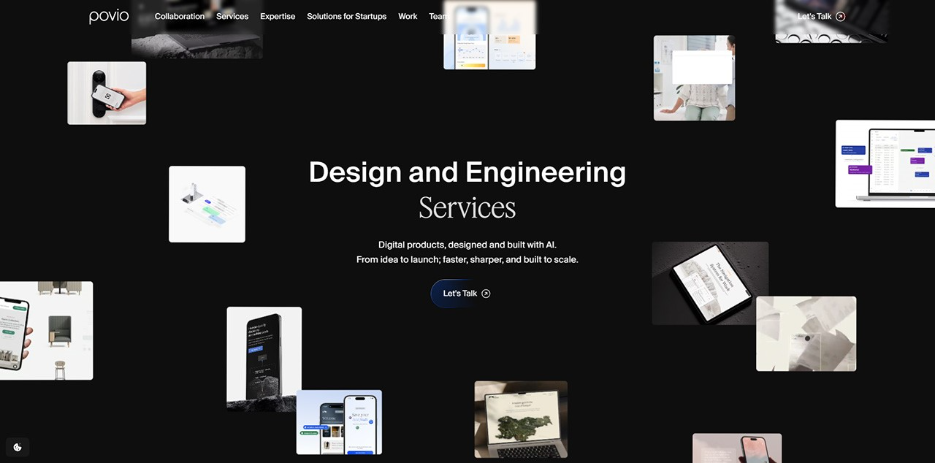
Povio has turned product ideas into released software since 2014. Its teams combine product design, engineering, quality assurance, project delivery, and AI-assisted development. Alexis Ohanian has worked with the firm since 2017, while Flexport founder Ryan Petersen has praised its delivery quality and budget control.
Specialists cover more than 38 development stacks. Clients can engage Povio through fixed-price projects, dedicated teams, or staff augmentation, allowing capacity to change as the product grows.
The company uses in-house AI coding tools to accelerate development. Venture firms also use Povio as an on-demand product and engineering partner for portfolio companies.
From MVP: MVP development, CTO as a service, and completion of AI-generated prototypes
At scale: Dedicated cross-functional teams for mature startups and growing products
Codem
Office: 347 Green Street #6, San Francisco, CA 94133
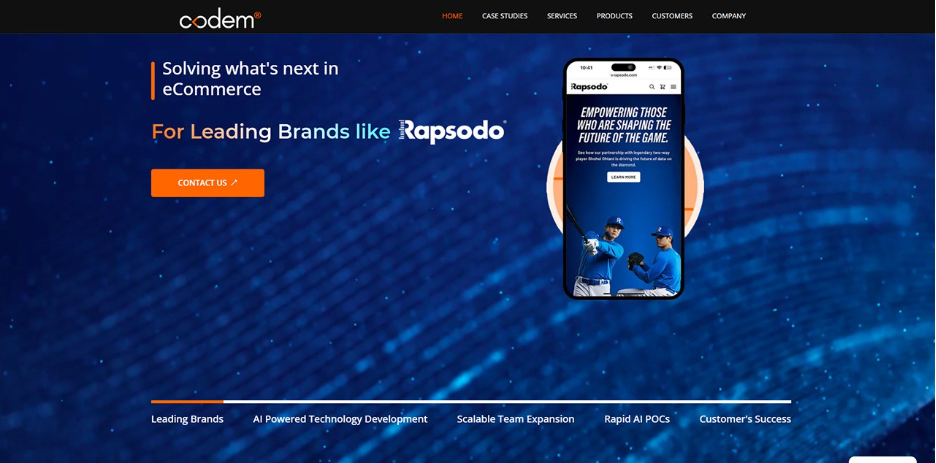
Codem was founded in San Francisco in 2017 as a global e-commerce technology company. Its certified Magento engineers have delivered enterprise-grade commerce products since 2010, while its advisory network includes Silicon Valley specialists in e-commerce and AI.
Engineering, AI and machine learning, DevOps, and QA specialists can join client teams as scalable extensions. Codem reports reducing development time by more than 50% on complex legacy migrations using Augment’s AI coding platform.
Luxasia credits the company with adding AI to a legacy system for omnichannel commerce. Codem also developed a continuously improving AI system for tapouts.
From MVP: AI proofs of concept delivered within weeks
At scale: Dedicated e-commerce teams and ready-made Shopify applications
Radiansys
Office: 39510 Paseo Padre Parkway, Suite 110, Fremont, CA 94538
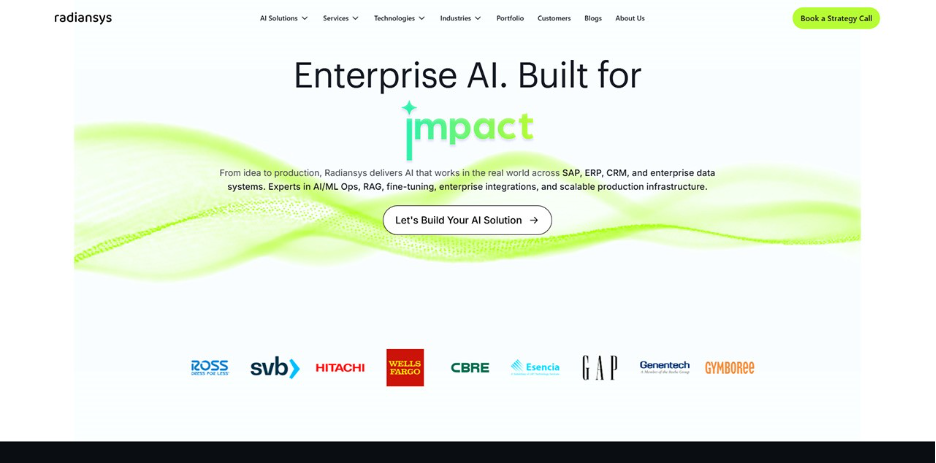
Radiansys develops enterprise AI across SAP, ERP, CRM, and data systems, supporting projects from strategy through production. Its expertise includes AI and machine learning operations, retrieval-augmented generation, model fine-tuning, AutoGen multi-agent systems, and n8n workflow automation.
GPU-optimized infrastructure uses CoreWeave, RunPod, Kubernetes, and Terraform to support growing AI workloads. SAP and ERP services cover S/4HANA programs, ECC migrations, SAP BTP, and long-term support.
Published work includes a multi-agent workflow platform, a bilingual customer support system for Wells Fargo, and IdeaFloat, a business copilot that helps entrepreneurs test ideas and prepare business plans.
From MVP: AI roadmaps and custom products using RAG and fine-tuned models
At scale: Governed production AI pipelines across cloud, hybrid, and on-premises environments
Teksun
Office: 1607 South Main Street, Milpitas, CA 95035
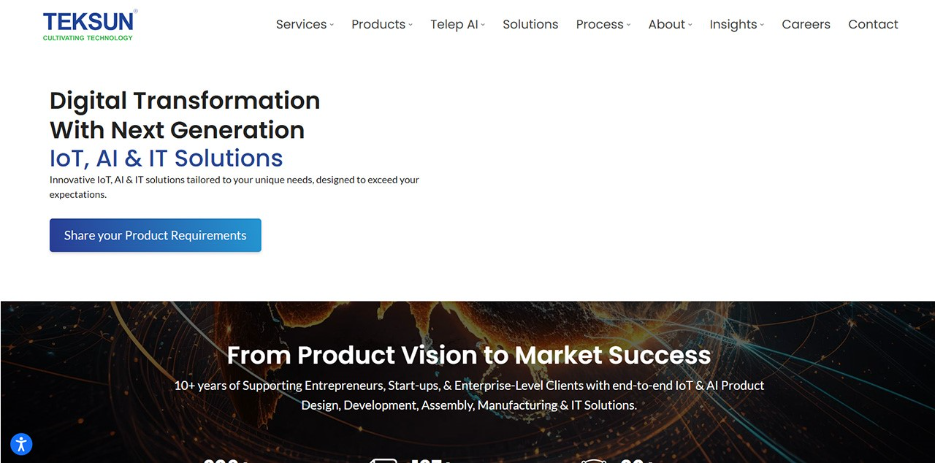
Teksun has supported entrepreneurs, startups, and enterprises for more than 10 years across IoT, AI, embedded systems, and software. The company reports over 300 employees, more than 300 projects, and at least 100 customers.
Hardware services cover electronic design, validation, PCB fabrication, assembly, enclosure production, and packaging. This allows clients to move from an initial device concept to manufacturing with one partner.
Software capabilities include IoT cloud integration, edge computing, industrial IoT, machine learning, and web and mobile applications. Quality engineering and DevOps support each release. Industry 4.0 services add factory monitoring and predictive maintenance.
From MVP: Product engineering from concept through embedded prototypes
At scale: Contract manufacturing, IoT cloud platforms, and automated testing
Growth Stages that Software Development Companies in California Can Support
Each stage of a product requires different skills from an engineering partner. Choose a firm based on the capabilities you will need next, not only the work required today.
Idea to MVP
Speed and learning matter most during the first stage. Look for a team that begins with discovery, prototypes quickly, and keeps the scope focused on the core product idea.
The contract should assign the source code and related intellectual property to your company from the first commit. You should also control the repository, cloud accounts, and product documentation.
Product-Market Fit
Once users arrive, reliability and iteration speed become more important. Your partner should introduce automated testing, monitoring, analytics, and a repeatable release process.
The team should also identify and refactor shortcuts taken during the MVP stage. Leaving temporary architecture in place can slow feature development and increase production risk as usage grows.
Scale
Growth increases system load, security requirements, and team size. At this stage, you need architects who can plan capacity, integrations, data models, and infrastructure.
The vendor should be able to add engineers without disrupting delivery. Documentation must also be strong enough for your internal hires to understand and eventually take ownership of parts of the system.
Warning Signs a Partner Can’t Scale With You
Some limitations only become visible after the product gains traction. Watch for these signals early:
- No architect on the team: Developers can ship features, but an architect must plan capacity, data models, and integrations.
- Thin documentation: Code without architecture notes, deployment instructions, or runbooks leaves the product dependent on its original developers.
- Fixed team size: A vendor that cannot add or replace engineers quickly may slow the roadmap when demand increases.
- No automated testing: Manual-only testing makes each release slower and riskier as the product grows.
- Vague security answers: Enterprise buyers will ask about access controls, audits, data handling, and compliance. Your partner should already have clear answers.
Conclusion
The team that builds the first release shapes the product for years. Architecture, testing, and documentation shortcuts may save time during the MVP stage but become expensive once customers depend on the system.
Picture the product 18 months from now and select a partner for that version. Ask the top software development companies in California how they would support ten times the users, twice the engineering capacity, and an enterprise security review. Their answers will show which firms can scale with you and which may need to be replaced when growth accelerates.