The Role of Conversational AI in Modern Workforce Management
Discover how conversational AI improves workforce management by automating tasks, enhancing employee engagement, and boosting business productivity.
Suppose a candidate came across your job post at 12 p.m. on a weekend night and he applies then only. Normally, a human recruiter wouldn’t be available to proceed with application. However, conversational AI already screens, asks follow-up questions, and schedules an interview by the time human recruiter gets to it. No one has to do anything manually. It’s all been taken care of while you were taking a nap.
This is what conversational AI does inside workforce teams who have already integrated it, and it is transforming how businesses support, hire, and handle people at each stage of the employee lifecycle.
Conventionally, workforce management used to mean just ticket queues, spreadsheets, and recruiter’s inbox being crowded by the “just checking in” emails. Conversational AI is slowly replacing that model with something that communicates back, remembers the context well, and works around the clock. In 2026, the question for HR leaders is not whether to incorporate the platform but how soon can they integrate it.
Almost 8 in 10 businesses have already implemented AI in at least a single HR functionality, as per McKinsey. The genuine question is where the conversational Artificial Intelligence platform earns its place in the workforce stack, and where it still requires a human behind it.
From Scripted Bots to Genuine Workforce Infrastructure
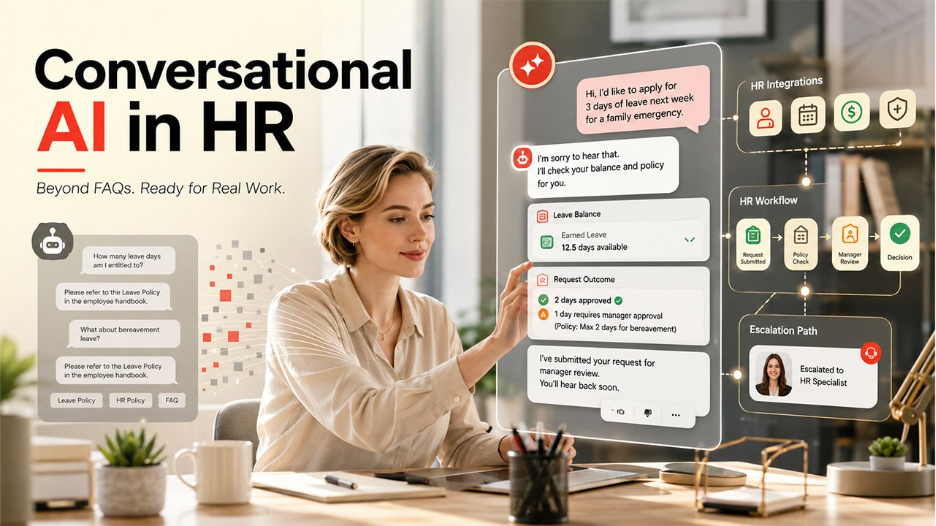
Initial HR chatbots were just exaggerated FAQ pages. All you had to do was to just type a keyword, get a canned response, and get frustrated when the phrasing does not match. Conversational AI is a distinct category of platforms. It integrates intent recognition, natural language processing, and live platform integrations to keep a dialogue that adjusts as it goes, instead of relying on a set decision tree.
That difference is important since it changes what tool you can rely on. A scripted bot can let an employee know where the leave policy exists. A conversational AI platform can read the leave balance of an employee, explain why a leave request was only partially approved, and direct the conversation to a human, all inside a single exchange. It is the core difference between a colleague and a directory.
Where Is Conversational AI Actually Changing Workforce Management?
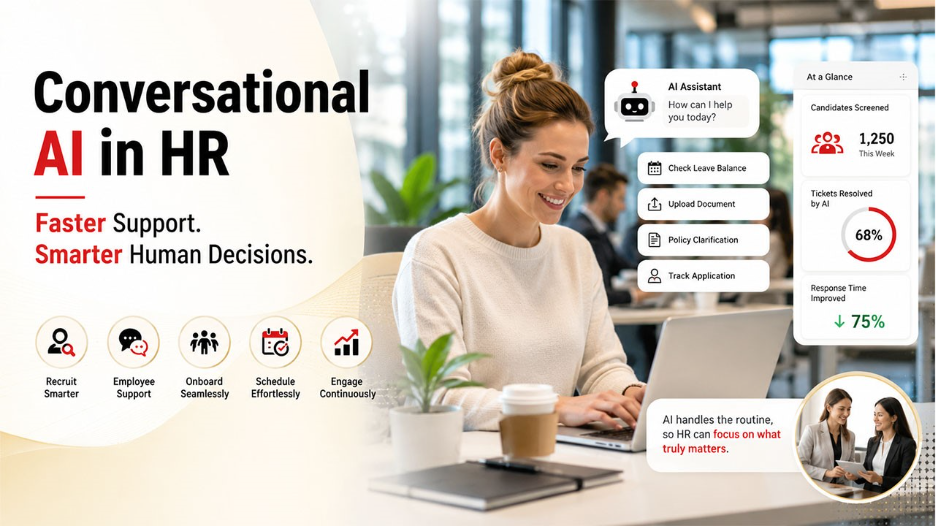
Recruitment and Screening of Candidates: This is one area where conversational AI has most matured. As per the industry data, approximately 73% of businesses now leverage chatbots for initial screening of candidate, and platforms such as Olivia of Paradox, deployed by employers including FedEx, have been recording a decrease in the response time of the candidate from around a week to less than 24 hours. Candidates get immediate response times about role alignment, salary bands, and further steps they need to take instead of just waiting for a recruiter to circle back. For high-volume hiring functionalities such as retail, BPO, and healthcare staffing, the speed alone can define whether a candidate remains in the pipeline or considers another lucrative offer.
HR Helpdesk and Employee Self-Service: Each HR team fields similar questions on repeat: payslip timelines, leave balances, and policy clarifications. Conversational AI implemented on an HR helpdesk generally deflects around 60-70% of such routine tickets before they even go to human employees. This frees HR operations to spend the majority of their time on judgement calls instead of looking at tickets. The cost factor is also an important thing to consider: AI interaction operates on a fraction of the cost that a human assistant requires. This is why HR processes have extensively adopted technology.
Onboarding. New joiners ask a repetitive set of questions. A lot of it has nothing to do with their jobs but the company culture, policy, appraisals, and other things. Conversational AI is a feasible choice to absorb this flood, explaining employees how to deal with this paperwork, benefits enrollment, and first-week logistics in natural back-and-forth manner, so people managers can spend time on onboarding and strengthening relationships instead of repetition.
Scheduling and Frontline Workforce Management: In retail, manufacturing, and logistics, conversational AI has become the interface for availability updates, shift swaps, and compliance training reminders. Retail companies leveraging AI for workforce management have reported notable improvements in labor cost efficiency, largely since the system can process repetitive scheduling requests immediately instead of waiting for the manager to sign into a portal.
Pulse Checks and Engagement: A conversational format lowers the barrier to giving feedback compared to a static annual survey. Employees respond to a quick, contextual question inside a chat thread far more often than they complete a 40-question form, which gives HR leaders a live read on sentiment instead of a lagging one.
The Trust Gap Nobody’s Solved Yet
Related walkthrough
GPT-6 Can Build a 3D Rocket Using ONLY Your Voice

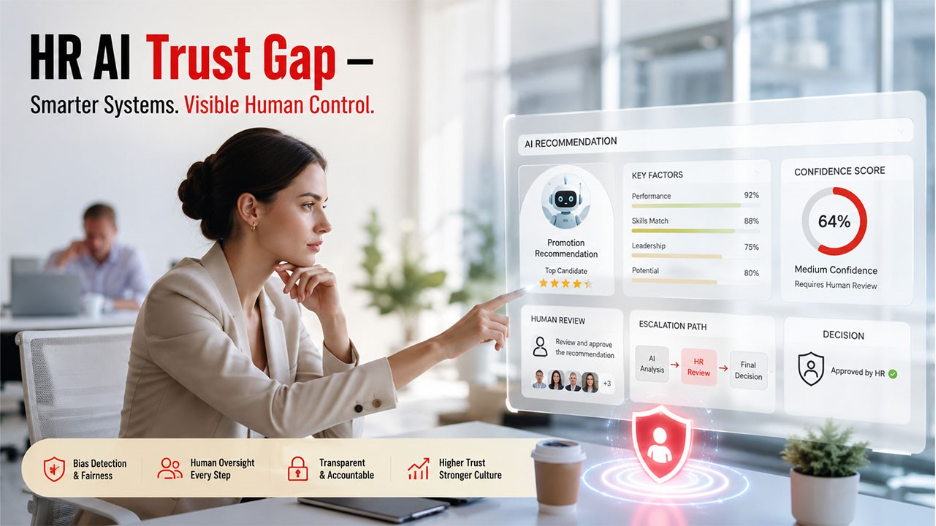
None of this happens without an element of friction, and honest thought leadership means directly naming it. Trust in AI-powered HR decisions is uneven. Research from IBM indicates employee trust in AI outputs averages approximately 35-55% across roles, and it is lowest exactly where the stakes are highest: promotion and compensation decisions.
Employees are comfortable letting a bot check their leave balance. They are far less comfortable letting one influence whether they get promoted. There’s also a governance gap. More than a quarter of HR leaders say trust in AI outputs and recommendation quality is the single biggest barrier to scaling these tools further, ahead of budget or technical integration. That’s a signal worth sitting with: the limiting factor on conversational AI in workforce management isn’t capability anymore. It is confidence. Organizations that combine every AI-powered workflow with clear paths of escalation and visible human oversight showcase essentially greater level of trust scores than those that implement AI as a black hole.
Read More: Ensuring Accuracy and Authenticity in AI-Generated Business Content
What This Means for HR Leaders Right Now
The organizations getting real value from conversational AI aren’t the ones chasing every new tool. They’re the ones being deliberate about where automation belongs and where it doesn’t. A few principles are emerging as the field matures:
- Automate the repetitive, not the consequential: Leave balances, FAQs, and scheduling are ideal for full automation. Compensation, performance ratings, and terminations still need a human name attached to the decision.
- Make the AI’s Presence Visible: Transparency related to someone when someone is speaking to an AI platform, not a person, raises trust by 25 to 40 percent points as per IBM’s research. Hiding it decreases the very confidence businesses need to improve adoption.
- Consider Conversational AI as Infrastructure, Not as Optional Technology: The systems providing precise Return on Investment are incorporated with ATS, HRIS, and the ticketing solution, not siting off to the side as a standalone chat widget.
- Measure containment quality, not just deflection volume. A chatbot that closes tickets by giving wrong answers creates more downstream work than it saves. Deflection rate without an accuracy check is a vanity metric.
Conversational AI has gone past the experimental phase in workforce management. It has now become the infrastructure; the same way a payroll or ATS becomes an infrastructure. The businesses that consider it the right way, with clear visible guardrails, ownership, and a sharp sense of which decisions remain human, are the ones converting it into an actual advantage instead of another tool that nobody trusts fully.
Frequently Asked Questions
What is conversational AI in workforce management?
Conversational AI is a technology that can communicate with humans in a back-and-forth and natural dialogue, often through voice or chat, to manage HR tasks such as answering questions of employees, screening candidates, and handling scheduling requests without a fixed script.
How is conversational AI distinct from a consistent HR chatbot?
Older chatbots align keywords to canned responses. Conversational AI comprehends intent, extracts real-time data from HR platforms, and adjusts its responses, closer to an interaction than a lookup.
Which HR functions most benefit from conversational AI?
Employee self-service, recruitment screening, and shift scheduling get the quickest returns, since these include high volume of repetitive queries.
Can conversational AI replace HR staff or recruiters?
No. It absorbs low-judgement or routine tasks so HR teams and recruiters that require human context, such as sensitive employee cases or final interviews.
Is conversational AI a good choice for high-stakes HR decisions?
No, while taking high-stakes decisions, it is not advisable to just rely on conversational AI. As per the reports, trust in AI declines sharply for promotion, compensation, and termination decisions, so the majority of businesses also keep a human that takes insights from conversational AI but also go through the reports themselves to take a call.
How do organizations assess success with HR conversational AI?
Common metrics involve first-response time, ticket deflection rate, and candidate response time, along with accuracy checks to make sure that AI is not just closing tickets with wrong responses.
Does utilising a conversational AI minimizes bias in hiring?
It depends. If the conversational AI is reliable and is trained with unbiased data, it can make the hiring a lot more transparent and consistent. However, if the conversational AI is poorly misconfigured, it can reinforce those existing bias.
What is the single biggest barrier to adjusting conversational AI in HR?
Trust and not technology. HR leaders mention confidence in AI outputs, not integration or budgets, as the biggest barrier to further scaling such tools.