
Logistics Is Becoming a Software Problem, but Software Alone Does Not Move Freight
Learn how logistics software, AI, automation, and data integration are transforming freight while domain expertise helps businesses achieve real-world results.
If you build or implement business software, the logistics industry should look strangely familiar. It is a world of fragmented data, manual workflows, and legacy systems held together by spreadsheets and institutional memory. In other words, it looks like customer relationship management did fifteen years ago, right before automation transformed it. The difference is that in logistics, every data failure has a physical consequence: a railcar sitting idle, a truck waiting at a dock, a customer order that arrives late.
That combination of familiar problems and physical stakes is why supply chain technology has become one of the most active areas of enterprise software, and why the companies getting the most from it are the ones pairing new tools with deep operating knowledge.
Freight Still Runs on Legacy Data
The average industrial supply chain generates data in every direction: transportation management systems, enterprise resource planning platforms, carrier EDI feeds, warehouse management systems, and a thick layer of email and spreadsheets filling the gaps between them. These systems were rarely designed to talk to each other. A single shipment can exist in five systems under five identifiers, none reconciled.
Anyone who has cleaned a CRM database before a migration knows this pattern. Duplicate records, inconsistent fields, and processes that exist only in one veteran employee’s head can quickly create operational problems. The lesson from the CRM world applies directly to freight: automation built on unreconciled data does not fix a process; it accelerates the mess. The first serious project in any logistics technology initiative is therefore unglamorous by design—building the reconciled shipment record that everything else will depend on, much like Best CRM and Operations Software Combos rely on clean, connected data to support effective workflows.
What Automation Looks Like on the Loading Dock
Where the data foundation is solid, the automation wins in logistics map neatly onto patterns software teams already know. Load tendering can be automated the way lead routing is, with rules that assign freight to carriers based on lane, rate, and performance history. Freight invoice auditing works like automated billing reconciliation, catching overcharges that manual review misses. Exception management mirrors support ticket escalation, surfacing the small percentage of shipments that actually need human attention.
The gains are real but they concentrate in the boring places. The companies that succeed rarely start with the flashiest tool. They start by documenting a workflow, standardizing the data that feeds it, and automating one decision at a time. That discipline will sound familiar to anyone who has rolled out CRM automation that people actually use.
The AI Layer: What Is Real and What Is Demo
Related walkthrough
TRON 2 & Embodied Robotics: How Robots Learn to Move Like Life
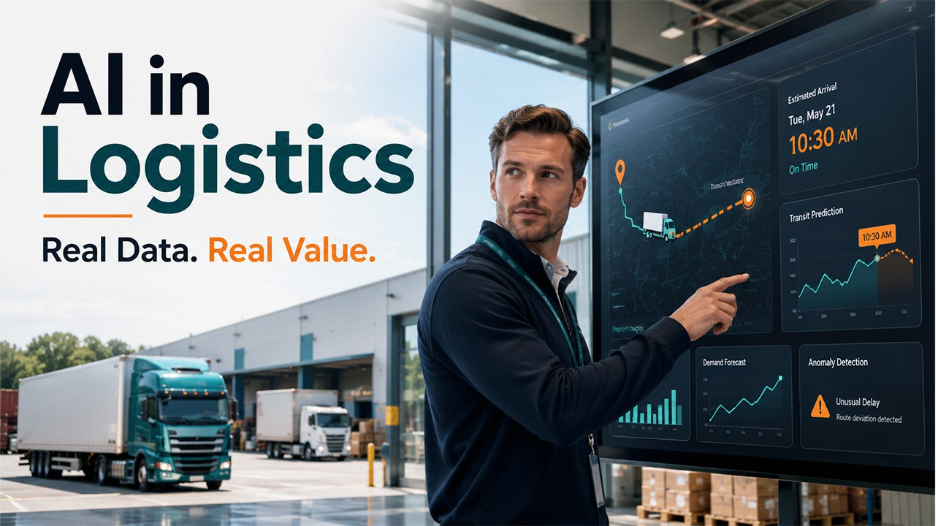
Artificial intelligence has arrived in logistics marketing faster than in logistics operations, and technology buyers should apply the same skepticism they would to any enterprise AI pitch. The applications delivering value today are mostly well understood machine learning on well understood problems: arrival time prediction trained on historical movement data, demand forecasting that improves on spreadsheet extrapolation, document extraction that reads bills of lading and invoices, and anomaly detection that flags a shipment behaving unlike its lane history.
What these successes share is narrow scope and clean training data, which brings the conversation back to foundations. A model predicting rail transit times is only as good as the movement history it learns from, and a chatbot answering shipment questions is only as good as the systems it queries. Teams evaluating AI vendors in this space should ask the same question they would ask of any CRM add on: what data does this actually need, and do we have it in usable form? The vendors who answer specifically are worth the meeting.
Visibility Platforms, Control Towers, and the Integration Problem
The most visible category in supply chain software is the visibility platform, often described as a control tower. These products promise a single pane of glass across every shipment and mode, with machine learning models predicting arrival times. Under the hood, they are integration projects: API connections, data normalization, and entity resolution across dozens of carrier and customer systems.
This is precisely where software skills and domain knowledge have to meet. A developer can build the pipeline, but deciding what a rail dwell time signal actually means, or which exceptions justify waking someone up, requires people who understand how freight networks behave. Modes with complex operating rules illustrate the point well. Rail freight has its own contract structures, car fleet economics, and service dynamics, which is why specialized rail supply chain consulting remains a discipline of its own even as the software layer matures.
Where Domain Expertise Beats Code
The uncomfortable truth for technology teams is that the highest value problems in logistics are often not software problems at all. No dashboard renegotiates a freight contract. No integration redesigns a distribution network around a new plant. The tools expose the opportunity, but capturing it takes operating experience, market knowledge, and negotiating leverage.
This is why the consulting layer of the industry has not been automated away, and why guides to the best logistics consulting firms now emphasize implementation depth over strategy decks. Firms like PraxiChain pair analytics with hands on execution, using data tools to find savings and experienced operators to actually land them. For a software audience, it is a useful model of what technology plus expertise looks like when it works.
There is a build versus buy lesson here too. The integration plumbing of logistics, carrier connections, rate databases, standard EDI translation, has become commodity infrastructure that few companies should build themselves. The differentiating layer is the decision logic on top: how your specific network, contracts, and service commitments turn data into action. That layer is worth owning, and it is also where a few weeks with a domain expert can save a development team months of reverse engineering how freight actually works.
Takeaways for Technology Teams
If your company touches physical goods, or your clients do, the opportunity is substantial and the pattern is repeatable. Treat data reconciliation as the first project, not an afterthought. Automate individual decisions rather than entire departments. Buy integrations where they are commodities and build only where your operation is unique. And bring in domain expertise early, because the most expensive automation failures in logistics are the ones that faithfully digitized a broken process.
It is also worth studying how the operations side measures success. Logistics teams judge automation by hard outcomes: dollars saved per shipment, hours removed from a workflow, exceptions caught before they became failures. Software teams that adopt that scorecard, and resist the temptation to celebrate deployment instead of results, will find logistics one of the most satisfying domains in enterprise technology to build for.
For agencies and development shops, logistics also represents an underserved client base. Most industrial shippers are not technology companies and never will be. They need partners who can connect a transportation system to an ERP, automate a document workflow, or build the reporting layer their operations team keeps asking for. The work is concrete, the return on investment is measurable in freight dollars, and the clients tend to stay once you understand their business.
The freight world is in the middle of its automation decade. The teams that combine software discipline with respect for the physical realities of the business will be the ones that ship, in both senses of the word.