
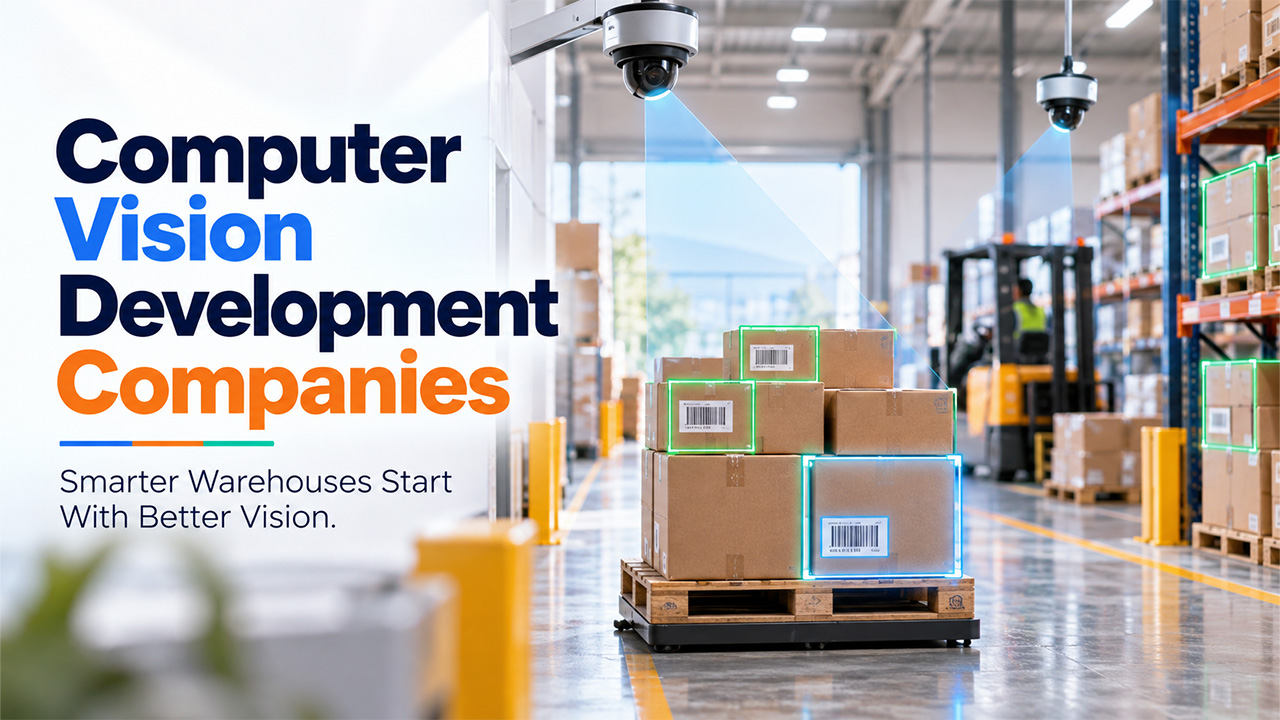
Top 5 Computer Vision Development Companies for Warehouse Automation in 2026
Compare 5 top computer vision development companies for warehouse automation in 2026, covering CV expertise, integrations, edge deployment, and enterprise fit
Computer vision is becoming a core layer of warehouse automation, helping operators identify inventory, inspect goods, verify picks and monitor activity without relying on manual checks. From object detection and OCR to real-time video analysis, these systems can improve accuracy while reducing repetitive work across receiving, storage and fulfillment.
The challenge is choosing a development partner that can handle more than model training. Warehouse projects often require edge deployment, camera and sensor integration, WMS connectivity and ongoing model optimization.
In this article, we compare five computer vision development companies for warehouse automation in 2026, looking at their technical capabilities, logistics experience, proof points and ability to deploy production-ready systems.
What Is Computer Vision Software Development?
Computer vision software development is the practice of building applications that automatically extract usable information from images and video, often in real time. The work covers model selection, data labeling, training, edge optimization, integration with existing systems, and the MLOps needed to keep models accurate after deployment.
Typical deliverables from computer vision software development services firms include:
- Object detection and tracking for pallets, totes, forklifts, and people moving through a facility
- Image classification and segmentation for SKU identification and condition grading
- OCR pipelines that read labels, shipping documents, and barcodes without manual keying
- Video analysis and visual inspection for damage detection and pack-quality checks
The technical stack is fairly consistent across vendors. OpenCV contains more than 2,500 algorithms and has been in operation since June 2000; TensorFlow and PyTorch handle model training, and YOLO architectures dominate real-time object detection in warehouse settings. Delivery models range from Proof-of-Value pilots and dedicated CV teams to staff augmentation and end-to-end custom development with ongoing model retraining.
Why Is Computer Vision Central to Warehouse Automation?
Roughly 58% of logistics facilities have already implemented computer vision for package tracking and warehouse automation, according to Business Research Insights. If you are still running manual cycle counts, your competitors probably are not. Here is what is driving the shift:
- AI in warehousing is the fastest-growing warehouse-tech segment. The Business Research Company puts it at a 25.7% CAGR, growing from $7.43 billion in 2025 to $9.34 billion in 2026.
- Piece-picking robots depend on vision. Mordor Intelligence forecasts the piece-picking robotics segment growing at 15.27% CAGR, specifically because improved vision and gripping systems now handle varied SKUs.
- Quality inspection is the single largest CV use case. The quality assurance and inspection segment led the computer vision market with a 26.1% revenue share in 2025, which maps directly onto inbound receiving and outbound pack inspection.
- The AI warehouse automation slice keeps compounding. Intel Market Research valued the AI warehouse automation segment at $6.8 billion in 2025, projected to reach $15.9 billion by 2034.
Warehouse CV projects generally fall into five buckets: inbound receiving inspection, put-away verification, inventory cycle counts, pick verification, and outbound quality checks. Every firm below ships production systems that touch at least one of them.
1. OpenCV.ai: The Team Behind the Open-Source CV Library Powering the Industry
OpenCV.ai is the professional consulting arm of OpenCV.org, the world’s largest open-source computer vision library, which runs on nearly every smartphone, inside every BigTech company, and even at NASA. The firm was founded in 2020 in Palo Alto, California, by the core team behind the library itself, according to Crunchbase.
The leadership bench reads like a computer vision faculty list. Dr. Gary Bradski founded OpenCV and still runs the open-source project. Anna Petrovicheva brings a decade of CV and AI work across medicine, security, sports, and virtual reality. Tatiana Khanova specializes in deep learning and object detection with 8+ years of experience and published papers at CVPR and ECCV, per the OpenCV.ai team page. Anna Kogan, Grigory Serebryakov, and Satya P. Mallick round out the original library team.
For warehouse buyers, the relevant capability is edge optimization. OpenCV.ai trains and deploys neural networks, tunes models to run on cameras and robots rather than in the cloud, and builds custom hardware when off-the-shelf sensors do not fit. The firm lists Storage as a stated industry vertical and has published technical content plus a demo video on real-time warehouse computer vision, including QR barcode reading for product identification and tracking.
Proof points:
- 50+ successful projects delivered, including work for 6 Fortune 100 companies
- Industries served: Medicine, Biotech, Storage, Sport, Manufacturing, Metaverse, Self-Driving
- Team members publish at CVPR and ECCV, the two premier academic CV conferences
- GDPR-compliant builds, with one client noting the team built the system “from the ground up, integrated it into our product, and ensured it was GDPR-compliant”
2. Azumo: Production Computer Vision with a SOC 2 Compliance Stack
Azumo is a San Francisco-based AI and software development firm founded in 2016 that has shipped more than 300 production deployments, including computer vision systems built on YOLO models and real-time OCR pipelines. Delivery runs through distributed teams across 20+ countries, primarily in Latin America.
The Azumo AI practice covers object detection, image classification, video analysis, and visual inspection. Published computer vision work includes super-resolution imaging systems, ID verification through automated document scanning, and visual data pipelines for real-time analysis. Manufacturing, retail, and security sit among the firm’s active verticals, which map closely to warehouse operations.
Three case studies show the pattern. For Centegix, a school safety technology company, Azumo built a computer vision and OCR system using YOLO models that detects and extracts structured data from driver’s licenses in real time, removing manual data entry from visitor workflows. That same detect-then-extract pattern transfers directly to inbound receiving, where labels and BOLs need to be read at speed.
For Meta, Azumo built a Named Entity Recognition system that pulls supplier capabilities and products out of unstructured text for more precise supplier matching. For Angle Health, an LLM automation system cut quote generation from 45 minutes to 5 minutes, a 90% cycle-time reduction.
Proof points:
- 300+ production deployments and 100+ production AI systems delivered since 2016
- 100+ customers, 4.9/5 verified client rating, 150% net retention, 3.2+ years average client engagement
- SOC 2 certified, GDPR and CCPA compliant, HIPAA-ready with BAA agreements, AES-256 encryption in transit and at rest
- MLOps across AWS SageMaker, Azure ML, Google Vertex AI, Databricks, and custom Kubernetes clusters
- Named Top AI Development Company by Clutch, The Manifest, and DesignRush; Hot Vendor for AI by Aragon Research
3. InData Labs: Computer Vision Meets Enterprise Data Infrastructure
Related walkthrough
Stellar OST to PST Converter Review 2026 | Online vs Desktop – Real Test

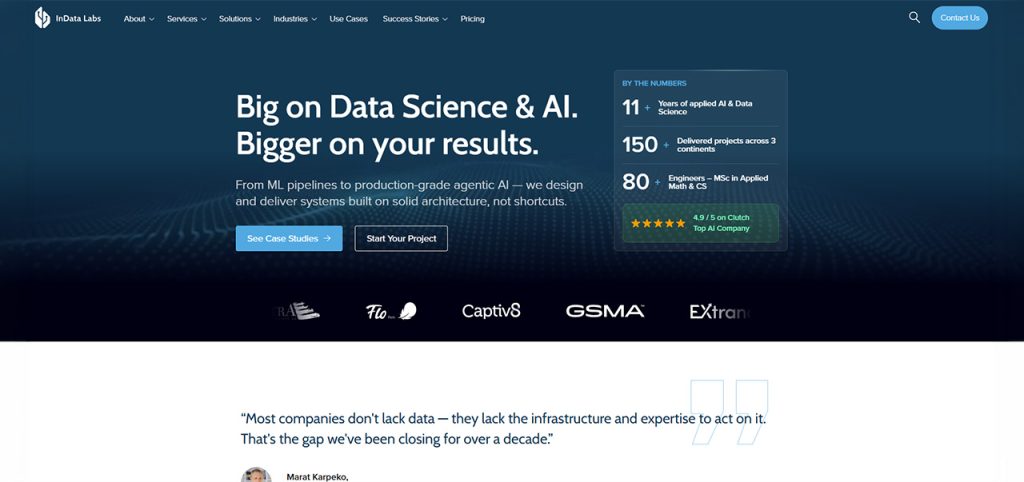
InData Labs is one of the few computer vision development firms that pairs a CV practice with a full data warehouse and data engineering practice. That combination matters when your vision output needs to land cleanly inside an enterprise data platform rather than a standalone dashboard.
Marat Karpeko co-founded the company in 2014 and serves as Chairman of the Board. The firm’s roots are in Minsk, Belarus, with expanded operations in Miami, Florida and Cyprus, per Tracxn and CB Insights.
The CV service line covers quality control, object detection, and document OCR, all listed directly on the company homepage. Document OCR applies straight to inbound receiving inspection and label scanning, while quality-control vision supports outbound pack inspection. Around those services, InData Labs runs big data analytics, predictive analytics and forecasting for inventory planning, and agentic workflow automation for document processing.
The Data Warehouse consulting practice is the real differentiator here. The firm engineers enterprise DWH implementations that vision systems feed into, and holds technology partnerships with AWS and Databricks. The company also runs its own R&D center for AI and computer vision development.
Proof points:
- 80+ specialists with an in-house R&D center
- 10+ years in operation, founded 2014
- Named to the Clutch Leaders Matrix and GoodFirms as a top data solutions provider
- Named to Techreviewer’s 2025 list of top 100+ DevOps consulting companies
- 20 verified reviews on Clutch
- Industries: finance, e-commerce, marketing, manufacturing, healthcare
4. Intellias: 23 Years of Transportation and Logistics Engineering
Intellias has shipped transportation and logistics software since 2002, the year it was founded. That gives the firm more than two decades of continuous domain experience in the exact category warehouse automation lives in.
Vitaly Sedler (CEO) and Mykhailo Puzrakov (Executive Chairman) founded the company in Lviv, Ukraine. In an interview with Croatian Hub, Sedler named computer vision and LiDAR among the firm’s focus areas, specifically for Intelligent Automation with augmented decision-making. Those two technologies together cover the sensing layer most modern fulfillment centers need for autonomous mobile robots and pallet-level tracking.
The dedicated Transportation and Logistics practice serves global transportation platform providers, eMobility innovators, and large vehicle fleets. Alongside it, Intellias delivers Modern Data Infrastructure and rapid cloudification for the high-throughput pipelines that warehouse video generates. The Centers of Excellence model gives clients access to dedicated engineering knowledge hubs by industry and technology.
Proof points:
- 2,500 to 2,600+ engineering specialists across seven delivery centers in Ukraine and Poland
- 23+ years in operation, 130+ partners globally, 14+ offices and delivery locations worldwide
- Global footprint spanning Ukraine, Poland, Bulgaria, Germany, UK, Spain, Portugal, Croatia, USA, Canada, Colombia, India, and UAE, per Highperformr
- Backed by Horizon Capital investment, per Tracxn
- Named a top ITO-BPO provider by KPMG and Lviv’s top IT employer since 2010
- Serves Fortune 500 clients across automotive, financial services, telecom and media, and transportation and logistics
5. LeewayHertz: Computer Vision Development, Now a Hackett Group Company
LeewayHertz has run a dedicated computer vision development practice for more than a decade. Since September 2024, it operates as “LeewayHertz, a Hackett Group Company” following its acquisition by The Hackett Group (NASDAQ: HCKT), which brings benchmarking IP and enterprise advisory reach that pure-play dev shops cannot match, according to Tracxn.
Akash Takyar (CEO) and Viresh Bhathia (Chairman) founded the firm in San Francisco in 2007. Takyar is a Forbes Technology Council member and holds US patent #US8972167 on an enhanced reverse geocoding algorithm. CTO Deepak Shokeen brings 20+ years of enterprise engineering and 50+ delivered AI projects, per the company’s About page.
The CV service line covers object detection, image retrieval, and video analysis, with model optimization through OpenCV, TensorFlow, and GPU modules. The most warehouse-relevant proof point is the NSG Group deployment. LeewayHertz built a computer vision anomaly detection system for the global glass manufacturer that analyzes live video feeds, flags beading anomalies in real time, triggers operator alerts, and cuts material waste. Swap glass for cartons and you have a working template for inbound damage detection and outbound pack-quality inspection.
The firm also runs a dedicated Logistics AI practice covering inventory management, asset tracking, and warehouse management modules.
Proof points:
- 174 employees as of July 2026
- 160+ digital solutions delivered across industry verticals
- 30+ Fortune 500 companies served, including Siemens, 3M, P&G, and Hershey’s
- Minimum engagement of $50K, an accessible entry point for a first CV pilot
- Production experience with GPT-4, LLaMA, PaLM-2, and Gemini
How We Chose the Right Computer Vision Software Development Services Partners
We focused on providers with proven computer vision capabilities and clear relevance to warehouse operations. The evaluation considered:
- Warehouse-specific use cases: Experience with inventory tracking, SKU identification, OCR, damage detection, pick verification or visual inspection.
- Computer vision depth: Expertise across object detection, tracking, classification, segmentation and real-time video processing.
- Edge deployment: Ability to optimize models for cameras, robots and on-site infrastructure where low-latency processing matters.
- Systems integration: Experience connecting vision outputs with WMS, ERP, robotics and enterprise data platforms.
- Production readiness: Evidence of real deployments, MLOps, retraining workflows and ongoing model monitoring.
Enterprise fit: Security, compliance, scalability and experience working with larger operational environments.
The strongest computer vision software development services partners are those that can connect accurate visual models with the warehouse systems and workflows already in place.
Conclusion
OpenCV.ai, Azumo, InData Labs, Intellias, and LeewayHertz all deliver production computer vision for warehouse operations, each backed by real case studies, verifiable certifications, and named engineering leadership.
Shortlist them based on domain fit, compliance requirements, and edge-deployment capability, then run a pilot before you scale.
Frequently Asked Questions
Computer vision software development builds applications that automatically extract usable information from images and video, including object detection, image classification, OCR, video analysis, and visual inspection. In warehouses, this translates to barcode and QR reading, pallet counting, empty-shelf detection, damage detection, and pick verification.
Computer vision handles SKU identification, pallet counting, empty-shelf detection, damage detection on inbound pallets, worker-safety monitoring, and pick verification. Roughly 58% of logistics facilities have already implemented CV systems for package tracking and warehouse automation.
Mordor Intelligence projects the warehouse automation market at $34.17 billion in 2026 and $65.74 billion by 2031, a 13.98% CAGR. The AI-in-warehousing slice grows faster at 25.7% CAGR.
Public data shows LeewayHertz's minimum engagement is $50K. Enterprise programs from firms like Intellias, Azumo, or InData Labs scale into six and seven figures depending on data volume, edge deployment complexity, and compliance needs.
The standard stack includes OpenCV with its 2,500+ algorithms, TensorFlow, PyTorch, and YOLO models for real-time object detection. All five firms here work with some combination of these.