

Key Benefits of Cloud Computing in the Energy Industry
Explore the key benefits of cloud computing in the energy industry, from cost reduction and grid optimization to renewable integration and real-time analytics.
The energy sector is going through huge changes. Terabytes of data are being processed by companies every day from different sources such as weather stations, wind turbines, solar panels and smart meters. Traditional data centers are not fit to handle this load as they are not flexible enough, and the maintenance cost is higher than the profits. Cloud technologies allow for processing real-time data, forecasting electricity consumption down to the neighborhood level, and distributed energy system management from a single interface.
This article critically examines how cloud computing in energy sector transforms the industry for producers, distributors and end consumers, what are the benefits companies gain from cloud migration and what are the challenges encountered along the way.
Current State of Cloud Solutions Market in Energy
Gartner analysts predict that by 2027, over 65% of energy companies will migrate mission-critical operations to the cloud. These are not just baseless numbers; there are real investments backing them up. Shell launched a project to move geological exploration data to Microsoft Azure, where https://dxc.com/industries/energy and other solution providers help process petabytes of seismic information. BP invested $1.5 billion in digital transformation, with cloud computing in the energy sector taking up a significant portion.
The market shows interesting trends. AWS launched a specialized Energy Command Center service that helps manage distributed energy systems. Google Cloud presented the Grid Optimization Suite – a set of tools for optimizing electrical grid operations based on machine learning. Siemens is testing digital twins of power plants in SAP cloud, while French EDF experiments with IBM Watson for predictive maintenance of nuclear reactors.
An interesting case – Danish Ørsted. The company uses cloud platforms to manage offshore wind farms. Sensors on turbines transmit data every three seconds, algorithms analyze vibrations, temperature, and wind speed, then the system automatically adjusts blade angles. Result – 12% increase in energy production without additional capital expenditures.
Startups are also actively entering the game. California’s AutoGrid created a platform for managing distributed energy resources – from home solar panels to industrial batteries. Their clients include Tokyo Electric Power and E.ON. German Next Kraftwerke united over 15,000 renewable energy sources into a virtual power plant through cloud infrastructure.
Reducing Operational Costs and Infrastructure Optimization
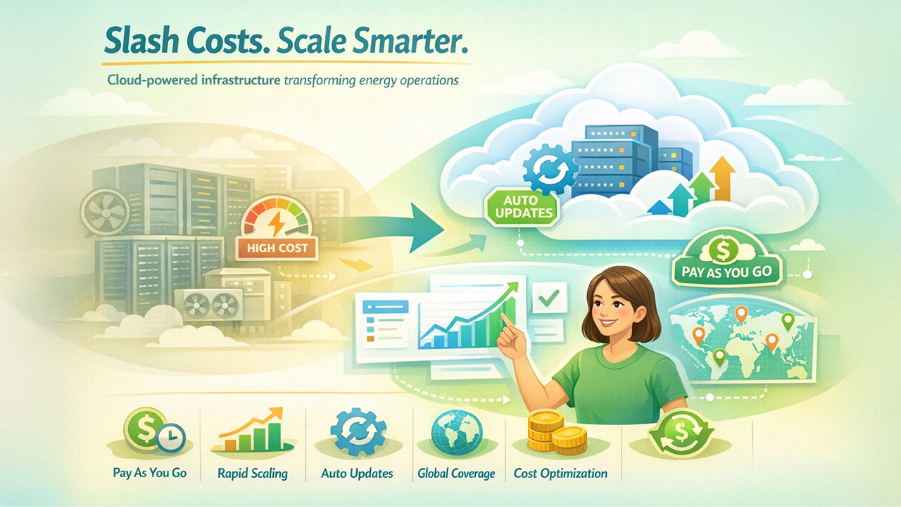
Transitioning to cloud computing radically changes the economics of energy projects. The traditional scenario looked like this: a company buys servers 5-10 years in advance, rents facilities, hires an IT admin team, spends money on electricity and equipment cooling. Half the capacity sits idle during off-peak periods.
Cloud solutions offer a fundamentally different model. You pay only for what you use. Need to process seismic data for geological exploration – rent a thousand servers for two weeks, perform calculations, and disconnect resources. Budget for this operation is equal to zero from next month.
Specific benefits from infrastructure optimization:
- No need to buy equipment upfront; it saves capital expenditure.
- Offers rapid scaling which means additional capacity is available within minutes
- It has automatic updates while provider handles software currency and security
- Provides geographic distribution; data replicates across different data centers
- It has flexible pricing. You can choose between hourly, monthly, or reserved instance billing
A real-world example of this is Texas-based Vistra Energy. By migrating power plant management systems to AWS, they lower operational costs by 37% in the first year. Major savings were due to elimination of proprietary data centers and optimization of software licensing. Previously, they paid for SAP licenses for all server volume, now – only for active instances.
Australian AGL Energy reports similar results. After moving CRM and ERP systems to the cloud, they closed three of four physical data centers. This yielded $4.2 million in annual savings just on facility maintenance, not counting IT staff reductions.
Energy Consumption Optimization Through Analytics
Cloud computing in the energy sector allows not just storing data but extracting real value from it. Modern day platforms use smart meters, forecast consumption peaks to process information, and balance network loads automatically.
A predictive analytics system based on Google Cloud was implemented by Pacific Gas and Electric. Algorithms that analyze conditions of weather, historical data of consumption and calendar events forecast electrical grid that loads with 94% accuracy rate. This enables companies to activate reserve capacity in advance to avoid situations of blackouts.
North Carolina’s Duke Energy employs a similar system. Their cloud platform processes data from 7 million smart meters every minute. When the system detects anomalies – for example, sharp consumption increases at atypical times – it automatically sends notifications to dispatchers and recommends redistributing load between substations.
Increasing System Reliability and Security
Energy infrastructure is the most important factor in any country. When the system fails, it leads to blackouts, monetary losses, and even life-threatening situations. Cloud providers invest billions in security and fault tolerance. It gives companies that work with energy access to enterprise-level technologies.
Reliability mechanisms in the cloud:
- Geographic redundancy – data is stored simultaneously across multiple data centers
- Automatic failure recovery – system immediately switches to backup capacity within seconds
- DDoS protection – providers identify attacks at network infrastructure level
- Data encryption – data is encrypted both in transit and at rest
- Multi-level authentication systems – privacy also includes biometrics
An incident occurred in 2021 when a massive power outage happened in Texas because of abnormal freezing temperatures. Those companies that were using cloud platforms like Microsoft Azure for critical systems maintained their operations. It was all possible due to the geographical distribution of cloud data centers. Their dispatching systems worked even when local offices lost electricity.
Security is a separate big topic. Colonial Pipeline, operator of the largest U.S. oil pipeline, suffered a hacker attack in 2021 precisely due to vulnerabilities in their own IT infrastructure. The company invested $200 million in migrating critical systems after the incident took place. It was done to protect cloud environments with zero trust.
Live Monitoring
Cloud platforms allow for energy system monitoring 24/7. UK’s electrical grid operator, National Grid utilizes Azure IoT to watch over 100,000 pieces of equipment ranging from transformers to high-voltage lines.
Sensors that are embedded in IoT AI devices collect and transmit data on vibrations, temperature, load, and other parameters. AI’s machine learning algorithm then analyzes this information to detect any unusual activity or anomalies long before the actual breakdowns happen. Requesting maintenance, assigning crews, and ordering spare parts is automatically done by the system.
This produced impressive results. The unplanned downtime was decreased by 41% while equipment service life was increased by an average of 15%. Preventing one serious failure can save millions of pounds.
Accelerating the Implementation of Renewable Energy Source
Related walkthrough
The Future is Here: Sanctuary AI & Microsoft's Groundbreaking AI Collaboration

A unique challenge is posed by solar and wind power plants. Their capacity continuously fluctuates as per weather conditions. That’s why cloud technologies intent to integrate renewable sources into the overall system while maintaining stability.
Even NextEra Energy—one of the largest renewable energy suppliers in North America leverages a cloud platform to integrate 25,000 wind turbines with millions of solar panels. The system offers weather predictions, evaluates current grid load, and plans to enable backup gas plants an hour before the wind slows down or the sun hides behind clouds.
Spanish Iberdrola developed its own PERSEO cloud platform for managing hybrid power plants. They have a project in Oregon where wind turbines, solar panels, and massive lithium-ion batteries share one site. Cloud computing in energy sector allows optimizing all three components – storing excess energy in batteries when production exceeds demand and releasing it back during consumption peaks.
Cloud technology advantages for renewable energy:
- Accurate production forecasting based on weather data
- Coordination of geographically distributed stations
- Integration with energy storage systems
- Automatic demand and supply balancing
- Virtual power plants from thousands of small sources
German company Sonnen created a virtual battery from 50,000 home accumulators. Solar panel owners install Sonnen batteries at home, connected to a cloud platform. When the grid experiences electricity shortages, the system can simultaneously use capacity from thousands of batteries for stabilization, compensating owners for electricity costs. Without cloud technologies, coordinating this many devices would be technically impossible.
Digital Twins of Power Plants
This is one of the most promising technologies. A company creates a complete virtual copy of a physical power plant in the cloud – with all turbines, generators, cooling systems, and controls. Sensors transmit real data, and the model simulates equipment operation.
General Electric has built this kind of system for the wind industry. With a digital twin of each turbine, testing diverse operating modes online is becoming possible while preventing genuine equipment from potential harm. Using blade pitch angles, rotation speeds, and other parameters, engineers perform experiments to find an optimal environment for distinct weather conditions.
French EDF leverages digital twins to manage nuclear power plants efficiently. This allows replicating emergency conditions, training staff, and planning maintenance without stopping reactors.
Improving Consumer Interaction
The electricity market is becoming increasingly competitive. Consumers want to understand what they’re paying, control expenses, and choose green tariffs. Cloud platforms give energy companies tools for building direct connections with clients.
British Octopus Energy built its entire business around the Kraken cloud platform. The system handles 6 million meters, instantly releases bills, initiates payments, and gives clients comprehensive consumption metrics through a mobile application. Users see hourly consumption graphs, receive savings recommendations, and can change tariffs with two clicks.
Interestingly, Octopus licenses its platform to other energy companies. E.ON in Italy, Origin Energy in Australia, and Tokyo Gas in Japan use Kraken for transforming their own operations. This became possible precisely thanks to cloud architecture – no need to install software locally, just connect to the platform.
Capabilities for improving customer experience:
- Mobile apps with real-time consumption statistics
- Personalized savings recommendations
- Flexible tariffs depending on time of day
- Automatic notifications about unusual consumption
- Smart home integration
American Constellation Energy launched a program for electric vehicle owners. The cloud platform monitors when cars charge and automatically transforms the process to nighttime hours when electricity is affordable. With cloud computing operations, users save a minimum of $40 per month, and the grid gets a more balanced load.
Blockchain and Collaborative Energy Trading
Integrating cloud computing in energy industries with blockchain technologies opens the door to new, exciting opportunities. The Power Ledger in Australia developed a platform that enables peer-to-peer trading among solar panel owners and local consumers directly, without relying on third parties.
Transactions, recorded in blockchain, and the cloud system dynamically balance energy distribution and processed payments. Several U.S. cities, like Bangkok and Vienna, already leverage these projects. Panel administrators earn 20-30% more than selling energy to conventional vendors, while consumers pay less for sustainable electricity.
Challenges and Development Prospects
Cloud migration isn’t a magic pill. Energy companies face real difficulties when implementing cloud technologies.
First problem – legacy systems. Many power plants use SCADA systems developed 20-30 years ago. These systems run on specialized equipment and protocols difficult to integrate with modern cloud platforms. Southern Company spent three years modernizing systems before cloud migration.
Second problem – cultural. Engineers and operators are experts in working with physical instruments. Shifting to virtual systems requires extensive training for staff. A few employees with years of experience oppose modifications. Companies must invest in training and gradually implement new technologies.
Third problem – regulatory. Energy is becoming one of the highly controlled sectors. In many countries, legislation requires local data storage or limits reliance on foreign cloud suppliers. Businesses need to strike a balance between technical expertise and legal constraints.
Core challenges occur when adopting cloud solutions:
- Combining with outdated systems and instruments
- Reliance on third-party suppliers
- Teams needs professional retraining
- Challenges in important infrastructure security
- Regulatory limitations and data storage requirements
Final Verdict:
Upholding data sovereignty is critical. As cyberattacks are increasing frequently, European regulators make strict requirements for organizing crucial environmental data. The French government program GAIA-X creates European cloud infrastructure meeting local security requirements. Participants include EDF, Engie, Siemens Energy, and other energy market players.
Development prospects look promising. Wood Mackenzie analysts forecast that energy company investments in cloud technologies will grow 28% annually through 2030. Main drivers – need to process growing data volumes from IoT devices and renewable energy source integration.
Quantum computing marks the forefront of modern innovation. Companies, like IBM and D-Wave, have already implemented it and provide access to quantum computers via the cloud. ExxonMobil experiments with quantum algorithms to improve oil delivery flows, while EDF tests with quantum modeling for creating cutting-edge equipment for solar panels.
Artificial Intelligence (AI) will become a key factor in energy systems. Additionally, large language model-driven systems will evaluate technical documentation, which helps engineers detect problems, and instantly create reports for regulators. Schneider Electric is already testing a GPT-4 based assistant for electrical substation maintenance.
The energy industry has undergone a major technological shift. Cloud computing supports businesses with tools to increase production efficiency, distribution, and power consumption control. From load predictions to virtual power plants and digital twins to blockchain trading, technologies are frequently evolving their nature for energy businesses. Organizations that successfully integrate these solutions will gain a competitive benefit in a decarbonized and decentralized energy future