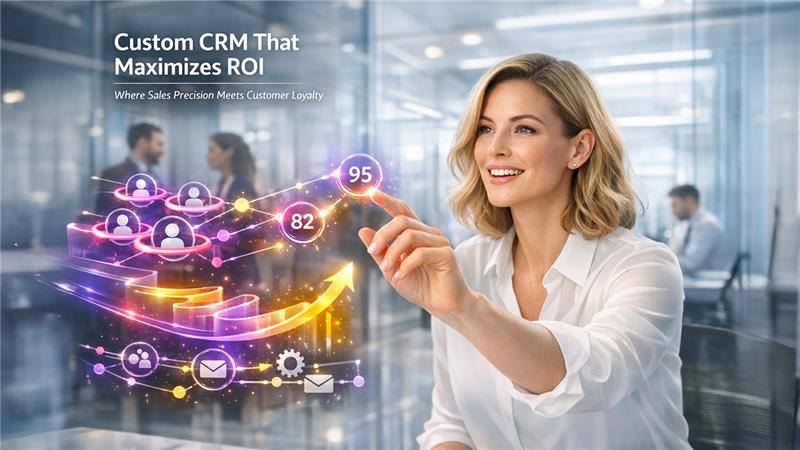
Maximizing ROI with Custom CRM Software Development
Learn how a custom CRM system optimizes sales pipelines and fosters long-term customer loyalty through data-driven personalization and automation.
Nowadays customers expect immediate responses, personalized interactions, and seamless experiences for all encounters at all brands. For salespeople, this means more information to handle, more touchpoints to engage, and increased expectations than before. An adaptive CRM solution helps businesses deal with this by relating their technology to the real processes of selling and customer relationships.
Custom-built platforms, unlike off-the-shelf software, are designed around how your team actually works, not the other way around. This adaptability is felt in sales productivity and customer retention rates.
Jelvix is a trusted technology partner that empowers business transformation, enabling start-ups and enterprises to make informed decisions. For the creation of custom software, Jelvix develops and designs systems adjusted to a specific company’s processes and operations. The company uses state-of-the-art technologies to provide scalable and all-inclusive solutions, allowing the development of efficient enterprise resource planning.
The Strategic Shift Toward Customization
Ready-to-go options come with what’s commonly known as the paradox of feature richness: prepackaged with features that you don’t need, and not enough tools that you do. A custom CRM system does away with this “feature bloat,” and concerns itself only with the functions that underpin your specific sources of revenue. When the software is closely aligned with your existing business logic, companies can lower the learning curve for employees and see better adoption rates of the tool across departments.
Custom CRM Development Services for Sales Precision
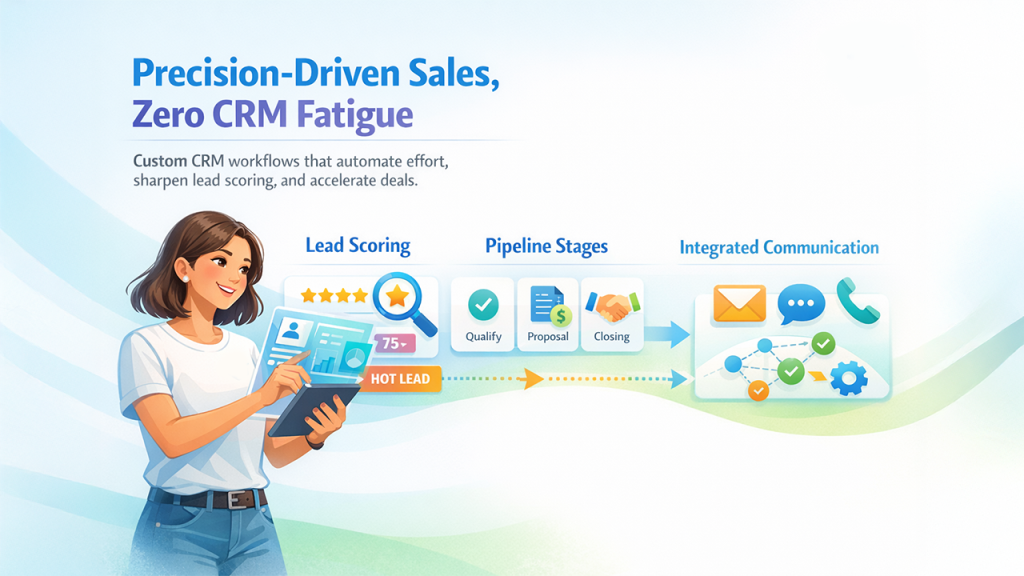
Every sales team’s main objective is to get leads through the funnel with as little friction as possible. Most generic CRMs call for sales reps to log data manually through tabs after 5 tabs, resulting in “CRM fatigue.” But when you work with a custom CRM development company, you can automate all these repetitive daily actions in accordance with your unique sales cycle.
- Lead Scoring Accuracy: Tailor your lead scoring algorithms to reflect your ideal customer profile (ICP) rather than using generic industry benchmarks.
- Pipeline Visualization: Develop a visual interface that reflects your unique phases of negotiation, ranging from the initial outreach through contract execution.
- Integrated Communication: Your own CRM can be integrated with your customized communications solutions by the CRM developer to automatically record all emails, calls, and even messages sent through “Slack.” For organizations which are keen to know about the technicals behind implementation projects like this one, examining the Software development life cycle is essential to ensure effective implementation.
Enhancing Retention with a Custom CRM System
Related walkthrough
SuiteCRM Training Day 4 | Outright Utils and Flight Dashboard for Faster CRM Development

The cost of acquiring a new customer is far more than retaining the existing. A custom CRM solution can go beneath the skin to deliver insights that are crucial to cementing long-term loyalty. When your data is siloed, you lose those tiny signals that a customer might be poised to leave you. High-performing sales teams are much more likely to rely on CRM systems that centralize customer data and enable tailored engagement, according to Salesforce’s State of Sales report.
- Personalized Customer Journeys: Trigger automated and personalized reminders based on behavior. For example, should the client’s behavior patterns shift, the software can notify the account manager instantly.
- Advanced Analytics: Using standard tools, creating your own solution enables the capability to perform proprietary modeling. Future consuming patterns can be modeled from historical engagement within your sub-niche.
- Proactive Support: With your customer support tickets directly integrated into your custom CRM, your business can access the 360-degree image of the client’s health prior to making a phone call.
Understanding the difference between CRM and ERP is also essential for companies aiming to create a unified data environment that supports both sales and back-office operations. Research from McKinsey shows that effective personalization, enabled by well-structured CRM systems, can increase customer loyalty and drive higher lifetime value across industries.
Why Hire a Custom CRM Software Development Company?
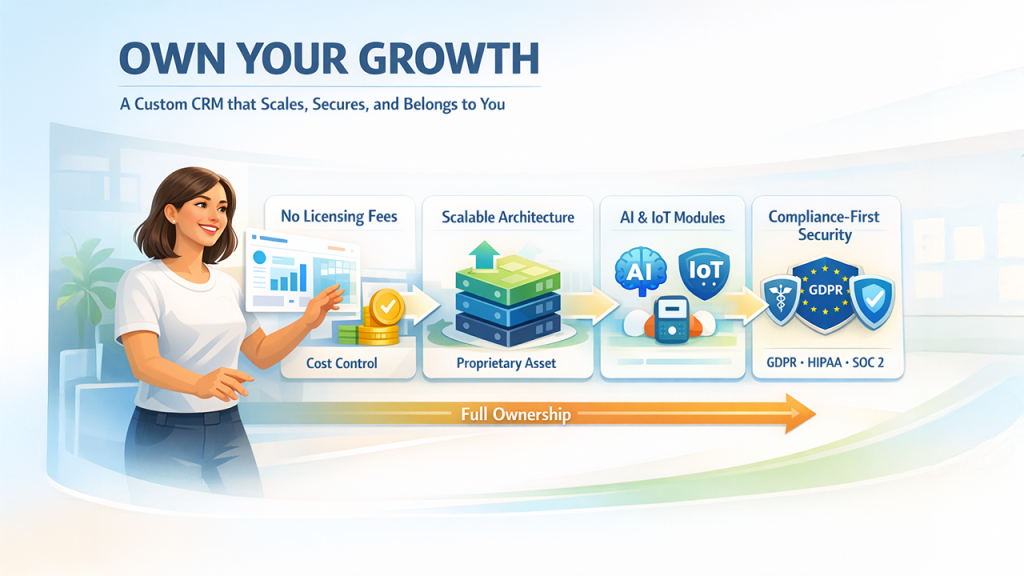
Understanding how a leading custom software development agency delivers business value is crucial when choosing to build rather than buy—a significant investment. However, the long-term Total Cost of Ownership (TCO) often favors custom builds because they eliminate per-user monthly licensing fees that scale aggressively as your company grows.
You are investing in a proprietary asset rather than merely purchasing code when you work with a custom CRM software development business. This asset scales with you, allowing for the addition of AI-driven modules or IoT integrations as your digital maturity increases.
Furthermore, a custom CRM ensures that security protocols are built around your specific compliance requirements (such as GDPR, HIPAA, or SOC 2), providing a level of protection that generic cloud providers might not prioritize for your particular region or industry. This focus on the customer experience strategy ensures that every touchpoint is secure and seamless.
Optimizing Workflows with Custom CRM Developers
A CRM is as good as its ability to connect with other software. Custom CRM developers concentrate their resources on developing a “single source of truth” by crafting strong APIs that link your CRM with marketing automation, accounting software, supply chain management, and reliable CRM Hosting environments that ensure seamless data access and performance.
That interconnectedness means that when a sale gets closed in their custom CRM system, the finance department gets informed, stock is updated, and the shipping department receives a manifest without anyone having to press a single button. This kind of synchronization is hardly reached with “out-of-the-box” plugins.
Key Features to Include in Your Custom Build:
- Use Role-Based Access Control (RBAC) to make sure that only those who require sensitive information may access it.
- Mobile-First Design: Give your field sales staff access to a personalized CRM system that functions flawlessly on mobile devices.
- Automated Reporting: Produce reports in real time that highlight the KPIs that are most important to your stakeholders.
Conclusion: The Future of Relationship Management
In a market that’s competitive, the “personal touch” is your greatest strong point. With custom CRM software development services, you can build that personalization into your automation flows. Investing in a solution specifically designed for your company, such as a glove, gives your sales force the tools they need to market more effectively and assist your support staff in providing better customer service.
Invest in your company’s future agility with a custom digital ecosystem. Whether you are an SMB or multinational enterprise, custom CRM is what sustainable growth stands on. For those who are ready to take this path, implementing a step-by-step guide on creating a CRM system can give a powerful push, from a technical and strategic point of view.