
How AI Model Orchestration Supports Scalable and Secure Systems
Discover how AI model orchestration services enable scalable, secure, and resilient systems by integrating multiple AI components for enterprise-grade efficiency.
One of the greatest challenges that hinder growth in modern technology stacks is growing complexity. As organizations implement more and more AI systems, they tend to develop silos. These silos cause inefficiency, security gaps and high operational costs. The solution lies in AI Model Orchestration. It is a framework that coordinates various components of AI to form a unified, robust system. Orchestration keeps every model in sync with the bigger scheme of things. It turns chaos into structured and scalable intelligence.
The Foundation of Enterprise-Grade AI
Orchestration is not limited to just making connections between APIs. It creates a centralised Control Plane for intelligence. This layer handles the lifecycle of all models, from deployment to-retirement. As AI systems are very complex, many companies use AI model orchestration services to create orchestration layers that connect legacy data to modern-day LLMs. These services offer an architectural blueprint to high-performance AI systems.
Without this central layer, scaling becomes reactionary and inefficient. Orchestration takes the distributed models to become a cohesive engine for business value. It makes it reliable, fast, and supervised.
Architecture for Elastic Scalability
Demand for AI resources is constantly changing. Static systems are not able to keep up. Orchestration allows for Dynamic Resource Allocation, allowing simple tasks to be assigned to small and efficient models, reserving heavy compute for complex reasoning. This type of load balancing is essential in order to effectively manage cloud costs. Key capabilities are as follows:
- Auto-Scaling — Based on real-time traffic, new instances spin up.
- Model Routing — Queries are routed to the best-fit model automatically.
- Latency Management — Orchestrators choose the quickest route for responses.
- Resource Prioritization — It prioritizes critical processes over background tasks.
These mechanisms guarantee that optimal use of resources at any point in time. They also promise predictable performance even during busy or peak hours.
Security and Governance in the Age of AI
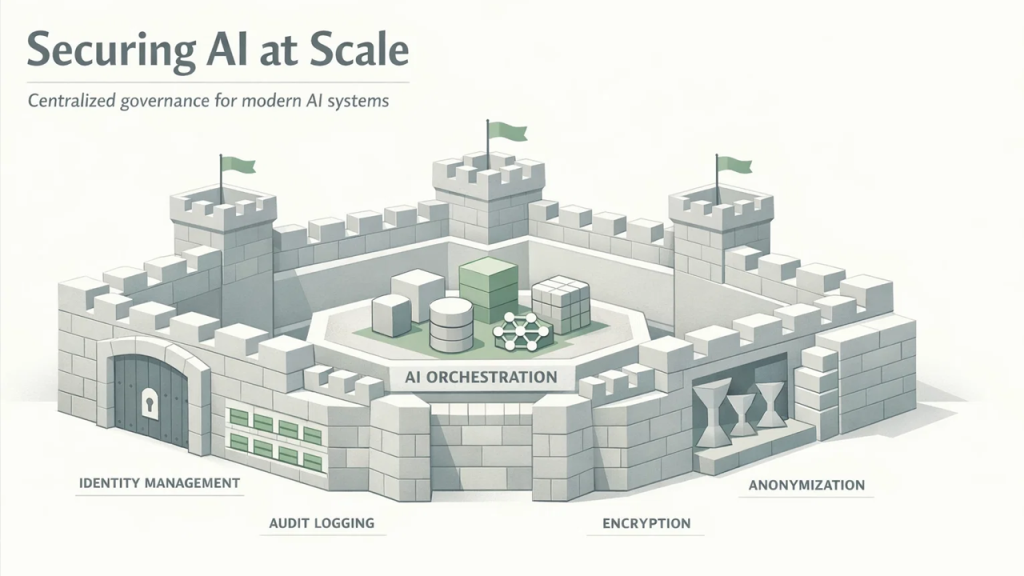
Security is one of the major concerns of scalable systems. AI enters the realm with prompt injection, data leakage, and misuse of models. Orchestration serves as a security perimeter and ensures the same policies are applied to all models. Components of the security framework are:
- Identity Management — Makes sure that only authorized agents can access certain models
- Encryption at Rest and In Transit — Encrypts data in transit between systems
- Anonymization Pipelines: Scrubbing of the personally identifiable information (PII) before processing.
- Audit Logging — Records all the model interactions for compliance and forensics.
By centralizing these functions, orchestration lowers the attack surface and ensures ethical AI usage. It is also easier to govern and allow global compliance with minimal overhead.
From Manual Workflows to Agentic Autonomy
Related walkthrough
This AI Orchestrates Humanoid u0026 Industrial Robots | KinetIQ

Traditional automation is based on unbending “If-This-Then-That” logic. It is brittle and cannot be easily scaled. Modern AI orchestration uses Agentic Workflows, self-correcting loops required to detect failures or anomalies and re-route tasks automatically. This way, fault tolerance across critical systems is guaranteed. Key benefits include:
- Automatic verification for the model outputs.
- Re-routing work to other models if mistakes are made.
- Continuous uptime when components fail.
Agentic autonomy makes orchestration work as proactive system resilience rather than reactive management. Teams are able to concentrate on strategic outcomes, rather than firefighting, provided they implement robust agentic ai security protocols to prevent unauthorized model actions. Leading AI Application Development Companies implement these agentic workflows to ensure continuous uptime and fault tolerance across critical enterprise systems.
Advanced Vocabulary for System Architects
Understanding the craft of orchestration means having a good command of technical terminology. These concepts define the scope and structure of enterprise A.I. systems:
Control Plane — Centralized layer to control AI operations.
- Model Drift — Gradual loss of accuracy of the models over time.
- Service Mesh — An infrastructure layer for secure service-to-service communication.
- Containerization — Packaging and deploying models with the help of tools such as Docker.
- Observability — Deep monitoring of health, latency, and quality of output.
- Cold Starts — Delays when activating idle model instances.
Mastery of these terms is what is required to ensure that architects can design systems that are efficient and resilient. Proper orchestration reduces downtime and makes it more predictable.
Ensuring Long-Term Integrity
Scalable AI systems should also be auditable. Orchestration offers a Single Source of Truth by keeping track of which version of which model generated a given output. This is called Model Versioning, which helps teams roll back updates safely.
Orchestration is the immune system of a scalable AI network. It identifies, separates, and corrects anomalies in real time. Centralized control enables companies to enforce global guardrails. Every model follows security, ethical, and regulatory standards automatically. This simplifies human oversight along with key decision-making.
Measuring Performance and Impact
Operational efficiency business outcomes determine success in AI orchestration. Important metrics include:
- System Uptime — It makes sure that important applications are available almost continuously.
- Token Utilization — Getting the most out of compute for cost efficiency.
- Response Latency — Fulfilling real-time experiences with minimal delay.
- Compliance Coverage — Ensuring regulatory compliance and zero data leaks.
These measures are both technical and business performance-related. They replace complicated tables with actionable and easy-to-read benchmarks for teams.
Final Word!
AI model orchestration forms the backbone of modern enterprise AI. It guarantees scalability, security, and operational efficiency. By having a central platform that brings together multiple models, companies are turning the collection of tools into a cohesive and resilient platform. Teams that learn to orchestrate gain speed, reliability, and confidence to build AI systems that can have real-world business impact. Orchestration is not just infrastructure. It is the powerhouse of enterprise intelligence.