

Management Abbreviation: 30 Common Business Terms Every Professional Should Know
Learn every important management abbreviation, common workplace acronyms, and the short form of management with 30 business terms explained for beginners.
Suppose it’s your first week on the corporate job, and you walk into a meeting with a notebook in one hand and coffee in another. Then you hear someone say, “Let’s circle back on the KPIs after we finish the ROP review, and keep ROI numbers in mind for the QBR.” You nod along, smiling on the surface but panicking inside and thinking, “What just happened?”
This makes you realize why management abbreviations matter in the corporate world. They’re used everywhere in business, from emails to Slack messages to board presentations.
This blog breaks down what management abbreviations actually are, how the word “management” itself gets shortened, walks through 30 of the most common management terms and why they exist, and shares honest advice on when to use abbreviations and when to leave them out.
What Are Management Abbreviations in Business?
Management abbreviations are shortened forms of common business terms, phrases, or job titles that professionals use to communicate faster in business landscapes. Rather than typing “Chief Executive Officer” every time, people just say “CEO.” They show up everywhere, from performance reviews to project updates to daily team chats. They exist to make businesses move fast instead of slowing it down with long phrases.
What Is the Standard Abbreviation for Management?
Before we explore the bigger list, let’s start simple. The word “management” itself gets shortened all the time, which is commonly visible in job titles, resumes, and internal documents.
- Mgmt – It is the most common short form, used in titles like “Mgmt Team” or “Sr. Mgmt.”
- Mgt – It is a slightly shorter version of the same word, often seen in older or more compact documents.
- Mngt – This is another accepted variation, though less common than “Mgmt” today.
It is worth mentioning that none of these are official or standardized in a strict sense; however, they’re widely recognized across industries. So, it is safe to use them in internal notes or informal writing.
30 Common Management Abbreviations and Acronyms You Should Know in 2026

Here’s a rundown of some of the most widely used management abbreviations, grouped by the area of work they show up in most. For each one, you’ll find what it stands for and why people actually use it.
General Management Abbreviations and Terms
- CEO (Chief Executive Officer) – The top decision-maker in a company. It is used constantly in org charts, reports, and everyday conversation because “Chief Executive Officer” is a mouthful to repeat.
- COO (Chief Operating Officer) – It oversees daily operations. Teams use this shorthand to quickly identify who’s responsible for keeping the business running smoothly.
- CFO (Chief Financial Officer) – Manages the company’s finances. This one shows up in budget meetings and financial reports where clarity and speed both matter.
- MBO (Management by Objectives) – A management style where goals are set collaboratively. It’s used to describe a whole philosophy in just three letters.
- SOP (Standard Operating Procedure) – A documented process for how a task should be done. Companies use SOPs, so nobody has to guess how something is supposed to work.
- B2B (Business to Business) – It describes companies that sell to other companies rather than individual consumers. It saves a lot of repetition in marketing and sales conversations.
- B2C (Business to Consumer) – The opposite of B2B. This means businesses sell directly to everyday customers.
Project Management Abbreviations
- PM (Project Manager) – The person steering a project from start to finish. It’s used so often that most teams drop the full title entirely.
- PMO (Project Management Office) – A team or department that sets standards for how projects are run across a company.
- WBS (Work Breakdown Structure) – A way of splitting a big project into smaller, manageable pieces. Project managers use this abbreviation constantly when planning timelines.
- SCRUM – It is not technically an acronym, but a framework for managing work in short cycles called sprints. Teams use it to describe an entire way of working in one word.
- KPI (Key Performance Indicator) – A measurable value that shows how well something is performing. It’s the go-to term when someone wants to know, “Are we actually succeeding here?”
- OKR (Objectives and Key Results) – A goal-setting method that pairs a big objective with specific, measurable results. It’s used to keep teams aligned on what actually matters.
- RACI (Responsible, Accountable, Consulted, Informed) – A chart used to clarify who does what on a project. This one saves entire conversations about “wait, whose job is this?”
HR and People Management Terms
- HR (Human Resources) – The HR department that handles hiring, employee relations, and workplace policies. It’s used so often that most people forget it’s even an abbreviation.
- PTO (Paid Time Off) – Time employees can take off while still getting paid. It’s used in almost every HR conversation about vacations and leave. Many teams now pair PTO with broader leave management systems to keep attendance records accurate.
- KYE (Know Your Employee) – A practice of understanding employee strengths and needs. Companies use this shorthand when discussing engagement strategies.
- L&D (Learning and Development) – The part of HR focused on employee training and growth. Teams use this term to talk about upskilling without repeating a longer phrase.
- EOD (End of Day) – A simple way of setting a deadline without specifying an exact time. It shows up constantly in emails and task lists.
- EOW (End of Week) – It is similar to EOD, but for weekly deadlines. It is a useful shorthand when you’re planning timelines.
Finance and Strategy Abbreviations
- ROI (Return on Investment) – It measures how much value or profit came from a particular investment. It’s one of the most used abbreviations in business because everyone wants to know if something was worth the money.
- P&L (Profit and Loss) – A financial statement showing a company’s revenue and expenses. Finance teams use this shorthand daily.
- YoY (Year over Year) – It compares performance from one year to the next. It’s a quick way to show growth or decline without writing a whole sentence.
- QBR (Quarterly Business Review) – A meeting held every quarter to review performance and set new goals. Teams use this abbreviation so often that the full phrase almost feels unnecessary.
- CAPEX (Capital Expenditure) – This means money spent on long-term assets like equipment or property. This term is common in budgeting conversations.
- OPEX (Operational Expenditure) – It explains the day-to-day costs of running a business. Paired with CAPEX, it helps finance teams separate short-term and long-term spending.
Getting CAPEX and OPEX right often comes down to solid integrated business planning across departments.
Business Communication and Meeting Terms
- ASAP (As Soon As Possible) – It is used to flag urgency without over-explaining. It’s one of the oldest and most recognized abbreviations in professional communication.
- FYI (For Your Information) – A quick way to share something without expecting a response. It keeps emails short and to the point.
- AOB (Any Other Business) – It is used at the end of meeting agendas to open the floor for last-minute topics.
- TBD (To Be Determined) – This is used when a decision or detail hasn’t been finalized yet. It’s a small phrase that saves a lot of back-and-forth explaining.
That’s thirty terms, and honestly, most professionals use a version of this list every single week without even thinking about it.
Benefits of Using Management Abbreviations in the Workplace
Related walkthrough
10 Must-Have WordPress Plugins: Every Site Needs These

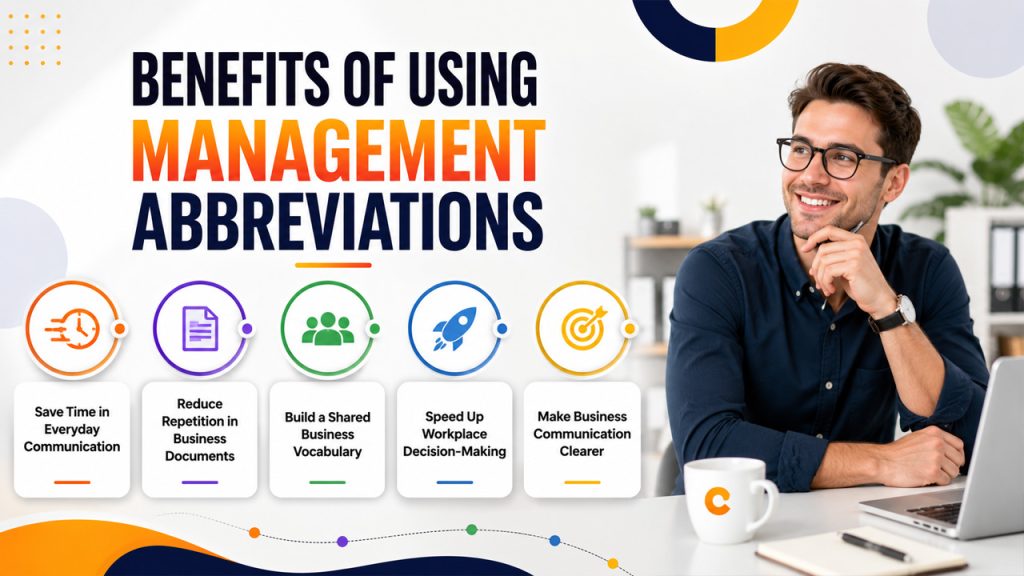
You must be wondering why businesses use these shortcuts heavily? It’s definitely not just about saving time or sounding professional. There are real, practical reasons behind it:
Save Time in Everyday Business Communication: Saying “KPI” instead of “Key Performance Indicator” might not mean much on its own. However, using the full form across hundreds of emails and meetings a week adds up time fast. Using “KPI” repeatedly becomes a real efficiency boost when you’re under time pressure and buried in work.
Reduce Repetition in Business Documents: If every single term is spelled out in full each time, it would make reading long documents and presentations exhausting, especially for those who read a lot. Abbreviations keep documents lighter and easier to skim through.
Build a Shared Business Vocabulary: Once a team agrees on what an abbreviation means, it becomes a reliable shorthand everyone can use without stopping to explain. It’s almost like a small, shared language that speeds up teamwork.
Speed Up Workplace Decision-Making: When people aren’t stopping every few minutes to explain basic terms, meetings get wrapped up a lot faster. The extra speed can mean closing up on time or running twenty minutes over. This kind of clarity is also one of the simplest problem-solving techniques teams can apply in meetings.
Make Business Communication Clearer: Shorter phrases mean conveying messages in fewer words. This means less cluttered emails. They make it easier for readers to quickly scan through information instead of wading through long, repetitive sentences.
When management abbreviations are used well, they make communication smoother for everyone involved.
When to Use Management Abbreviations (and When to Avoid Them)
Abbreviations are only helpful when the audience understands them. Otherwise, they do the complete opposite and confuse people instead of saving time.
Use abbreviations with people who share the same context as you, like your internal team, a department you work within, or your colleagues who use the same terms daily. In these situations, abbreviations speed things up since everybody is on the same page.
Avoid abbreviations when you’re dealing with a broader or less familiar audience. For instance, new employees, clients outside your organization or cross-department teams who don’t share the same vocabulary will end up getting confused. In these cases, it’s worth spelling things out, at least the first time, before switching to the shorter version.
Final Thoughts
Management abbreviations are more than just workplace slang; they’re practical responses to how fast and smoothly business communication moves. When you use them thoughtfully, they save time, keep things efficient, and help teams stay aligned without having to repeat the same long phrases over and over.
However, like any other tool, they only work when the people around you actually understand them and share the same vocabulary as you. The real skill isn’t memorizing every acronym in the book; it’s knowing when a shortcut helps and when plain language serves your audience better. Once you get comfortable with that balance, you’ll never feel lost in a meeting again, and you might even be the one explaining the acronyms to someone else.
Frequently Asked Questions (FAQs)
What is the most commonly used management abbreviation?
KPI (Key Performance Indicator) is one of the most widely used management abbreviations. It is used widely because businesses constantly need a quick way to measure and discuss performance across teams and projects.
Are management abbreviations the same across every industry?
Not always. Some abbreviations like ROI or KPI are nearly universal, but many industries develop their own internal shorthand.
How can I learn management abbreviations quickly?
The easiest way is repetition. Keep a small glossary of terms you encounter, review it occasionally, and don’t hesitate to ask a colleague what an unfamiliar abbreviation means.
Should I use abbreviations in formal business writing?
It depends on your audience. For internal, familiar readers, abbreviations are fine. For external or formal documents, it’s safer to spell out terms fully, at least the first time, to keep your writing clear and professional.
Can too many abbreviations hurt communication?
Yes. Overusing abbreviations, especially with people unfamiliar with them, can make your message confusing instead of efficient. The goal is always clarity first, and shorthand second.