
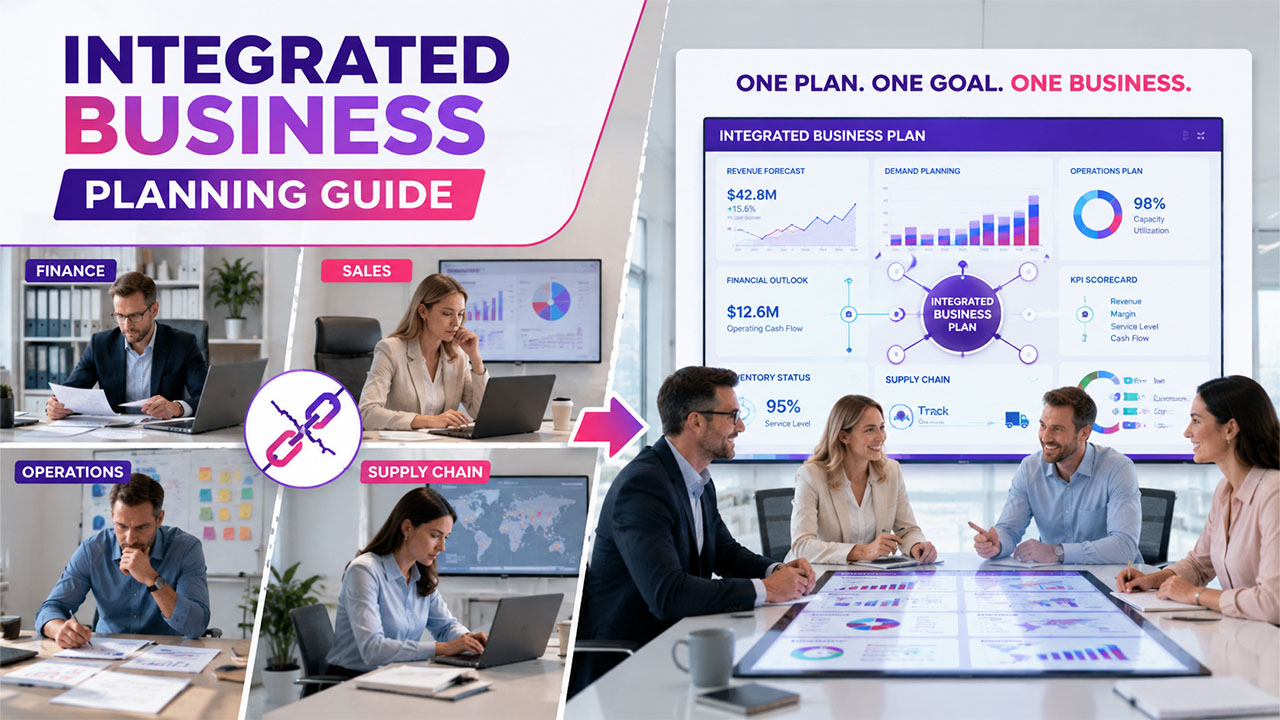
How Integrated Business Planning Improves Strategic Alignment
Integrated business planning connects finance, sales, operations, and supply in one cycle. Here's how it closes alignment gaps and sharpens strategic decisions.
When there is no communication and coordination between sales, finance, operations, and supply planning; strategic alignment quietly breaks down. Targets may look sound on paper, yet timing, cash needs, and capacity limits often surface too late.
To close these gaps, there is a need for a connected planning process. When there is a proper process in place, it links commercial intent with operational reality to significantly bridge the gap. This allows teams to make clearer decisions, carry out steadier execution, and maintain stronger follow-through across the business.
One Plan
Many companies still run budgets, forecasts, and supply reviews on different calendars. When things run separately, it splits the focus and creates blind spots. This affects productivity as one team may be able to grow easily while another faces inventory or labor limits.
With integrated business planning, leaders examine demand, production, staffing, margin, and cash in one connected view. When assumptions are shared by the team, it makes tradeoffs visible early and prevents local targets from drifting away from company priorities.
Shared Facts
Alignment depends on a common set of numbers. When departments work from separate files, simple questions can turn into long arguments over volume, price, or cost.
A connected model gives each function the same baseline and the same decision context. The debate then shifts from whose spreadsheet is right to which action best supports the plan. That change improves speed and judgment.
Better Timing
However, no matter how good a strategy is, it can still fail if the timing is not good. Sales may expect a stronger quarter while operations need more lead time to add capacity or secure materials.
Integrated business planning surfaces those gaps before things get serious. This allows leaders to sequence hiring, production, sourcing, and spending more effectively and with fewer surprises. When you have early visibility into the gaps, you can take your time making your decisions without having to rush through it. This also helps you deliver what you actually promised to your customers.
Cross-Functional Tradeoffs
Every strategic choice carries a cost somewhere else. Higher service levels may tie up working capital. Aggressive pricing may lift volume while weakening margin. Faster expansion can strain labor, supplier performance, or cash reserves.
Integrated business planning also helps make those tradeoffs quite visible, even before approval. With integrated planning, leadership teams can easily compare different scenarios, test assumptions, and choose the best path, which support broader business goals, while also minimizing unintended effects.
With Integrated business planning also helps make those tradeoffs quite visible, even before approval. Using principles from Operations Research, leadership teams can easily compare different scenarios, test assumptions, and choose the best path that supports broader business goals while minimizing unintended effects.
Financial Link
Related walkthrough
WhatsApp Business API Pricing 2026 Explained (Simple Breakdown)


The plans generally gain credibility when operating choices are connected directly to financial outcomes. The volume of shifts, product mix changes, labor requirements, and supply chain constraints affect revenue, profits, and cash flow.
Integrated business planning helps finance move closer to operational decision-making instead of reporting results after the fact. Leaders can see whether a growth proposal improves earnings, stretches liquidity, or requires a different operating pace.
The plans generally gain credibility when operating choices are connected directly to financial outcomes. Concepts from What is Business Economics help explain how volume shifts, product mix changes, labor requirements, and supply chain constraints affect revenue, profits, and cash flow.
Faster Response
Conditions can shift long before the next formal review. Demand may soften, input costs may rise, or supplier performance may weaken within weeks.
A connected planning process supports quicker response because teams already share assumptions, data, and ownership. Leaders spend less time rebuilding reports and more time testing options. That speed matters most when action stays aligned with the broader plan.
Accountability
Clear ownership strengthens alignment. A connected process assigns targets, assumptions, actions, and review points across functions, so weak spots become easier to identify. Leaders can then trace outcomes back to the choices that shaped them.
That visibility improves discipline during execution and reduces room for vague accountability. Teams work with greater trust when decision rights, follow-up steps, and expected results are plainly defined.
Metrics That Matter
Too many companies track a long list of measures yet still miss what matters. Integrated business planning works best when a small group of linked indicators guides discussion and action.
Useful measures often include forecast accuracy, gross margin, inventory turns, service levels, operating expense, and cash conversion. Reviewed together, these indicators show whether one gain is creating pressure elsewhere.
That balanced view keeps meetings grounded in business performance instead of departmental preferences. It also helps leaders judge progress with more discipline and less noise.
Better Meetings
Planning meetings often lose value when people arrive ready to defend their numbers rather than solve problems. A connected planning process changes that dynamic by establishing one factual starting point before discussion begins.
Time then goes to decisions, not reconciliation. Conversations become sharper, shorter, and more useful. That shift improves alignment because leadership energy moves into action while there is still time to adjust.
Conclusion
Strategic alignment is rarely fixed in one budget cycle. It improves through repeated decisions that connect ambition, resources, timing, and accountability over time.
Integrated business planning supports that discipline by keeping leadership teams focused on shared facts, linked measures, and realistic scenarios. Companies that work this way are better prepared to protect performance, respond with control, and keep strategy closely tied to results.
Read also: What Is Product Management? Roles, Tools & Key Frameworks Explained