


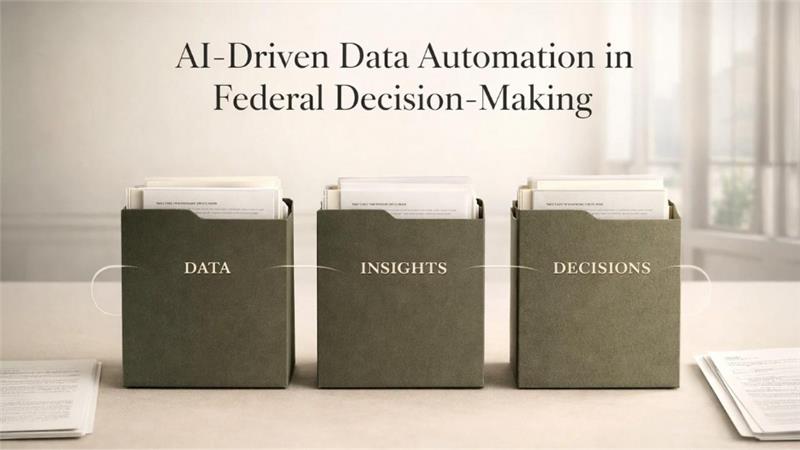

Federal decision-making is not dependent on delayed summaries and static reports. Agencies now make use of AI-driven data automation to extract actionable insights, connect systems, and stay ahead in this rapidly
Federal decision-making is not dependent on delayed summaries and static reports. Agencies now make use of AI-driven data automation to extract actionable insights, connect systems, and stay ahead in this rapidly evolving digital environment. Having access to clean, updated, and real-time information reduces guesswork and allows teams to work with accurate and credible data that strengthens credibility. This results in improved efficiency and smarter policy choices based on measurable evidence and coordinated action.
The Shift from Manual Reporting to Intelligent Systems
For a long time, federal teams were dependent on loads of spreadsheets, long email chains, and manual data entry to keep track of performance and expenses. That approach worked when datasets were smaller, but today it slows everything down. AI-driven automation replaces those repetitive workflows with structured data pipelines that collect, clean, and organize information automatically, which reduces delays and prevents costly inconsistencies.
According to specialists from AI-Vets, instead of waiting weeks for reports to circulate, agencies can now pull real-time insights from multiple systems at once. Leaders no longer rely on outdated summaries; they see current metrics displayed in live dashboards. This instant visibility into activities increases response time as agencies can now respond faster, make timely changes in budgets, and address operational bottlenecks before they get worse and turn into a large institutional problem.
Manually entering data has always been risky. Even a minor error in transcriptions can distort compliance reports or budget analyses. Intelligent systems reduce that exposure by validating inputs automatically and flagging irregularities instantly. However, automation does not eliminate oversight; it strengthens it by giving analysts cleaner data to review and clearer context for their decisions.
When machines handle repetitive compilation tasks, analysts gain time to focus on interpretation and long-term planning. You see the shift immediately in productivity. Instead of chasing numbers, teams don’t just chase numbers now; they actively evaluate trends, test different scenarios, and refine recommendations. With this, reporting doesn’t just remain as reactive obligation but transforms into a strategic asset that actively shapes and supports federal decision-making.
Breaking Down Data Silos Across Departments
There are many federal agencies that are still operating with legacy systems that struggle to communicate effectively with one another. As a result, critical information remains locked inside isolated platforms. AI-driven integration tools connect those systems without forcing agencies to abandon their existing infrastructure, which preserves investments while creating a shared data environment that supports coordinated decision-making.
Data interoperability matters more than ever because inconsistent formats slow collaboration. Automation tools standardize datasets, align terminology, and translate incompatible records into usable formats. That consistency helps different departments compare performance metrics across programs. This also allows them to recognize overlaps or identify inefficiencies that were difficult to spot because they remained hidden in separate reporting structures.
Secure data sharing frameworks also play a central role. Agencies must collaborate without compromising privacy or national security. Intelligent automation enforces access controls, encrypts transfers, and logs every interaction. With this, leaders can easily track and trace who accessed what and when. This significantly strengthens accountability while encouraging responsible collaboration across departments.
Unified dashboards give federal leadership a single source of truth. Instead of requesting updates from multiple teams, decision-makers review consolidated insights in one place. This shared visibility reduces internal friction, promotes alignment, and ensures that policy discussions are well-supported by consistent evidence rather than fragmented or contradictory reports.
Enhancing Policy Modeling and Scenario Planning
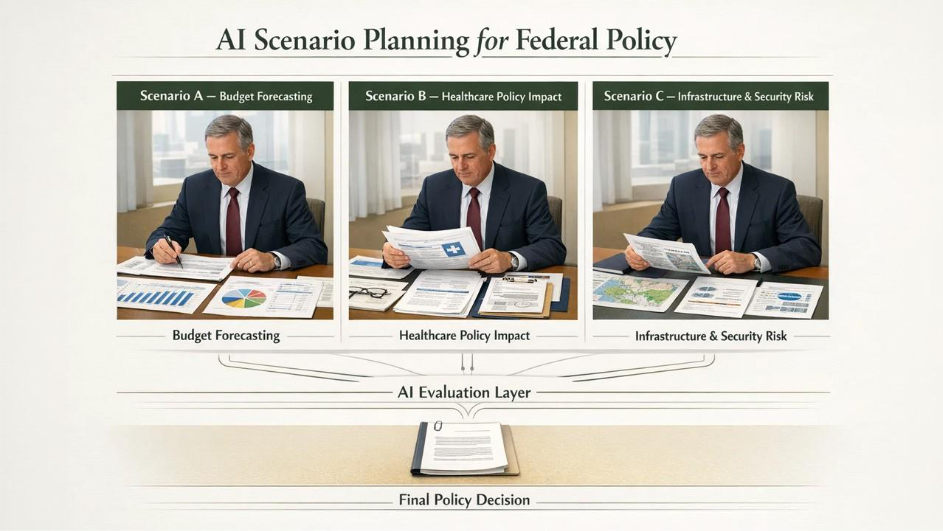
Federal policy decisions often carry long-term financial and social consequences. This is where predictive analysis comes into picture as it helps agencies forecast budget trajectories with the help of demographic data, historical trends, and economic indicators. Leaders don’t have to solely rely on static projections; rather, they can test multiple scenarios of funding paths and compare plausible outcomes before fully committing resources.
AI-driven simulations add extra layer of depth. This allows agencies to model the effect of regulatory changes on employment rates, healthcare access, or usage of infrastructure. That modeling process surfaces unintended consequences early. Moreover, it allows policymakers to refine proposals before implementation, which saves time, money, and public trust.
Risk assessment models also strengthen national security and infrastructure planning. Intelligent systems evaluate patterns of threat, supply chain vulnerabilities, and environmental risks in real time — a capability closely tied to advances in machine learning in threat detection, which enables faster and more accurate identification of emerging risks before they escalate. Instead of scattered or fragmented reports, analysts receive structured alerts. This allows them to give priority to threats based on measurable probability and potential impact.
Legislative evaluation becomes significantly faster with automation. Instead of commissioning lengthy manual studies for every proposed amendment, agencies generate scenario comparisons within days. However, human oversight and judgment are still required for final decisions. Automation supports clarity and speed, but experienced policymakers interpret results and weigh broader societal considerations.
Strengthening Compliance, Oversight, and Accountability
Federal oversight depends on accurate documentation, yet manual audit trails can often leave gaps that are detected after months. AI-driven automation records transactions, approvals, and modifications in real time. Every action leaves behind a digital footprint. This allows compliance teams to review processes quickly and confirm that agencies are following a established regulations without having to hunt through scattered files.
Financial oversight improves when systems detect anomalies instantly. Instead of waiting for quarterly audits to uncover irregularities, intelligent platforms flag unusual spending patterns as they occur. Analysts can investigate discrepancies within hours, not weeks. This rapid response reduces the likelihood of prolonged misallocation and strengthens fiscal responsibility across departments.
Grant and contract monitoring also benefit from automation. Agencies manage thousands of agreements simultaneously, and manual tracking simply cannot scale. AI tools evaluate milestones, deadlines, and spending benchmarks continuously. When a contractor misses a requirement, the system alerts responsible officials immediately, which keeps projects aligned with federal standards and performance expectations.
Public accountability grows stronger when performance data becomes transparent and accessible. Leadership teams can publish structured progress metrics without exposing sensitive information. Citizens and oversight bodies gain clearer insight into how funds are used, and decision-makers maintain confidence that their programs withstand scrutiny because the underlying data remains consistent and verifiable.
Accelerating Emergency Response and Crisis Management
Crisis or emergency situations demand high coordination, speed, and accurate information. AI-driven data automation pulls live feeds from weather systems, healthcare networks, transportation hubs, and public safety databases. Instead of juggling fragmented updates, emergency coordinators view synchronized information that support faster, more confident decisions during high-pressure situations.
Resource allocation becomes far more precise when predictive models analyze supply levels and demand patterns in real time. Agencies can redirect personnel, medical supplies, or infrastructure support before shortages escalate. This proactive approach helps reduce bottlenecks while ensuring that federal response efforts align with real on-the-ground conditions rather than outdated or incorrect estimates.
Early warning systems that are powered by machine learning can identify emerging public health threats or infrastructure failures before they escalate and cause financial loss. Structured alerts are received by analysts which highlight the patterns that human observers might miss or overlook. However, trained professionals still validate findings, which ensures that automated insights translate into responsible, well-informed action.
Interagency coordination improves dramatically when teams operate from a shared decision dashboard. Leaders don’t have to rely on separate communication chains; instead, they can review synchronized updates and align strategies immediately. This clarity reduces confusion, boosts response times, and allows federal agencies to act as a unified force when communities are in need of instant support.
Wrap Up
AI-driven data automation is not just limited to speeding up reporting. It actively reshapes the thought process, strategies, and responsiveness of federal agencies. By breaking down silos, improving oversight, and strengthening crisis coordination, intelligent systems turn raw information into strategic clarity. However, technology works best when paired with human judgment. When you combine automation with experienced leadership, it creates a faster, more transparent, and far more resilient decision-making model.
Respond to this article with emojis