

How to Evaluate AI Humanizers for a Team: A Buyer’s Guide for 2026
Understand how to compare AI humanizers for businesses and learn what matters most, from detector performance to privacy and scalability.
Most teams pick their first AI humanizer the same way they pick their first project management app: someone signs up for whatever ranked first in a search, the trial works on a paragraph or two, and six weeks later the whole marketing department is pasting drafts into a tool nobody actually vetted. That works fine until it doesn’t. And when it does fail, the cost shows up late: flagged content, a leaked client draft, or a workflow that falls apart the moment more than one person needs to use it.
If your team is starting to lean on AI Writing Tools for first drafts, product copy, support docs, or outbound messaging, a humanizer is no longer a personal productivity gadget. It becomes a piece of your content stack, and it deserves the same scrutiny you would give any tool that touches your data and your brand voice.The problem is that this category markets itself almost entirely in superlatives. Every landing page claims the highest bypass rate, the most natural output, and unlimited everything. None of that tells you whether the tool fits how your team actually works.
This guide skips the vendor rankings and gives you an evaluation framework instead. Run any AI humanizers you are considering through these criteria and you will know within an afternoon whether it belongs in your stack, regardless of what its homepage promises.
First, get clear on what a humanizer is (and is not)
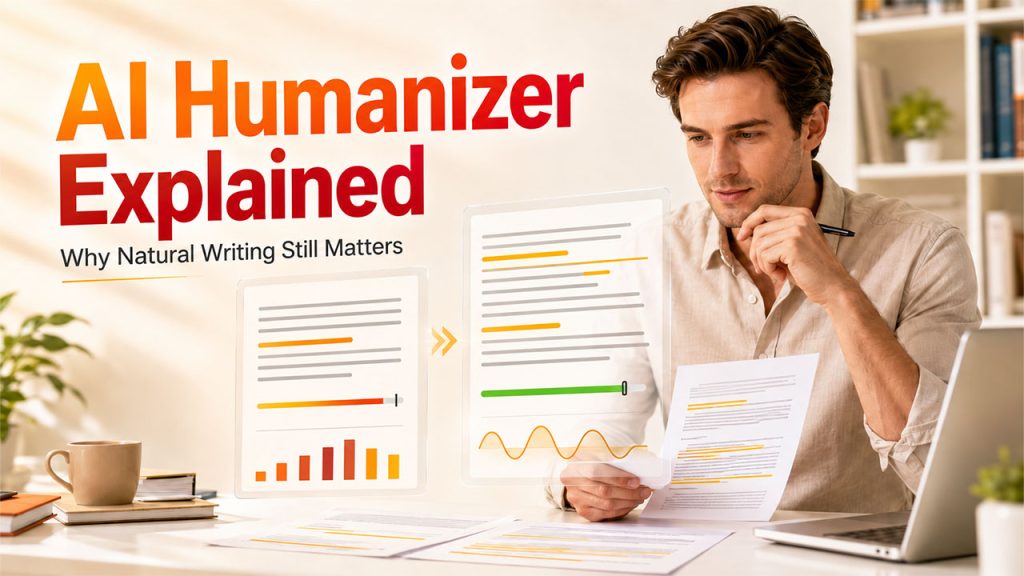
An AI humanizers takes machine-generated text and rewrites it so that it reads and measures like something a person wrote. The “measures like” part is what separates it from a plain rewriter. AI detection tools never engage with what your content says. They measure how it is built: whether word choices follow predictable paths, whether sentence lengths cluster around the same size, and whether the structure repeats itself across a document. Raw output from a large language model tends to be smooth, even, and predictable in exactly the ways these systems are tuned to catch.
A basic paraphraser trades one word for another and moves clauses around. The sentence looks different afterward, but the measurements underneath barely move, which is why paraphrased text so often still trips detectors. A genuine humanizer works a layer deeper, changing how predictable and how uniform the writing measures so the output varies the way human writing naturally does. When you evaluate tools, this is the first line to draw. Plenty of products marketed as humanizers are really just paraphrasers with a new label, and they will not hold up under the detectors your audience or your platforms actually use.
Why does any of this matter for a business rather than a student trying to sneak an essay past a professor? Because detection has worked its way into the channels teams publish through. Client sign-off increasingly includes a detector pass, agencies see RFP responses and deliverables checked before contracts move, and a growing share of publishing platforms screen what they accept. You may never intend to hide that you used AI, but a false flag on genuinely reviewed, human-edited work still costs you a conversation you did not want to have, or a rejection you cannot easily appeal.
Why the accuracy problem makes evaluation criteria matter so much
Here is the part most buyers miss: the detectors your work will be judged against are themselves unreliable, and that unreliability is exactly why your choice of AI humanizers has to be deliberate rather than casual.
A 2026 study published in the International Journal for Educational Integrity (Hadra et al.) put two leading commercial detectors through a balanced set of 192 texts spanning authentic human writing, professional prose, raw AI output, and mixed human-and-AI drafts. The two tools landed at roughly 69 percent and 61 percent overall accuracy. They performed worst of all on the hybrid, human-edited content that describes how most teams actually use AI in practice. The researchers concluded these tools are not suitable as authoritative arbiters of who wrote something.
Sit with what that means for a working team. The systems standing between your content and its audience are wrong a meaningful share of the time; they are least reliable on precisely the edited, mixed-authorship drafts your team produces, and yet a flag from one of them can still trigger a rejection or a trust problem. You cannot control whether a client or platform runs a flawed detector. What you can control is whether the tool you adopt reliably clears that gate without wrecking your writing in the process. That is the whole game, and it is why loose criteria produce expensive mistakes.
So treat detection as a gate you need to pass consistently, not a coin flip you hope to win. The rest of this guide is about how to tell which tools clear it reliably and which just claim to.
AI Humanizers Capabilities That Actually Matter for a Team
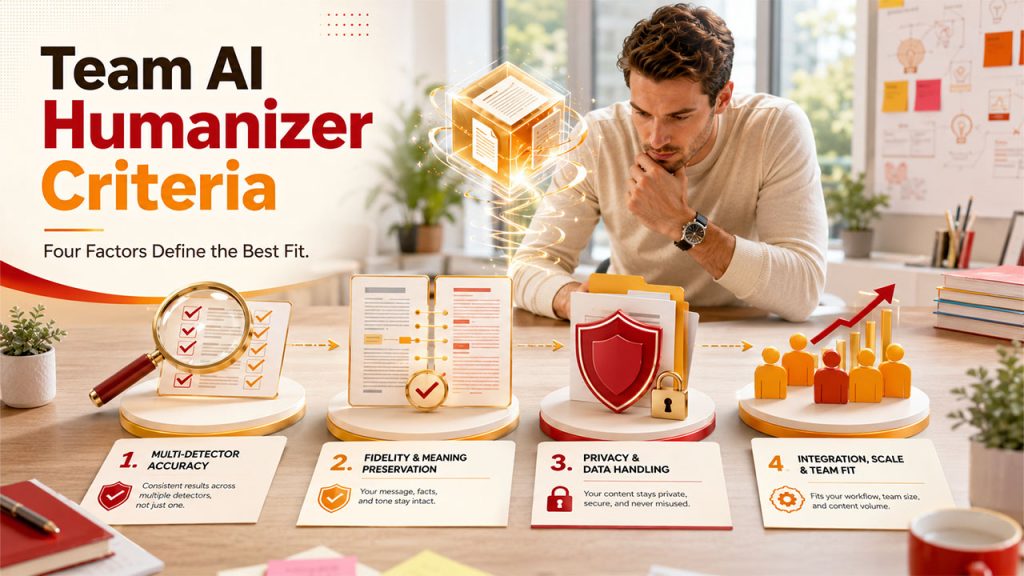
When a single person uses AI humanizers, the only question is whether the output reads well and passes. When a team adopts one, four dimensions matter, and most buyers only think about the first. Nearly every tool you will shortlist, the UndetectedGPT humanizer included, markets on that first dimension alone, which is exactly why the other three need your attention.
1. Detection accuracy across multiple detectors, not one
The single most common evaluation mistake is testing against one detector and declaring victory. A tool that reliably clears one popular checker may fall apart against another, because each detector weighs those statistical signals differently. If your content goes out to varied audiences and platforms, you cannot predict which system will screen it.
So build a small test bench before you commit. Take three or four representative pieces of your actual output (a product description, a support article, an outbound email, whatever your team ships most), run each through AI humanizers, then check the results against several independent detectors rather than the one the vendor happens to show on its own site. Be especially skeptical of tools that only advertise results against the easiest, least reliable detectors. That selective framing is usually hiding weaker performance where it counts.
What you are looking for is consistency across checkers on your own content, not a single flattering screenshot. A tool that clears three detectors on your real material is worth more than one boasting a 99 percent figure you cannot reproduce.
2. Fidelity: does your meaning survive the rewrite?
A humanizer that passes every detector but mangles your message is worse than useless, because the damage is subtle. The text still reads fluently. It just no longer says quite what you meant. For a team, that is how a product claim drifts into something inaccurate, a compliance-sensitive line loses its careful wording, or a brand’s tone flattens into generic filler.
Test fidelity on your hardest content, not your easiest. Feed the tool a paragraph with a specific technical claim, a number that matters, or a nuanced argument, then read the output line by line against the original. Do the same points appear in the same order? Did any figure change? Did a hedge or qualifier quietly disappear? Cheaper tools tend to trade fidelity for bypass rate, scrambling text aggressively enough to fool a detector while sanding off the precision that made the writing worth publishing.
For a team, this criterion is also about voice. If every humanized draft comes back sounding like the same beige corporate template, you have lost the brand differentiation you were paying writers to build. Good output preserves your argument, your evidence, and your tone. Weak output preserves none of those reliably.
3. Privacy and data handling
This is the criterion teams skip and later regret. Every piece of content you run through AI humanizers is text you are sending to a third-party service. That might include unpublished campaigns, client deliverables under NDA, internal strategy, or product details that are not public yet.
Before you standardize on any tool, get concrete answers. Does the vendor retain your submissions, and for how long? Is your content used to train models? Who on their side can access it? Is there a business or team plan with the data-handling commitments your legal or security people will actually accept? A tool that is perfectly fine for a solo blogger writing public posts may be completely inappropriate for a team handling confidential client work, and the difference has nothing to do with output quality.
Treat this exactly as you would treat any SaaS vendor touching sensitive data. If you cannot get a clear answer on retention and training use, that silence is your answer.
4. Integration, scale, and team fit
The last dimension is the one that separates a personal tool from a team tool. A humanizer that works beautifully for one person can become a bottleneck the moment five people need it.
Think about volume first. Free and entry tiers often cap output at a few hundred words per run or a small monthly allowance, which evaporates the instant a content team leans on it daily. Map the pricing to your real throughput, not a demo. Then think about access: does the plan support multiple seats, or is everyone quietly sharing one login and stepping on each other’s usage? For higher-volume or repeatable workflows, an API matters, because it lets you fold humanization into an existing pipeline instead of making it a manual copy-paste chore that someone will eventually skip.
Also weigh the everyday friction. How many steps does it take to move a draft through the tool and back into your workflow? AI humanizers that adds thirty seconds of paste-wait-copy to every piece will get abandoned by a busy team no matter how good the output is. The best fit is the one your people will actually keep using under deadline pressure.
Running the comparison
Related walkthrough
Stellar OST to PST Converter Review 2026 | Online vs Desktop – Real Test

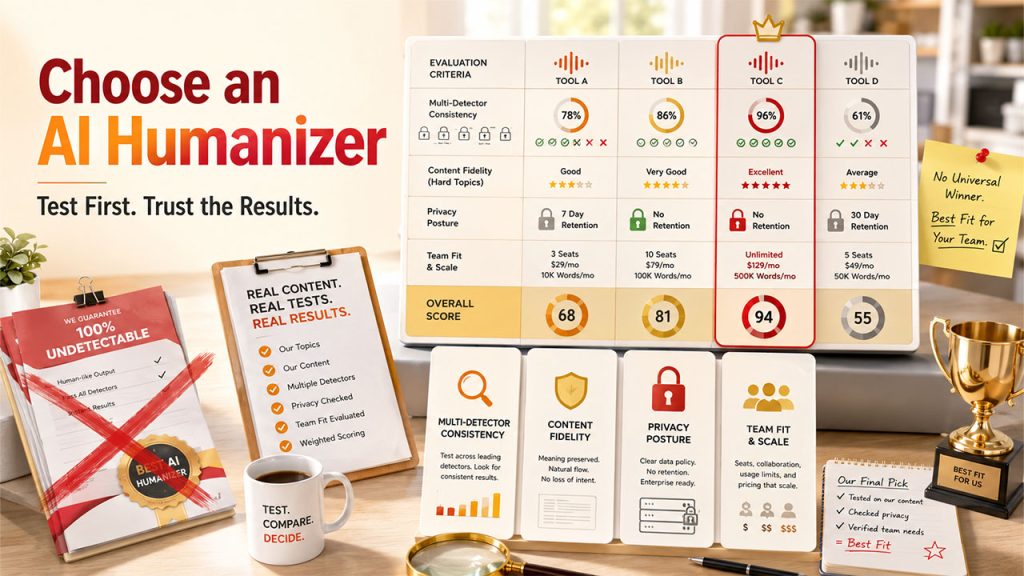
Once you have your four criteria, comparing tools becomes a structured exercise rather than a vibe check. Set up a simple scorecard as part of your Humanize AI Tool Analysis. Down the side, list the humanizers you are considering. Across the top, put your four dimensions: multi-detector consistency, fidelity on hard content, privacy posture, and team fit including price and scale. Score each tool on your own material, not the vendor’s examples.
A few tools have built a reputation in this space, and you will see the same names surface as you research: Undetectable AI, WriteHuman, and UndetectedGPT among them, alongside a long tail of cheaper entrants. Do not take any ranking, including one you read here, as a substitute for running your own bench. The point of the scorecard is that it neutralizes marketing. A vendor cannot claim its way to a good score on content you supplied and checked yourself.
Weight the criteria to your situation. A team publishing public marketing copy might weight fidelity and team fit highest and treat privacy as a lower bar. A team handling client deliverables under NDA might make privacy a hard gate that disqualifies any tool that cannot answer the retention question, regardless of how well it performs elsewhere. There is no universal winner, only the best fit for your constraints. That is the honest version of “best,” and it is the only one that holds up on your actual work.
How to run a two-week evaluation
If you want a concrete process, here is one that fits into a normal sprint without derailing anyone.
In the first few days, assemble your test bench: three to five real pieces of content that represent the range of what your team ships, and a short list of detectors you will check against. In the first week, run every candidate tool against that same bench and log the detector results in your scorecard. Read every output for fidelity as you go, marking anywhere the meaning drifted. In the second week, narrow to your top two candidates and pressure-test them: send higher volume through, add a second team member to check seat handling, and get your privacy questions answered in writing. By the end, your scorecard will point at a clear choice, and it will be a choice you can defend to whoever signs off on the budget.
The reason this beats picking on reputation is simple. The gap between a tool that reliably clears detection on your content and one that mostly does is the gap between shipping with confidence and rolling the dice on every piece. When the downside is a flagged deliverable or a rejected submission, that reliability is worth paying for and worth testing before you pay.
What no humanizer will do for you
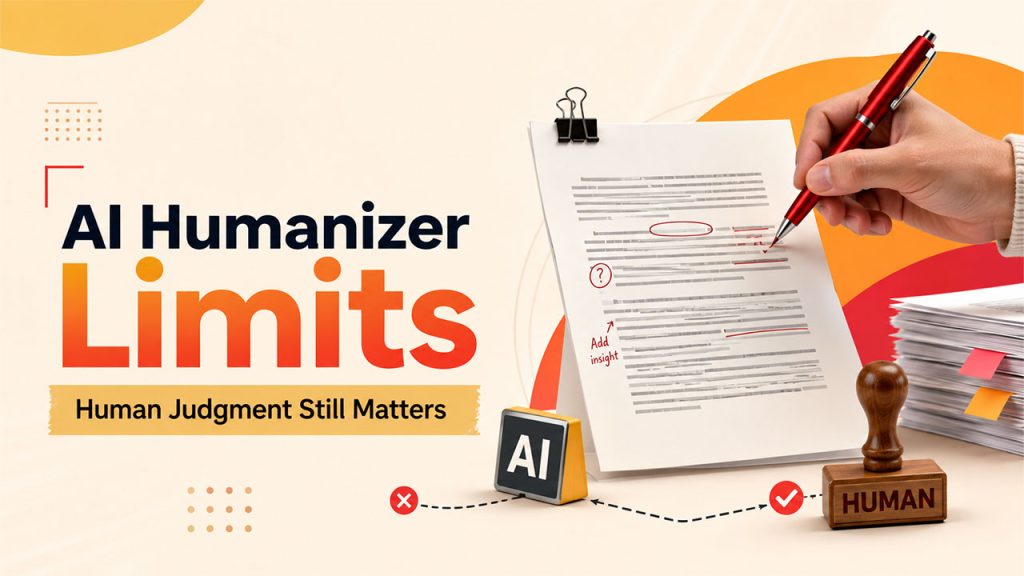
Set expectations honestly with your team, because overselling this category internally creates its own problems.
No AI humanizers remove the need for a human editor. The tools that consistently clear detection do so partly because their output is genuinely well-formed, but you still want a person reading final copy for accuracy, tone, and the small brand-specific touches software cannot know about. The strongest results come from a person adding real substance and voice on top of a clean humanized draft, not from treating the tool as a fully automated content machine.
No humanizer makes false-flag risk disappear entirely either. Detection is a moving target. Detector vendors retrain their models, and what clears a checker this quarter may need a different approach next quarter. That is another reason to favor a tool that treats output quality seriously rather than one chasing a single bypass metric, and to keep a light ongoing check rather than assuming a one-time evaluation holds forever.
And no AI Humanizers can be the substitute for judgment about when to use AI at all. The tool solves a specific problem: making legitimately produced, human-edited content read and measure like the human-involved work it actually is, so an imperfect detector does not misjudge it. Used that way, in a workflow where a person still owns the final draft, it removes friction without removing accountability.
The short version
When your team evaluates tools to humanize AI text, ignore the superlatives and score four things on your own content: consistency across multiple detectors, fidelity to your original meaning and voice, a privacy posture your security people will accept, and a fit for how your team works at your real volume. Detection is unreliable enough, as the 2026 accuracy research makes clear, that clearing it consistently has to be a deliberate choice rather than a hopeful default. Build a small test bench, run a two-week evaluation, and let your own results, not a vendor’s landing page, decide. That is how you adopt an AI Humanizers you will still trust six months from now.
Frequently asked questions
Q1. What is the difference between an AI humanizer and a paraphraser?
A paraphraser swaps words and rearranges sentences at the surface level, which usually leaves the deeper statistical patterns detectors measure intact. A true humanizer rebuilds those underlying measures (word predictability, sentence-length variation, and overall uniformity) so the output varies the way human writing does. For evaluation, treat any tool that only rewords as a paraphraser, not a humanizer, no matter what it calls itself.
Q2. How should a team test a humanizer before buying?
Build a small test bench of three to five real pieces of your own content, run each candidate tool over it, and check the outputs against several independent detectors rather than the one the vendor promotes. Read every result for fidelity, confirm the privacy and retention terms in writing, and check that the plan supports your seat count and volume. Score the results, and pick on your data, not on marketing claims.
Q3. Are AI detectors accurate enough to trust?
Not fully. A 2026 study in the International Journal for Educational Integrity (Hadra et al.) found two leading commercial detectors reached only about 61 to 69 percent overall accuracy across 192 texts, and performed worst on the mixed human-and-AI writing teams most often produce. That unreliability is exactly why clearing detection has to be a deliberate, tested part of your workflow rather than something you leave to chance.
Q4. Does using a humanizer mean my content is dishonest?
Not inherently. For a team, the common case is content that a person genuinely produced and edited but that an imperfect detector might still misclassify. Passing that gate protects legitimately produced work from a false flag. The judgment call is about how you use AI overall and whether a human still owns the final draft, which is a policy question for your team, not something the tool decides.
Q5. Do we still need human editors if we use a humanizer?
Yes. The best results come from a person adding accuracy, voice, and brand-specific detail on top of a clean humanized draft. A humanizer removes the statistical tells and reduces false-flag risk; it does not replace the editorial judgment that makes content worth publishing.