

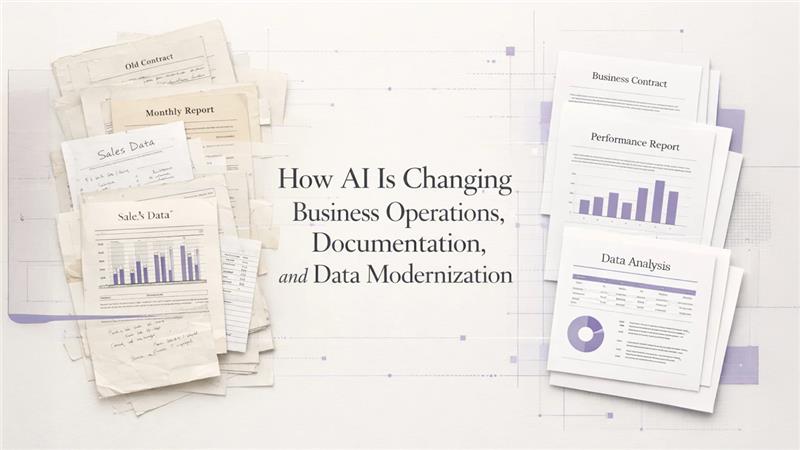

Today businesses are under consistent pressure to move quickly, minimize manual work, and more effectively use their data. While the majority of the conversation around AI greatly focuses on automation
Today businesses are under consistent pressure to move quickly, minimize manual work, and more effectively use their data. While the majority of the conversation around AI greatly focuses on automation and analytics, one area that is generally overlooked is how AI provides support to routine business processes and documentation. In this blog, we will deeply focus on the importance of AI in business operations.
Contracts, invoices, legacy records, contracts, and internal documentation are key elements to business processes. When these assets are poorly organized, outdated, or difficult to use, efficiency drops across departments. AI is greatly being utilized to advance these workflows, not by replacing platforms, but by enhancing how data is created, processed, and maintained.
Why Businesses Are Reconsidering Data Workflows and Data Processes?
Numerous businesses still depend on legacy operations that were never designed for the modern data volume or speed needs. Over time, this ensures operational friction.
Prevalent challenges involve:
- Copious volumes of paper-based and soft copies.
- Inconsistent formats of documentation.
- Poor quality of images impacting data extraction.
- Manual rework reducing audits and approvals.
As businesses improve, these problems scale and become layered. Businesses have also started to remove these bottlenecks by turning robotic process automation for digital business systems to simplify workflows and minimize manual errors. Another way you can solve it is through data modernization. Modernization of data has become less about replacing core platforms and more about enhancing the usability and quality of information flowing through them.
The Significance of AI in Business Operations
Artificial Intelligence is now an intrinsic aspect of diverse layers of business processes. Apart from analytics and forecasting, its significance in operational efficiency has evolved greatly.
Important areas where Artificial Intelligence provides value involve the following:
- Automating the routine documentation tasks.
- Enhancing consistency of data across diverse departments.
- Meeting the compliance and audit guidelines.
- Improving collaboration with much clear visual records.
Instead of working as a standalone solution, AI works as a support layer that minimizes friction in the present workflows. This is specifically significant in documentation-heavy ecosystems where clarity and accuracy play a crucial role.
Advancing Business Documentation with Artificial Intelligence
Documentation has to be one of the most resource-intensive aspects of business processes. Financial records, contracts, compliance documents, and internal reports are available in quality levels and diverse formats.
Conventional documentation workflows deal with:
- Scans in low resolution
- Cropped or misaligned images
- Visual noise that impacts readability
- Time-taking manual cleanup
AI-powered platforms aid in modernizing documentation by enhancing usability before the data reaches the analysis or processing stages. Clearer visuals often lead to more effective extraction of data, quicker reviews, and less downstream errors.
How AI Image Creation Provides Support to Business Documentation?
Visuals are not strictly limited to design or marketing. You can clearly see the images being broadly used for training, documentation, and reporting in business environments.
An AI image generator can help processes by:
- Generating visual diagrams for internal workflows.
- Creating structured visuals for presentations and reports.
- Minimizing dependency on external resources of design.
- Supporting materials used in training having consistent imagery.
Instead of depending on generic stock visuals or diagrams created manually, teams can create specialized visuals that align with particular operational requirements. Such visuals enhance understanding across non-technical and technical teams, specifically when explaining complicated processes.
Enhancing Quality of Data with AI Image Editing
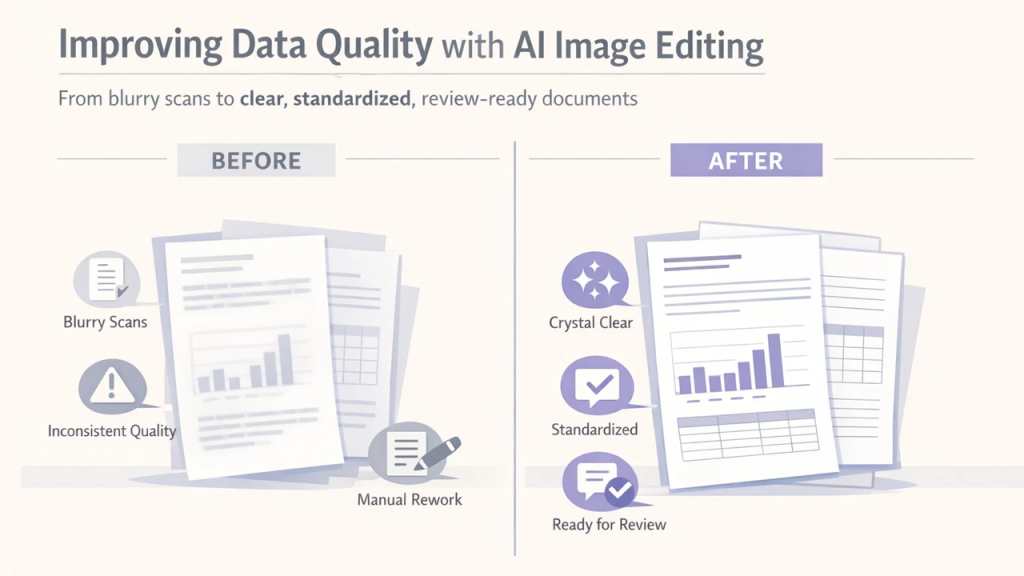
Poor quality of images is an operational risk that is not easily visible. Essentially, inconsistent visuals or blurry scans can often lead to failed extraction of data, misinterpretation of data, and compliance problems.
An AI image editor aids businesses:
- Improve clarity of scanned documents
- Standardize quality of images across datasets
- Remove visual noise that impacts processing
- Create images for precise review and annotation.
By enhancing quality of images, teams minimize the need for manual corrections later on. This impacts productivity in legal, finance, and compliance-based environments directly.
Preserving Legacy Records with Restoration of AI Photo
Numerous businesses depend on historical data that only exists in degraded or aging formats. Recreating this information from scratch is generally impossible.
This is exactly where AI photo restoration becomes crucial. It enables teams to:
- Restoring clarity in old-scanned records
- Preserve the structure of the original documents
- Enhance readability without changing the content.
- Widen the shelf-life of legacy data.
Restored images can then be directly incorporated into modern platforms, becoming useful in reporting, audits, and long-term keeping of records. This approach closes the gap between modern operational needs and legacy data.
Where Tools Like ImagineArt Align into Business Workflows
While AI platforms are generally associated with creative applications, platforms such as ImagineArt are greatly utilized as part of operational workflows.
In the context of business, such platforms provide support:
- Image creation for structured documentation.
- Editing of images for clarity and consistency.
- Restoration of photos for legacy records.
Instead of replacing the present platforms, they augment them by enhancing visual inputs quality. This enhances the efficiency of analysis, downstream processes, and collaboration.
Right Practices for Utilizing Artificial Intelligence in Modernization of Data
To extract the best value of AI in processes and documentation, businesses must follow the structured guidelines provided below:
Right practices involve:
- Refining the AI outputs with human review
- Selectively apply AI to areas of higher impact.
- Ensuring higher standards of documentation.
- Ascertaining data security and compliance.
AI is best utilized as a targeted tool, not as a one-size-fits-all solution. Clear governance and objectives make sure that automation enhances results instead of introducing newer risks.
Considerations and Limitations
AI cannot be considered as a replacement for business judgement as well as governance. While it enhances efficiency, oversight is a crucial aspect.
Organizations must consider:
- Processes of validation for AI-driven outputs.
- Access controls and data privacy.
- Regulatory needs for managing documents.
Being familiar with such limitations help businesses to implement AI responsible and sustainably.
Conclusion
AI is transforming how businesses handle documentation, operations, and modernization of data. By enhancing quality of images, creating structured visuals, and restoring legacy records, AI minimizes friction across various workflows that have traditionally protracted business operations and hindered growth.
When it is thoughtfully used, platforms such as AI image editors, AI image generators, and photo restoration solutions improve quality of data and efficiency of operations. As businesses continue to become more advanced, AI will remain a great asset in turning data into reliable and usable assets.
Frequently Asked Questions
Q1. How Artificial Intelligence is used in business processes beyond analytics?
A1- AI provides support to routine processes by enhancing documentation workflows, improve quality of data, and minimizing manual effort in managing reports, records, and internal processes.
Q2. Can AI image creation be valuable for business documentation?
A2- Yes. AI image generation aids in creating clear workflow diagrams, process visuals, and structured images for training materials, reports, and internal communication.
Q3. Why does quality of images is important in data modernization projects?
A3- Images in low-quality can often lead to errors in misinterpretation, data extraction, and compliance risks. Enhancing clarity of images early makes downstream processing more dependable.
Q4. How does AI image editing improve operational efficiency?
A4- AI image editing standardizes visuals, removes noise from scanned documents, and prepares images for review or annotation, reducing manual rework.
Q5. What role does AI photo restoration play in legacy data management?
A5- AI photo restoration helps recover clarity from old or degraded records, allowing businesses to preserve historical data and integrate it into modern systems.
Respond to this article with emojis