



Digital transformation is more than a buzzword. It is a quantifiable change in the way that businesses make decisions, allocate resources, and operate on a day-to-day basis. At the center
Digital transformation is more than a buzzword. It is a quantifiable change in the way that businesses make decisions, allocate resources, and operate on a day-to-day basis. At the center of this change are mathematical models of AI for business, algorithms that take murky numbers and turn them into clear and confident decisions. The end result is processes that are cleaner, decisions that are more confident, and teams that are no longer bogged down in number-crunching.
Why math-focused AI matters
Numbers speak the language of operations. Inventory, delivery times, cash flow analysis, and personnel management – all these are based on mathematical calculations. However, humans tend to get tired, and the spreadsheet may get damaged. Simple models are prone to missing out on the subtle patterns. This is where mathematical AI models come into play. These models are designed to solve optimization problems, calculate probabilities, and identify patterns.
These models minimize the chances of human error in analysis and enable informed decision-making by transforming unorganized data into sound conclusions. There are quick wins here. Some organizations report double-digit improvements — 10–30% — in efficiency or forecasting accuracy after deploying targeted AI-based math solutions. These are not miracles; they’re the result of applying the right math to the right operational question.
Core mathematical AI models used in operations
Machine learning classifiers and regressors uncover relationships that traditional statistics miss. Reinforcement learning can tune dynamic decision systems (think pricing engines or routing policies). Each model type answers a different operational question. Choose poorly and you get complexity without value; choose well and you yield insight and reduced costs.
AI-driven systems automate complex calculations that would otherwise require teams of analysts. These systems integrate ERP data, market data, and operational inputs in real time. ERP combined with AI to solve math problems can significantly speed up decision-making cycles. Calculating any numbers is a piece of cake for a math AI extension and ERP, but not for humans.
Practical use cases: where math AI drives value
Supply chain management is the obvious arena. AI-driven operational optimization can plan inventory across multiple warehouses, set reorder points, and recommend safety stock levels that balance service and cost. This reduces stockouts and storage waste. In forecasting, predictive analytics combine historical sales, promotions, weather, and macro trends to improve accuracy; this often leads to lower inventory carrying costs and fewer emergency shipments.
In financial modeling, AI accelerates scenario analysis — running hundreds of what-if forecasts in minutes rather than days. For workforce planning, optimization models suggest shift patterns and staffing levels that meet demand while minimizing overtime. In short: apply mathematical AI models for business where repeated, complex calculations and competing constraints exist — and you'll see faster, more defensible decisions.
How AI automates complex calculations
Automation begins with data. Clean it, join it, and then feed it to models designed for the task. A demand-forecasting pipeline, for example, ingests daily sales; it cleans out anomalies; it trains a time-series model; it evaluates prediction intervals; and it exports recommended order quantities.
All that used to require manual spreadsheets, rule-of-thumb adjustments, and long meetings. Now it runs overnight and surfaces exceptions for human review. The human role becomes oversight, not calculation. That shift decreases human error in analysis and speeds cycle time. It also frees analysts to focus on the exceptions — the interesting problems that algorithms flag but can’t fully resolve.
Optimizing resource allocation and operational efficiency
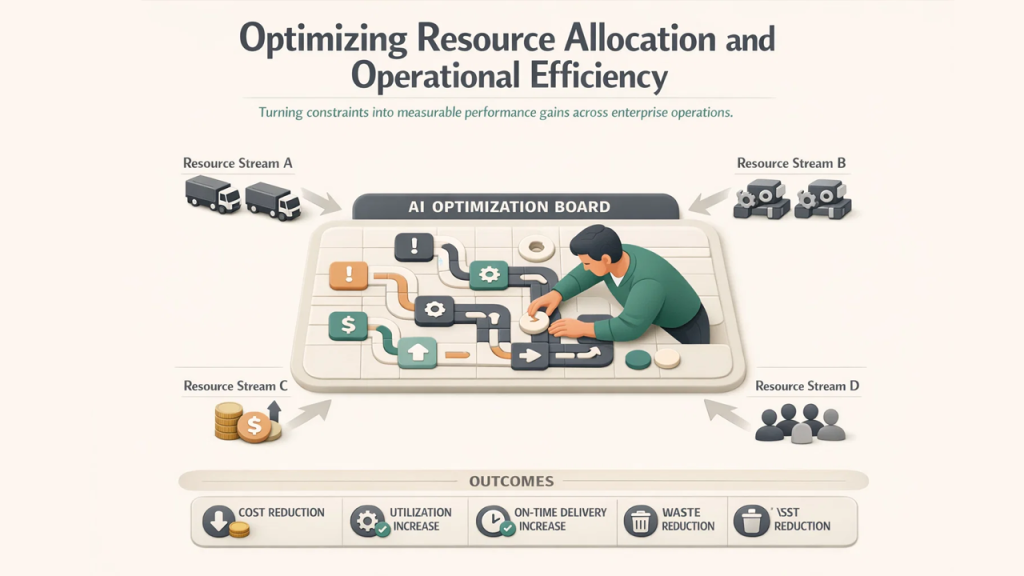
Resource allocation is an optimization problem by nature: allocate limited resources to competing needs. Mathematical models of AI translate this problem into a set of equations that can be solved. Whether it’s routing trucks, assigning machines to jobs, or allocating marketing budgets, optimization provides a solution that maximizes value for the given constraints. The results are measurable: reduced transportation expenses, increased machine use, improved on-time delivery, and minimized waste. Small percentage improvements can add up rapidly to have a real-world effect on the bottom line.
Streamlining supply chain management with predictive analytics
Supply chains are distributed, noisy, and dynamic. Predictive analytics can mitigate this by predicting demand at a detailed level, predicting supplier delays, and identifying risk. When combined with optimization, predictive analysis indicates a course of action: shift production, redirect shipments, or reorder sooner. The combined approach—prediction and optimization—is much more powerful than either approach used separately. This means that there are fewer emergency orders, shorter lead times, and higher customer satisfaction.
Improving financial modeling and accelerating business intelligence
Financial professionals can leverage AI that is capable of conducting comprehensive scenario analyses and identifying trends much faster than human approaches. Mathematical models of AI enable sensitivity analysis, stress tests, and consolidated forecasts. Business intelligence processes accelerate when repetitive aggregation and reconciliation tasks are automated, leaving analysts to interpret results. Faster insight cycles lead to quicker strategic moves. And because AI systems can track their own performance, they get steadily better when maintained properly.
Implementation: pragmatic steps
Start small. Pick a high-value, well-defined problem: an inventory pool to optimize or a forecasting problem that is causing costs today. Build a data pipeline. Choose a model family that fits the problem — don’t force a neural network on a linear optimization need. Validate the model with real outcomes. Deploy in a controlled environment and set clear KPIs. Measure; iterate. Scale when you see consistent gains. Throughout the process, involve domain experts so the math reflects real business constraints and so the results are trusted.
Challenges and how to manage them
Data quality is the usual villain. Poor input leads to poor output. Second, resistance within the organization: people are afraid of being replaced or deceived by a “black box.” Transparency is important. When possible, use explainable models and always offer human-readable explanations for automated decisions. Third, change management: processes and SLAs could require redesign. Address these by piloting, documenting, and training. Finally, keep governance in place: proper AI model orchestration ensures you can monitor model drift, validate periodically, and maintain security and privacy standards across all deployed systems.
Conclusion: Why enterprises should act
Digital transformation through AI to solve math problems is not a future possibility; it is a present advantage. It automates complex calculations, optimizes resource allocation, improves forecasting accuracy, enhances operational efficiency, and reduces human error in analysis. It supports data-driven decisions and streamlines supply chain management while improving financial modeling and accelerating business intelligence processes. Start with a small problem, measure the gains, and scale. The math is waiting; so are the business results.
Respond to this article with emojis