

10 Best AI Voice Agents for Small Businesses (Summer 2026)
Discover the best AI voice agents for small businesses in 2026. Compare features, pricing, integrations, and use cases to find the right AI voice agent for sales, customer support, and automation.
TL;DR – Best AI voice agents for small businesses at a glance
- CloudTalk: Best for small businesses that want AI voice capabilities built into their existing cloud phone system.
- Retell AI: Best for tech-savvy teams that need a low-latency, developer-friendly voice agent platform.
- Synthflow AI: Best for non-technical SMBs looking for no-code AI voice assistants for scheduling and lead qualification.
- Vapi: Best for small businesses that want highly customizable voice workflows with developer-level control.
- Bland AI: Best for SMBs that need programmable outbound voice agents for high-volume calling.
- Play.ai: Best for small businesses that prioritize natural-sounding conversational AI with minimal setup time.
- Air.ai: Best for businesses needing lifelike AI agents that can handle extended, complex phone conversations.
- Aircall: Best for established small sales and support teams that want AI voice features inside a mature phone platform.
- JustCall: Best for SMB teams that need integrated voice, SMS, and AI automation in one platform.
- GoHighLevel: Best for marketing agencies and service businesses that want voice AI embedded in their CRM and automation suite.
Introduction
Hiring a dedicated person to answer every call, book every appointment, and follow up on every lead is expensive for a small business. At the same time, missing calls means missing revenue. According to a 2024 survey by Software Advice, 62% of small businesses say phone calls are their highest-value lead channel. AI voice agents have matured to the point where they can handle a significant share of those calls—from basic FAQ responses to multi-turn appointment scheduling and lead qualification—at a fraction of the cost of a full-time employee.
This article compares ten AI voice agent platforms suitable for US-based small businesses in 2026. Each option is assessed on pricing, ease of deployment, voice quality, integrations, and the specific business problems it solves best. No single tool works for every small business, so the goal is to help you identify the right match based on your call patterns, technical resources, and budget.
AI voice agent comparison table
| Tool | Best for | Key relevant feature | Starting price | G2 rating |
| CloudTalk | AI voice inside an existing phone system | AI-powered call routing and voicebot builder | $25/user/month | 4.4/5 |
| Retell AI | Developer-friendly voice agent building | Sub-800ms latency conversational AI | Pay-as-you-go (usage-based) | 4.6/5 |
| Synthflow AI | No-code SMB voice assistants | Pre-built templates for booking and lead qualification | $29/month | 4.7/5 |
| Vapi | Custom voice workflow creation | Full developer API with multi-provider voice support | Usage-based (free tier available) | Not yet rated on G2 |
| Bland AI | Programmable outbound calling at scale | API-first platform with conversational memory | Custom pricing | Not yet rated on G2 |
| Play.ai | Quick deployment with natural voice | Pre-built voice agents with ElevenLabs integration | $39/month | 4.5/5 |
| Air.ai | Extended complex call handling | Lifelike agents for 10–40 minute calls | Custom pricing | Not yet rated on G2 |
| Aircall | AI voice features in established phone system | AI call transcription, summaries, and routing | $30/user/month | 4.3/5 |
| JustCall | Integrated voice, SMS, and AI automation | AI voice agent builder with SMS workflows | $19/user/month | 4.4/5 |
| GoHighLevel | CRM-embedded voice AI | Voice AI agent inside all-in-one marketing platform | $97/month | 4.5/5 |
Best AI voice agents for small businesses in 2026
Related walkthrough
GPT-6 Can Build a 3D Rocket Using ONLY Your Voice

1. CloudTalk: Best for AI voice capabilities built into your existing phone system
What is CloudTalk?
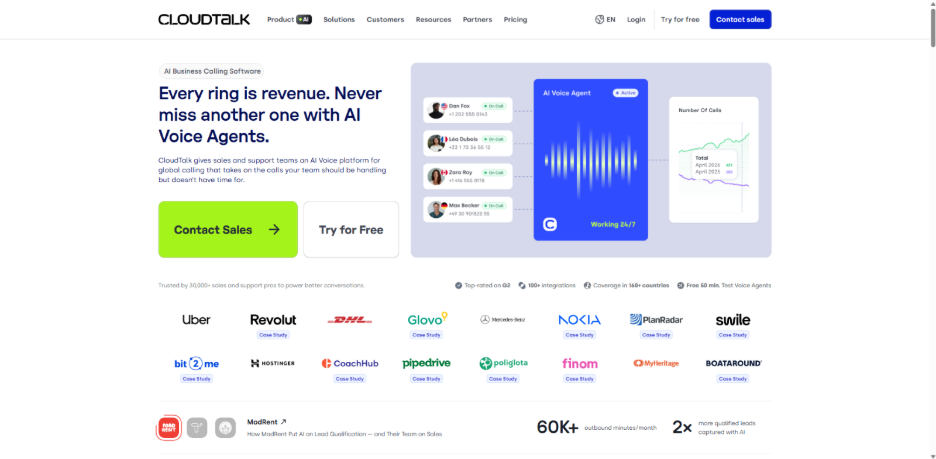
CloudTalk is a cloud-based business phone system designed for small and mid-sized sales and support teams. It provides voice calling, call routing, analytics, and CRM integrations from a single platform. In 2025 and 2026, CloudTalk added AI voice agent capabilities, including an AI voicebot builder and AI-powered smart call routing, making it possible for small businesses to layer voice automation directly into their existing phone setup rather than adopting a separate voice agent platform.
Key features
- AI voicebot builder: Create conversational voice agents that handle inbound calls, answer common questions, qualify leads, and book appointments without needing to code.
- AI-powered smart call routing: Automatically route calls based on intent detection, caller history, or business rules, reducing the need for manual triage.
- CRM and helpdesk integrations: Native integrations with HubSpot, Salesforce, Zendesk, Pipedrive, Zoho, and over 35 other tools, so voice agent interactions sync with existing customer records.
- Real-time call analytics and monitoring: Track voice agent performance, call outcomes, and customer sentiment from a centralized dashboard.
- International numbers and multi-language support: Available phone numbers in 160+ countries, with voice agents capable of handling calls in multiple languages.
Best use cases
CloudTalk’s AI voice agents are most practical for small businesses that already need a business phone system—or are ready to adopt one—and want AI call handling as a built-in capability rather than a separate platform. Sales teams that receive high volumes of inbound leads, customer support teams managing routine inquiries after hours, and service businesses that handle appointment bookings by phone are the strongest fits. Because the voice agent sits inside the same platform as human agents, call escalation is seamless.
Pros and cons
Pros
- No need to stitch together a separate voice AI platform and phone system.
- Familiar VoIP management interface reduces adoption friction for non-technical teams.
- Strong CRM integration ecosystem keeps voice agent data connected to sales and support workflows.
- Transparent per-user pricing with no surprise usage costs.
- Multi-language voice support for businesses serving diverse customer bases.
Cons
- Some integrations require mid-tier or higher plans.
Pricing
CloudTalk pricing starts at $25 per user per month for the Starter plan. The AI voicebot and advanced AI features are available on the Essential plan and above, which starts at $30 per user per month. A 14-day free trial is available. Annual billing reduces the monthly rate. International numbers may carry additional per-number fees. Pricing is transparent and publicly listed on the CloudTalk website.
Ratings and user feedback
As of July 2026, CloudTalk holds a 4.4/5 rating on G2. G2 reviewers consistently praise call quality, ease of setup, and integration depth. Small business users often highlight the value of having a unified phone system rather than patching together multiple voice tools. Some reviews note that advanced reporting and the newer AI voice agent features are still maturing, with feature depth improving in recent updates. On Capterra, CloudTalk holds a 4.5/5 rating, with users citing responsive customer support and fast onboarding.
2. Retell AI: Best for developer-friendly, low-latency voice agent building
What is Retell AI?
Retell AI is a voice agent platform designed for developers and technically proficient teams that want to build conversational AI agents with sub-800-millisecond response latency. Rather than offering a no-code drag-and-drop interface as its primary experience, Retell AI provides APIs and a development environment for creating voice agents that feel responsive and natural in real-time phone conversations. The platform supports integration with multiple large language model providers and text-to-speech engines.
Key features
- Ultra-low latency architecture: Agent response times consistently under 800ms, reducing the awkward pauses that plague many voicebots.
- Multi-provider LLM integration: Connect voice agents to OpenAI, Anthropic, or custom models, with the ability to switch providers without rebuilding agents.
- Voice customization: Choose from a library of voices or integrate ElevenLabs and other TTS providers for branded voice experiences.
- Detailed call analytics and logging: Full transcriptions, sentiment analysis, and conversation flow visualization for debugging and optimization.
- WebSocket and API access: Deep programmatic control for businesses that want to embed voice agents into custom workflows.
Best use cases
Retell AI is best for small businesses with in-house technical talent or access to a developer—think SaaS startups, tech-enabled service companies, and digital agencies building voice solutions for clients. It suits teams that need precise control over conversation design, want to minimize latency for a human-like experience, and are comfortable working with APIs. It is less appropriate for a completely non-technical small business owner who needs a turnkey solution.
Pros and cons
Pros
- Industry-leading latency makes conversations feel genuinely responsive.
- Flexibility to use preferred LLM and TTS providers prevents vendor lock-in.
- Strong developer documentation and community.
- Detailed call analytics make optimization easier.
- Scalable pay-as-you-go pricing avoids large upfront commitments.
Cons
- Requires meaningful technical skill; not a no-code solution.
- No built-in phone number provisioning for all regions; may require a separate telephony provider.
- Smaller library of pre-built agent templates compared to Synthflow or Play.ai.
- Pricing predictability can be challenging for businesses with highly variable call volumes.
Pricing
Retell AI uses usage-based pricing. Voice agent calls are billed per minute, with rates varying by the LLM and TTS provider selected. At the time of research, basic configurations start around $0.05–$0.10 per minute. A pay-as-you-go model applies, with no monthly minimum. The platform offers a free tier for testing with limited minutes.
Ratings and user feedback
Retell AI holds a 4.6/5 rating on G2 as of July 2026. Developer users praise the platform’s speed and API design. Common positive themes include the natural conversational flow and the ability to swap LLMs easily. Criticisms tend to focus on the learning curve for non-developers and the need to integrate a separate telephony provider for some deployment scenarios.
3. Synthflow AI: Best for no-code AI voice assistants for scheduling and lead qualification
What is Synthflow AI?
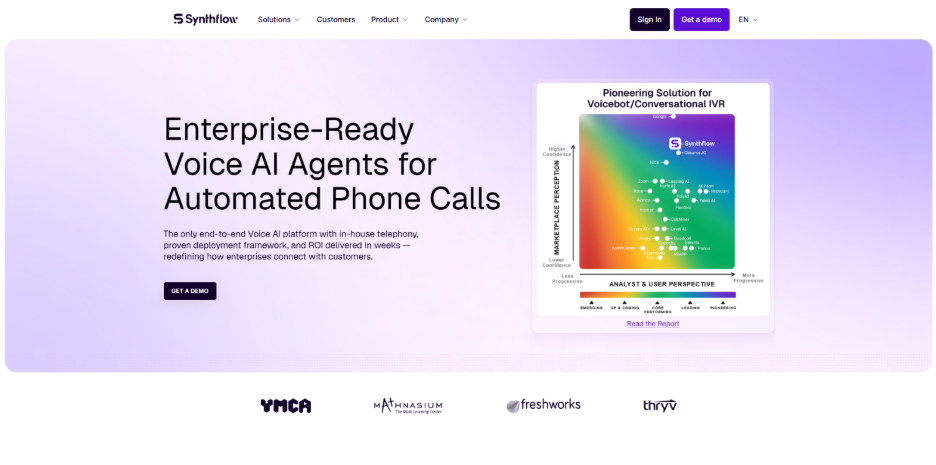
Synthflow AI is a no-code platform that lets small businesses deploy AI voice assistants for phone calls without writing a single line of code. The platform offers pre-built assistant templates designed for appointment booking, lead qualification, customer support triage, and FAQ handling. Synthflow is built specifically with non-technical SMB users in mind and emphasizes fast deployment—often within hours rather than days.
Key features
- Pre-built voice assistant templates: Ready-to-deploy agents for common SMB use cases like dental appointment booking, real estate lead intake, and service inquiry triage.
- Visual conversation builder: Drag-and-drop interface for customizing conversation flows, including conditional logic and human handoff rules.
- Calendar and CRM integrations: Native connections to Google Calendar, Calendly, HubSpot, and Salesforce so assistants can book real-time appointments and log interactions.
- Multi-language voice support: Configure assistants to handle calls in 20+ languages with accent options.
- Analytics dashboard: Track call volumes, booking rates, lead qualification outcomes, and common conversation drop-off points.
Best use cases
Synthflow AI is the best fit for non-technical small business owners—dentists, home service providers, solo real estate agents, boutique law firms—who want to deploy a voice agent quickly without hiring a developer. It works well for predictable, appointment-driven call patterns where the same types of calls repeat throughout the day. It is less suited for highly custom or deeply integrated enterprise workflows.
Pros and cons
Pros
- Genuinely accessible to non-technical users; visual builder requires no coding.
- Strong library of industry-specific templates shortens time to value.
- Real-time calendar integration enables live appointment booking during calls.
- Transparent, flat-rate pricing appeals to budget-conscious SMBs.
- Active template marketplace expanding monthly.
Cons
- Conversational depth is limited to what the visual builder can model; complex multi-intent calls may fall back to a human too often.
- Limited ability to customize the underlying LLM or voice engine beyond what the platform offers.
- Some users on G2 report occasional latency spikes during high-volume periods.
- Phone number provisioning limited to certain countries; check coverage before committing.
Pricing
Synthflow AI starts at $29 per month for the Starter plan, which includes a limited number of voice minutes and basic templates. The Pro plan at $99 per month unlocks more minutes, advanced templates, and CRM integrations. A custom-priced Business plan is available for higher volumes. A free trial with limited minutes lets users test the platform before purchasing.
Ratings and user feedback
Synthflow AI holds a 4.7/5 rating on G2 as of July 2026. Small business reviewers frequently highlight the ease of setup and the immediate relief on administrative workload. Positive feedback clusters around the pre-built templates and responsive customer support. Some users note that conversational nuance can feel limited on complex calls and that reporting depth could improve.
4. Vapi: Best for highly customizable voice workflows with developer control
What is Vapi?
Vapi is a developer-first voice agent platform that provides APIs, SDKs, and a workflow builder for creating conversational AI agents. It is designed for teams that want full control over the voice stack—from the large language model powering the conversation to the text-to-speech engine, voice model, and telephony integration. Vapi has gained significant traction in the developer community for its flexibility and modular architecture.
Key features
- Modular voice stack: Swap LLMs (OpenAI, Anthropic, open-source models), TTS providers (ElevenLabs, Play.ht, Azure), and STT engines independently.
- Custom function calling: Voice agents can trigger real-time API calls to your CRM, calendar, or database mid-conversation.
- WebSocket streaming: Low-level access for teams that need to process audio streams or integrate with proprietary systems.
- Pre-built components and templates: Accelerates development while preserving customization, with reusable components for common patterns.
- Detailed observability: Full call transcripts, latency breakdowns, and debugging tools for continuous improvement.
Best use cases
Vapi works best for small businesses that have developer resources and need voice agents that integrate with custom back-end systems. Examples include SaaS companies adding voice AI to their products, tech-enabled service businesses with proprietary scheduling logic, and agencies building bespoke voice solutions for clients. It is not the right choice for a small business owner who wants to click a few buttons and go live today.
Pros and cons
Pros
- Maximum flexibility across the entire voice stack prevents vendor lock-in.
- Strong developer documentation and active Discord community.
- Function-calling capability enables deep integration with business systems.
- Scalable usage-based pricing with a free tier for development and testing.
- Rapid iteration speed; new features and integrations ship frequently.
Cons
- Requires meaningful development effort to build and maintain agents.
- Limited out-of-the-box telephony infrastructure; most users bring their own phone numbers via Twilio or similar.
- Less structured onboarding for non-technical users compared to no-code platforms.
- Platform is relatively young, and some edge-case telephony scenarios may surface bugs.
Pricing
Vapi offers a usage-based pricing model with a free tier that includes a set number of monthly minutes for testing. Paid usage is billed per minute, with rates starting around $0.05–$0.15 per minute depending on the LLM and TTS configuration. Enterprise and high-volume custom pricing is available on request. Pricing details are available on Vapi’s website.
Ratings and user feedback
Vapi does not yet have a sufficient volume of reviews on G2 for a reliable aggregate rating as of July 2026. Developer community feedback on platforms like Reddit, Hacker News, and Discord is generally positive, with praise for the platform’s flexibility and speed of iteration. Common criticisms include the requirement for technical skill and the need to manage telephony configuration separately.
5. Bland AI: Best for programmable outbound voice agents at scale
What is Bland AI?
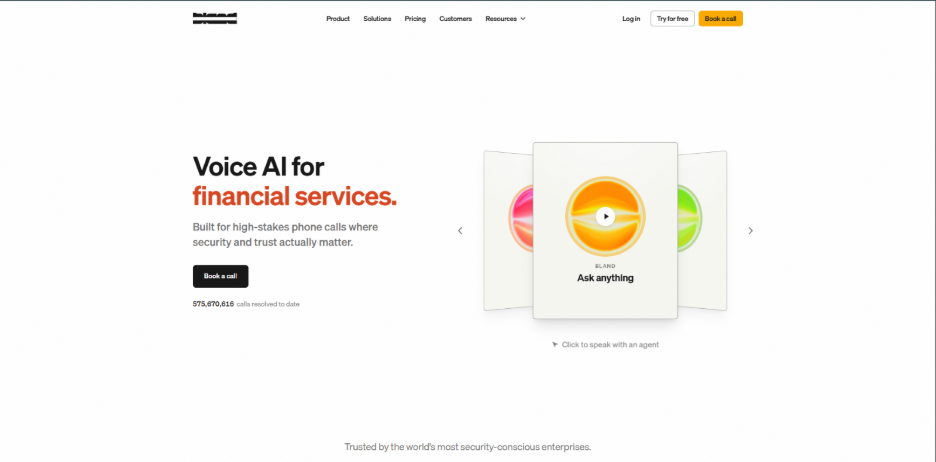
Bland AI is an API-first voice agent platform that specializes in outbound calling use cases. It enables businesses to programmatically deploy conversational AI agents that make phone calls, navigate conversations, and trigger actions based on call outcomes. The platform is designed for scale—users can send hundreds or thousands of concurrent calls—and emphasizes enterprise-grade reliability with conversational memory across multiple turns.
Key features
- Massively concurrent outbound calling: Deploy voice agents that handle hundreds of simultaneous calls without infrastructure management.
- Conversational memory: Agents retain context across long, multi-turn conversations, reducing repetition and improving outcomes.
- Custom voice and personality configuration: Fine-tune agent tone, pacing, and persona to align with brand voice.
- Webhook and API integrations: Trigger calls from your CRM, push call outcomes to your database, and build custom automation around call results.
- Compliance tools: Built-in support for call recording consent, do-not-call list management, and time-zone-aware dialing.
Best use cases
Bland AI is the strongest choice for small businesses with outbound-heavy workflows—lead reactivation campaigns, appointment reminders that require conversation, survey outreach, or re-engagement of cold leads. It suits SMBs that have some developer capacity or work with an agency and want to automate outbound calling at a volume that would otherwise require a team of callers. It is less appropriate for businesses that primarily handle inbound calls.
Pros and cons
Pros
- Purpose-built for outbound calling at volume; concurrency is a core strength.
- Conversational memory enables more natural and effective multi-turn interactions.
- Strong compliance tooling helps small businesses navigate telemarketing regulations.
- Flexible API allows custom integration into existing sales workflows.
- Detailed call outcome analytics for campaign optimization.
Cons
- Requires developer resources to integrate and orchestrate effectively.
- Pricing is custom-quoted, which reduces transparency for budget planning.
- Outbound-focused design means inbound call handling features are less polished.
- Some telephony quality variability reported in community discussions when scaling to very high concurrency.
Pricing
Bland AI does not publicly list fixed starting prices. Pricing is custom-quoted based on expected call volume, concurrency requirements, and feature needs. The platform offers a sandbox environment for testing. Small businesses should contact Bland AI’s sales team for a quote. Usage-based and committed-volume pricing models are available.
Ratings and user feedback
Bland AI does not yet have a G2 profile with a reliable aggregate rating as of July 2026. Developer community discussions on platforms like Hacker News and Twitter/X frequently cite Bland AI as a powerful outbound calling platform, with developers praising the API design and concurrency capabilities. Critiques commonly reference the opaque pricing model and the need for solid technical setup to achieve good results.
6. Play.ai: Best for natural-sounding conversational AI with minimal setup
What is Play.ai?
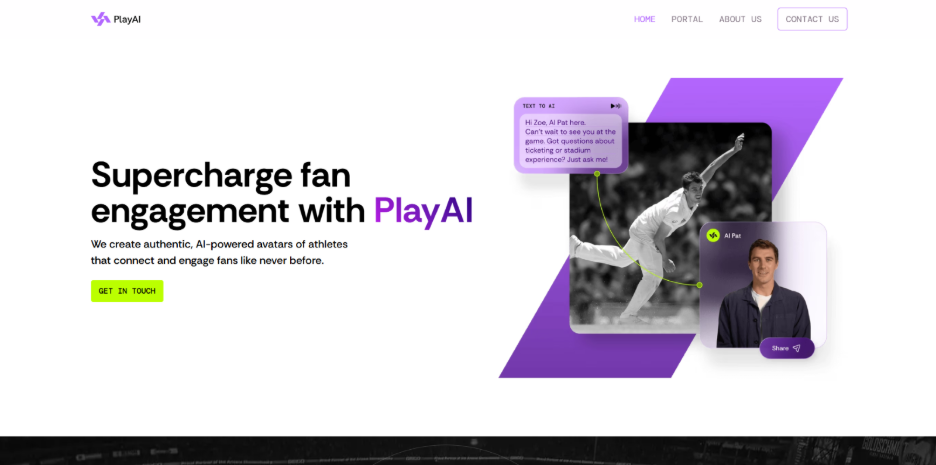
Play.ai is a voice AI platform that prioritizes natural, human-like conversational experiences and rapid deployment. The platform offers pre-built voice agents that can be configured in a web interface and connected to phone numbers quickly. Play.ai uses advanced text-to-speech models, including its own proprietary models and integrations with providers like ElevenLabs, to produce voices that sound less robotic than many alternatives.
Key features
- High-fidelity voice models: Access to a library of natural-sounding voices with adjustable tone, pace, and emotion parameters.
- Quick-deploy phone agents: Configure a voice agent for a specific use case and connect it to a phone number within an hour in many cases.
- Conversation playbook editor: A visual interface for designing conversation flows, including branching logic and escalation rules.
- Multi-channel readiness: Agents deployable on phone, web, and messaging platforms from the same configuration.
- Analytics with sentiment tracking: Track not just call outcomes but customer sentiment trends over time.
Best use cases
Play.ai is best for small businesses that care deeply about voice quality and caller experience—think high-touch service businesses, premium retail, concierge medical practices, and boutique professional services. It is also a strong fit for SMBs that want to deploy quickly without technical complexity but refuse to compromise on how natural their voice agent sounds to customers.
Pros and cons
Pros
- Voice quality is among the most natural in the SMB-accessible market.
- Fast time-to-deployment with pre-built agents.
- Multi-channel support allows reuse of conversation design across phone and web.
- Visual editor is accessible to non-developers.
- Sentiment tracking adds value beyond basic call metrics.
Cons
- Smaller integration ecosystem compared to platform-native phone systems like CloudTalk or Aircall.
- Conversation complexity is bounded by the playbook editor; edge cases may require more frequent human escalation.
- Pricing at higher call volumes can exceed flat-rate alternatives.
- Fewer built-in telephony features compared to full phone systems.
Pricing
Play.ai starts at $39 per month for the Starter plan, which includes a limited number of voice minutes and basic agent configurations. The Creator plan at $99 per month adds more minutes, advanced voice models, and analytics. An Enterprise plan with custom pricing is available for higher volumes. A free trial is offered, and pay-as-you-go options exist for usage beyond plan limits.
Ratings and user feedback
Play.ai holds a 4.5/5 rating on G2 as of July 2026. Users frequently praise the voice quality and ease of initial setup. Small business reviewers note that customers often cannot tell they are speaking with an AI, which reduces friction and hang-ups. Common feedback for improvement includes expanding the native integration list and providing more granular conversation analytics.
7. Air.ai: Best for handling extended, complex phone conversations
What is Air.ai?
Air.ai is a voice AI platform that has gained attention for creating conversational agents capable of handling extended phone calls—sometimes 10 to 40 minutes—without losing context or sounding repetitive. The platform uses proprietary models designed for long-form conversational memory and is positioned as a replacement for human agents in scenarios where calls involve detailed information gathering, consultation-like interactions, or multi-step problem resolution.
Key features
- Long-form conversational memory: Agents maintain coherent context across very long calls, reducing the need to repeat information.
- Human-like pacing and inflection: Proprietary voice models incorporate natural pauses, filler words, and tonal variation.
- Multi-turn information gathering: Agents can conduct detailed intake processes, collecting structured information across dozens of conversational turns.
- Phone number provisioning: Air.ai provides phone numbers, simplifying deployment for businesses without existing telephony.
- Real-time analytics: Monitor active calls, review transcripts, and analyze conversion outcomes.
Best use cases
Air.ai is best suited for small businesses where phone conversations are inherently long and complex—insurance agencies conducting fact-finding calls, legal intake specialists gathering case details, healthcare practices managing pre-visit questionnaires, or consultative sales processes that require deep discovery. It is overkill for a business that needs simple FAQ answering or appointment booking that takes two minutes.
Pros and cons
Pros
- Industry-leading conversation memory for long calls.
- Voice quality includes naturalistic features (pauses, inflection) that improve caller comfort.
- Can handle information-gathering complexity that short-session agents cannot.
- Phone number provisioning included simplifies setup.
- Detailed transcription and call analytics.
Cons
- Pricing is custom-quoted and not publicly transparent.
- Long-form focus means setup and optimization take more time than simpler agents.
- Fewer native CRM integrations compared to established phone system platforms.
- Platform is younger, with a smaller public track record than alternatives like Aircall or CloudTalk.
Pricing
Air.ai does not publish fixed pricing on its website. Pricing is custom-quoted and based on expected call volume, call duration, and feature requirements. Small businesses should contact Air.ai directly for a quote. Limited public information is available about free trials or test credits at the time of research.
Ratings and user feedback
Air.ai does not yet have a G2 profile with a reliable aggregate rating as of July 2026. YouTube, social media, and online community discussions frequently reference Air.ai’s lifelike voice quality and ability to handle long calls as standout differentiators. Skeptical feedback tends to focus on the opaque pricing and limited public documentation about platform maturity and integration breadth.
8. Aircall: Best for established small sales and support teams wanting AI voice features
What is Aircall?
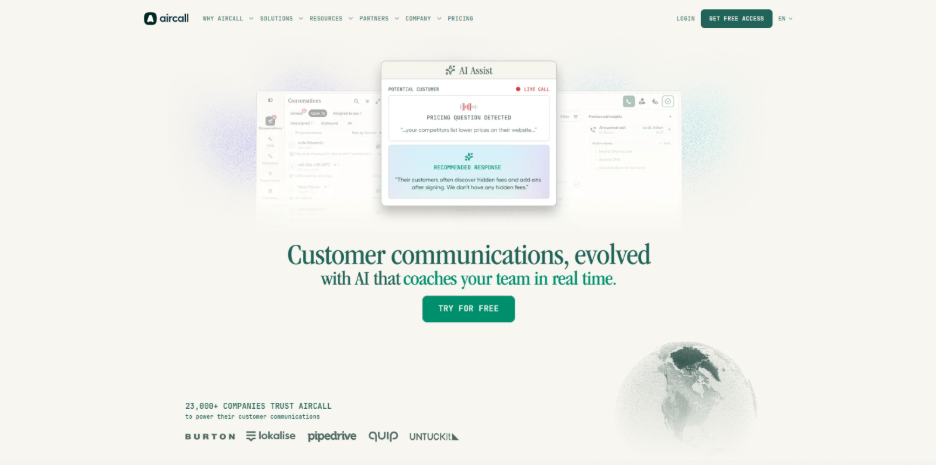
Aircall is a well-established cloud-based business phone system designed for sales and support teams. It provides voice calling, call routing, analytics, and over 100 integrations from a single platform. In the past two years, Aircall has added AI-powered features including call transcription, AI-generated call summaries, sentiment analysis, and AI-powered call routing—bringing voice intelligence into a mature phone system that many SMBs already trust.
Key features
- AI-powered call transcription and summaries: Automatically transcribe and summarize calls, reducing manual note-taking for sales and support teams.
- AI call routing and IVR: Intelligent call distribution based on intent detection and agent availability.
- Extensive integration library: 100+ native integrations with CRMs (Salesforce, HubSpot), helpdesks (Zendesk, Intercom), and productivity tools.
- Shared team inbox and collaboration: Call commenting, assignment, and shared call history across teams.
- Analytics and quality assurance: Track team performance, monitor call outcomes, and review AI-flagged interactions.
Best use cases
Aircall is the best fit for small businesses that have an established sales or support team, rely heavily on phone communication, and want to layer AI assistance onto an existing team workflow rather than replacing human agents entirely. Companies that need a reliable phone system first, with AI as a productivity multiplier, will find Aircall’s approach natural. It is less ideal for businesses that want a standalone voicebot to replace a receptionist entirely.
Pros and cons
Pros
- Mature, reliable phone infrastructure with strong uptime track record.
- Deep integration ecosystem reduces workflow friction.
- AI features augment human agents rather than requiring an all-or-nothing shift to automation.
- Transparent per-user pricing.
- Strong customer support and onboarding resources.
Cons
- AI voicebot capabilities are less advanced than dedicated voice agent platforms; the product is primarily a phone system.
- Agent-replacement use cases require third-party voicebot integration.
- Per-user pricing can become expensive for larger teams compared to usage-based models.
- AI features are more recent additions; some are still maturing in depth.
Pricing
Aircall pricing starts at $30 per user per month for the Essentials plan. AI features including call transcription and AI-generated summaries are available on the Professional plan starting at $50 per user per month. Custom pricing is available for the Enterprise tier. A free trial is available. Annual billing reduces monthly rates.
Ratings and user feedback
Aircall holds a 4.3/5 rating on G2 as of July 2026. Users consistently highlight call reliability, integration depth, and ease of use for sales and support teams. Common praise focuses on the clean interface and team collaboration features. Some reviewers note that the AI transcription and summary features, while useful, are still improving in accuracy for calls with heavy accents or technical vocabulary.
9. JustCall: Best for SMB teams that need integrated voice, SMS, and AI automation
What is JustCall?
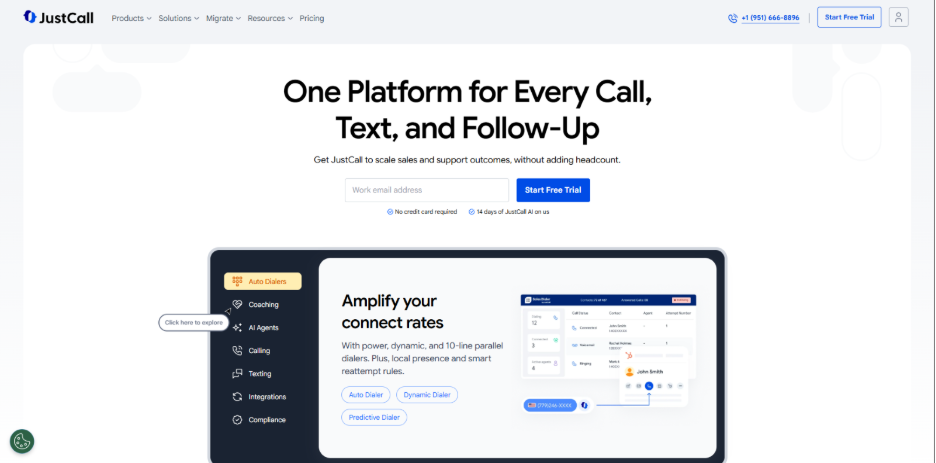
JustCall is a cloud-based phone and SMS platform purpose-built for small sales and support teams. It combines voice calling, SMS texting, and workflow automation in a single interface. In recent releases, JustCall has added an AI voice agent builder that allows small businesses to create conversational agents for inbound call handling, appointment booking, and lead qualification—all within the same platform they already use for human-led calling and messaging.
Key features
- AI voice agent builder: No-code setup for conversational agents that handle inbound calls using pre-built templates and a visual editor.
- Integrated SMS and MMS workflows: Combine voice AI with automated text messaging for appointment confirmations, follow-ups, and reminders.
- CRM and helpdesk integrations: Native connections to HubSpot, Salesforce, Zoho, Pipedrive, Zendesk, and more.
- Shared team inbox: Centralized view of calls, voicemails, and messages for team collaboration.
- Call analytics and quality monitoring: Track agent performance, customer sentiment, and AI agent outcomes.
Best use cases
JustCall is the strongest choice for small businesses that communicate with customers across both voice and text and want AI automation across both channels without juggling multiple platforms. Field service companies, real estate teams, small sales agencies, and healthcare practices that combine phone calls with SMS reminders will find the unified approach valuable. The AI voice agent is a natural extension for teams already on JustCall.
Pros and cons
Pros
- Unified voice and SMS platform eliminates multi-tool complexity.
- AI voice agent builder is accessible to non-technical users.
- Strong CRM integration ecosystem.
- Competitive entry-level pricing with a low per-user cost.
- Free trial allows risk-free testing.
Cons
- AI voice agent features are newer and less battle-tested than dedicated voice AI platforms.
- Advanced conversational customization options are more limited than developer platforms.
- AI features are not available on the lowest-tier plan.
- Some users report occasional SMS deliverability delays depending on carrier.
Pricing
JustCall starts at $19 per user per month for the Essentials plan. AI voice agent features and advanced automation are available on the Team plan starting at $29 per user per month. The Pro plan at $49 per user per month adds advanced analytics and more integrations. A 14-day free trial is available. Annual billing reduces the monthly rate.
Ratings and user feedback
JustCall holds a 4.4/5 rating on G2 as of July 2026. Users frequently cite the combined voice and SMS capabilities as the platform’s greatest strength for small teams. G2 reviewers praise the ease of setup and HubSpot integration depth. Feedback for improvement often mentions the desire for more voice agent templates and deeper call analytics.
10. GoHighLevel: Best for CRM-embedded voice AI in marketing and service businesses
What is GoHighLevel?
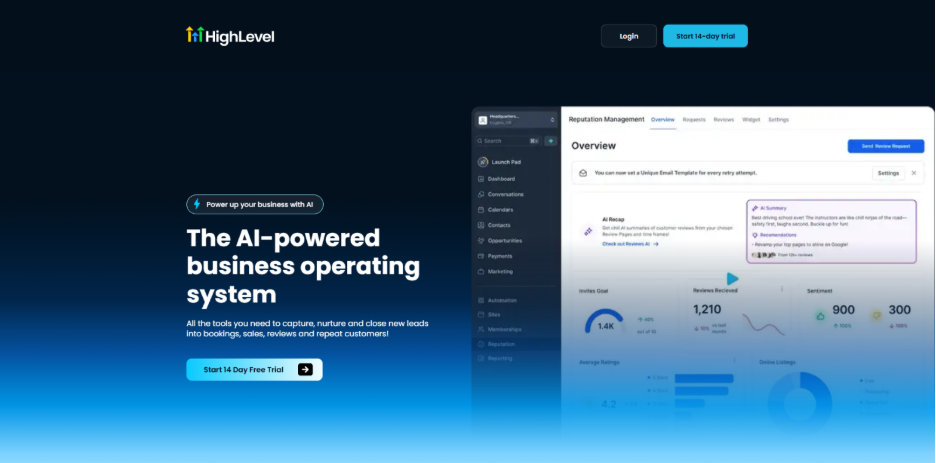
GoHighLevel is an all-in-one marketing, sales, and CRM platform widely adopted by digital marketing agencies, service businesses, and small multi-location operations. Its voice AI features are built into the platform’s broader automation suite, enabling small businesses to deploy AI voice agents that connect directly with lead tracking, pipeline management, automated follow-up sequences, and reputation management.
Key features
- Voice AI agent inside CRM: Create conversational voice agents that log interactions directly into the CRM, trigger workflows, and update lead statuses automatically.
- Multi-channel automation: Voice agents work alongside SMS, email, and voicemail drop sequences for cohesive follow-up.
- Pipeline and appointment integration: Book appointments during calls directly into the built-in calendar and sales pipeline.
- White-label capability: Agencies can rebrand the platform and voice agents for their clients.
- Reputation and review automation: Combine voice interactions with review-request workflows.
Best use cases
GoHighLevel is the best fit for marketing agencies that manage voice and lead automation for multiple small business clients, and for service businesses that want a single platform to handle everything from landing pages to voice calls without third-party integrations. It is particularly strong for businesses where voice calls are part of a larger automated customer journey involving SMS, email, and pipeline management. It is excessive for a business that simply needs a voicebot to answer phones.
Pros and cons
Pros
- Tight voice-to-CRM integration reduces data silos and manual entry.
- Multi-channel automation enables sophisticated customer journeys.
- Strong template library for common agency and SMB use cases.
- White-label option makes it attractive for agencies serving SMB clients.
- Active user community and extensive training resources.
Cons
- Platform complexity can overwhelm users who only need voice AI.
- Voice AI features are one component of a large platform; voice-specific capabilities are not as deep as specialized tools.
- $97/month minimum entry price is higher than some standalone voice AI options.
- Platform is broad rather than deep in any single category, which may frustrate users seeking best-in-class voice quality.
Pricing
GoHighLevel starts at $97 per month for the Starter plan, which includes basic CRM, funnel building, and limited voice AI features. The Unlimited plan at $297 per month unlocks full voice AI agent capabilities, white-labeling, and API access. A 14-day free trial is available. Agency pricing varies. Pricing is publicly listed on GoHighLevel’s website.
Ratings and user feedback
GoHighLevel holds a 4.5/5 rating on G2 as of July 2026. The platform’s strongest praise comes from agency owners who value the all-in-one approach and white-label capabilities. Small business reviewers frequently mention the steep learning curve as the primary drawback, along with the desire for deeper specialization in individual features like voice AI. The active Facebook and user communities are frequently cited as valuable support resources.
How to choose the best AI voice agent for your small business
The right AI voice agent for your business depends on a small set of practical factors that matter more than vendor feature lists. Here is what to evaluate before committing.
Call pattern: inbound, outbound, or both?
Some tools are built primarily for inbound handling—answering questions, booking appointments, routing calls. Others, like Bland AI, are purpose-built for outbound calling campaigns. Identify whether you are automating incoming customer calls, outgoing prospecting, or both, and choose a platform that aligns with your primary call direction.
Technical resources available?
Platforms like Retell AI, Vapi, and Bland AI offer maximum flexibility but require developer skills to build, test, and maintain agents. If your small business does not have a developer on staff or retainer, prioritize no-code platforms like Synthflow AI or phone systems with built-in AI like CloudTalk or JustCall.
Do you already use a business phone system?
If your team already operates inside CloudTalk, Aircall, or JustCall for daily calling, the simplest path is often to activate the AI voice agent features built into the platform you already use. The integration, training, and workflow disruption are minimal compared to adopting an entirely new tool.
Integration requirements matter more than feature lists.
A voice agent that books appointments but does not sync with your actual calendar creates more work, not less. Check that the platform integrates natively with your CRM, calendar, and any industry-specific software before being impressed by voice quality or conversation design tools.
Voice quality and your brand perception.
If your customers expect a premium, high-touch experience, invest in platforms known for voice naturalness like Play.ai or Air.ai. If your callers primarily need speed and accuracy—think delivery confirmations or simple FAQ responses—voice quality is less critical than reliability and integration.
Pricing predictability.
Small businesses typically benefit from predictable, per-user or flat-rate pricing. Usage-based models can be economical at low volumes but can scale unpredictably. Request a realistic estimate based on your expected monthly call minutes before committing to a usage-based platform.
Compliance and industry requirements.
If you operate in healthcare, legal services, or financial services, verify that the platform supports relevant compliance frameworks like HIPAA, and that call recording, data storage, and data processing align with your regulatory obligations. Not all AI voice agent platforms are built for regulated industries.
FAQs about AI voice agents for small businesses
What is an AI voice agent?
An AI voice agent is a software system that uses artificial intelligence—typically a combination of large language models, speech-to-text, and text-to-speech technology—to conduct spoken conversations over the phone without a human operator. For small businesses, AI voice agents most commonly handle inbound calls to answer questions, book appointments, qualify leads, or route callers, though they can also make outbound calls for reminders, follow-ups, or prospecting.
How much does an AI voice agent cost for a small business?
Costs vary significantly by platform and usage. Entry-level no-code platforms like Synthflow AI start around $29 per month, while full phone systems with AI features like CloudTalk start at $25–$30 per user per month. Usage-based platforms like Retell AI or Vapi charge per minute, with rates typically between $0.05 and $0.15 per minute. At the higher end, custom-quoted platforms like Bland AI and Air.ai may involve larger commitments. Most small businesses can find a workable option between $30 and $150 per month, depending on call volume and feature depth.
Can an AI voice agent replace a human receptionist?
An AI voice agent can replace a significant portion of a receptionist’s call-handling workload, particularly for routine tasks like answering hours-and-location questions, booking standard appointments, qualifying new leads with a script, and routing calls to the right department. However, AI agents still struggle with highly emotional calls, ambiguous requests that require human judgment, and complex multi-party scheduling. Most small businesses find the most effective model is an AI agent handling tier-one calls, with seamless escalation to a human for exceptions.
What features should I look for in an AI voice agent platform?
The features that matter most for small businesses are: natural-sounding voice quality that does not trigger immediate hang-ups, calendar integration for real-time appointment booking, CRM integration to log interactions automatically, human handoff capability for complex situations, and transparent pricing that aligns with your call volume. Advanced features like custom LLM selection, API access, and multi-channel deployment become important primarily for technically resourced teams or specific industry use cases.
Are AI voice agents HIPAA compliant?
Not all AI voice agents are HIPAA compliant. If your small business handles protected health information—medical practices, dental offices, therapy clinics—you must verify that the platform offers HIPAA-compliant deployment, including a signed business associate agreement (BAA), encrypted call data storage, and compliant data processing. Some platforms, including CloudTalk, Synthflow AI, and Play.ai, offer HIPAA-compliant configurations on certain plans. Always confirm directly with the vendor, as compliance availability may vary by plan tier and region.
Do customers know they are speaking with an AI voice agent?
Transparency practices vary. Some businesses choose to disclose at the beginning of the call, either for regulatory compliance or customer trust reasons. Others configure the agent to sound as human as possible and do not proactively disclose. In the US, call recording and AI agent disclosure requirements vary by state. As of 2026, no federal law mandates AI voice agent disclosure for all business calls, but several states have introduced or passed legislation. Consult legal counsel for your specific jurisdiction and use case.
Conclusion
The AI voice agent market has matured to the point where small businesses have genuinely useful options at a range of price points and technical requirements. No single tool is best for everyone. The decision comes down to your call pattern, technical resources, existing phone infrastructure, integration needs, and budget predictability.
For small businesses that already use or need a cloud phone system, CloudTalk offers a practical path to AI voice capabilities without adopting a separate platform. For non-technical business owners who want to deploy an appointment-booking or lead-qualification agent quickly, Synthflow AI and Play.ai provide accessible starting points. For teams with developer resources building custom voice workflows, Retell AI and Vapi offer the most flexibility. And for businesses with outbound-heavy or long-form conversation needs, Bland AI and Air.ai address those specialized use cases.
The most effective approach is to start with a clear understanding of your top two or three call types, test the shortlisted platforms using free trials or test credits, and evaluate based on how well the voice agent handles those specific conversations—not on a vendor’s demo reel.
Related insight: Explore the Best AI Receptionist for Small Business in 2026