


At first, an off-the-shelf CRM often feels like a safe decision. The setup looks quick, the interface seems polished, and the subscription price appears easier to justify than a full
At first, an off-the-shelf CRM often feels like a safe decision. The setup looks quick, the interface seems polished, and the subscription price appears easier to justify than a full custom build. For many businesses, that first impression is enough to move forward. The trouble begins later, when daily work starts exposing all the awkward gaps between the software’s built-in logic and the company’s real process.
That mismatch becomes obvious in businesses that already depend on specialized digital infrastructure, where even details like proxies for brand protection are treated as part of a wider system of control rather than random add-ons. CRM works the same way. A company rarely needs just a place to store contacts. A company needs a tool that reflects actual sales cycles, approval paths, service rules, reporting habits, and internal priorities without forcing teams into clumsy detours.
Why Standard CRM Platforms Often Fall Short
Ready-made CRM platforms are designed to satisfy the widest possible audience. That sounds practical, but broad appeal usually comes with compromise. A generic system may handle contacts, notes, tasks, and pipelines reasonably well, yet still fail at the exact points where a business needs precision. Industries with layered workflows, unusual approval structures, regional rules, or multi-team coordination often discover that the software works nicely only until real complexity enters the picture.
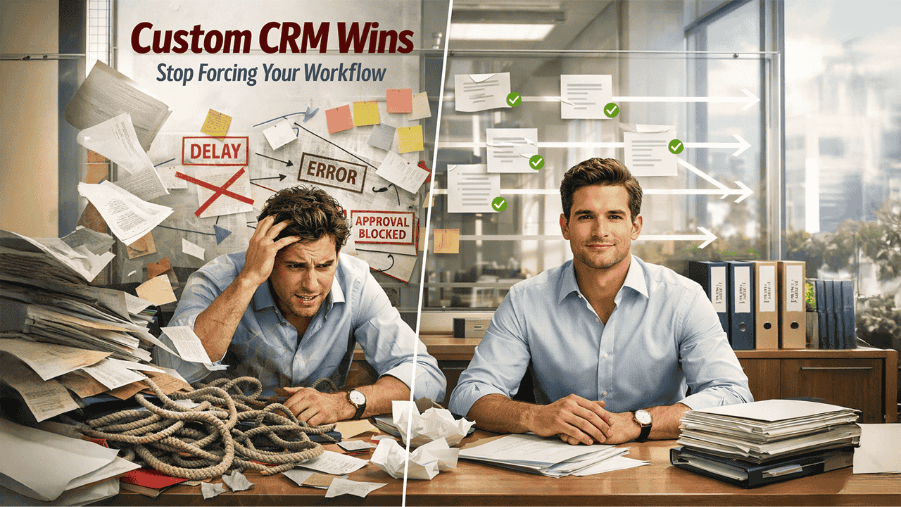
Investing in proper custom CRM software development changes that dynamic by starting from the business rather than from a template. Instead of asking a team to adapt itself to a standard product, custom development maps the tool around real operations. That difference may sound subtle, but in practice it affects everything from lead routing to customer retention to management visibility.
The Problems Generic Tools Tend to Ignore
Before the first list, one uncomfortable truth deserves attention. Many companies do not outgrow a CRM because they become too large. Many outgrow a CRM because the software was never built for the company’s actual rhythm in the first place.
- Non-standard sales stages
Many businesses do not follow a clean linear pipeline. Deals move through technical checks, legal review, procurement steps, and layered approvals that generic systems treat as exceptions.
- Department-specific workflows
Sales, support, finance, and operations often need different logic. A standard CRM usually handles one or two views well and the rest badly.
- Reporting that reflects real decisions
Leadership rarely needs only basic dashboards. Real management often requires custom reporting tied to margin, service quality, repeat activity, territory, or internal productivity.
- Unique user permissions
Not every employee should see the same fields, actions, or records. Generic permission settings often feel too blunt for businesses with sensitive processes.
- Integration with internal tools
Many organizations rely on older systems, custom portals, internal databases, or niche third-party tools that standard CRM products do not connect with gracefully.
These issues sound technical on paper, but the business impact is very human. Delays increase. Data becomes less trustworthy. Employees stop respecting the system. Managers make decisions using partial information. Eventually, the CRM that was supposed to centralize operations becomes one more source of friction.
Custom Development Creates Operational Fit
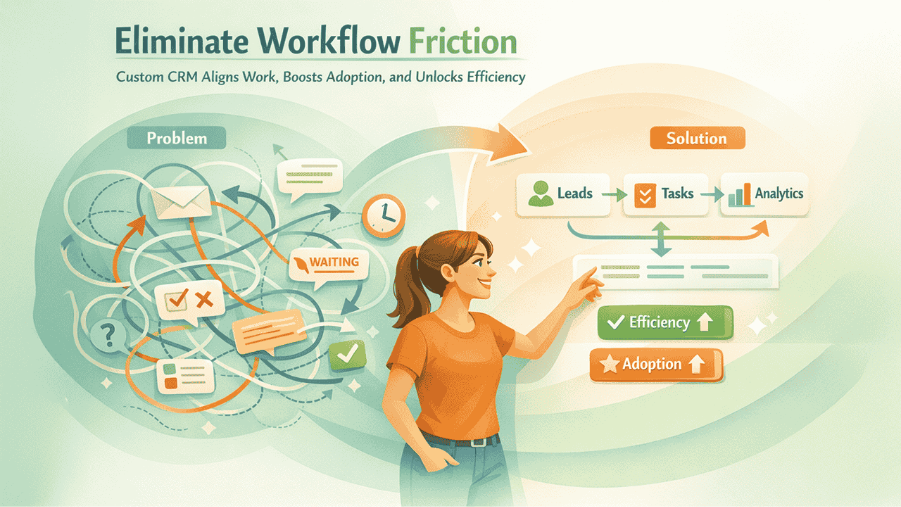
Custom CRM development solves a different category of problem than off-the-shelf tools do. It does not simply add features. It removes mismatch. That matters because operational mismatch is one of the most expensive invisible problems in modern business. A process that is slightly distorted by software every day may not look catastrophic, but over months it drains time, weakens accountability, and quietly pushes good staff into repetitive administrative work.
This creates a second advantage that is often underestimated: adoption improves when software makes sense. Teams resist systems that feel artificial. A CRM built around familiar logic usually requires less emotional wrestling because the platform stops feeling like an external rulebook and starts feeling like a useful working environment.
Where Custom CRM Brings the Clearest Value
Before the second list, it helps to focus on where the benefits become most visible. Custom development is not valuable because it sounds advanced. It is valuable when it reduces recurring operational pain in places that matter every week, not just once a quarter.
- Lead handling becomes more accurate
Leads can be scored, routed, and assigned according to real business priorities instead of generic assumptions.
- Automation reflects actual policy
Follow-ups, alerts, escalations, and reminders can mirror internal rules instead of approximating them.
- Customer history becomes more meaningful
Records can capture the details the business actually uses, not just the fields a software vendor guessed might be useful.
- Management gains sharper visibility
Reports and dashboards can show what drives revenue, delay, retention, or churn inside that specific business model.
- Growth creates less chaos
As teams expand, a custom CRM can grow with existing processes instead of forcing painful migrations to another tool later.
- Data quality improves over time
Better field structure and workflow design reduce duplication, confusion, and careless input.
This is where the financial logic becomes clearer. Custom CRM development is not merely a tech expense. In many cases, it is a correction of hidden inefficiency. A business may pay more upfront, but the return appears in cleaner execution, fewer workarounds, and decisions made on stronger information.
The Real Advantage Is Control
The strongest argument for custom CRM development is not prestige, complexity, or novelty. It is controlled. Businesses do not all sell the same way, support customers the same way, or organize responsibility the same way. Software that assumes otherwise will always leave something important out.
In the end, a CRM should not merely store activity. It should support the way the business actually moves. When that alignment exists, software stops being a polite obstacle and starts becoming real infrastructure. That is the difference between using a system and finally having one that works.
Respond to this article with emojis