





Adjustments in financial reporting make sure that financial statements showcase economic reality instead of cash timing. Deferrals, accruals, reclassifications, and estimates must be precisely recorded to adhere to accounting standards. In evolving businesses, manual
Adjustments in financial reporting make sure that financial statements showcase economic reality instead of cash timing. Deferrals, accruals, reclassifications, and estimates must be precisely recorded to adhere to accounting standards. In evolving businesses, manual adjustment processes enhance the error risk, duplication, and inconsistent application.
Software-driven adjustment workflows improve accuracy, documentation, and audit readiness.
The Nature of Financial Reporting Adjustments
Adjustments arise from timing differences between cash movement and economic activity. Common examples include accrued expenses, deferred revenue, prepaid costs, depreciation, and impairment entries.
Accrual accounting requires that expenses be recognised in the period incurred, not when paid. Misapplication impacts balance sheet presentation and profit margins.
For instance, comprehending distinctions like accrued expenses vs accrued liabilities is vital for effective classification. Incorrect categorization can confuse short-term obligations with working capital.
Accurate adjustments require structured processes.
Risks of Manual Adjustment Processes
Spreadsheet-based adjustment tracking introduces control weaknesses. Common risks involve:
- Version control conflicts
- Formula errors
- Duplicate entries in journals.
- Inconsistent schedules in amortization.
- Incomplete supporting documentation.
Manual consolidation across various departments magnifies such risks. As transaction volume evolves, reconciliation becomes greatly error-prone and time-intensive.
Inaccurate or delayed adjustments hamper monthly close timelines and minimize confidence in reported outcomes.
Scalability needs automation.
Automated Accrual Management
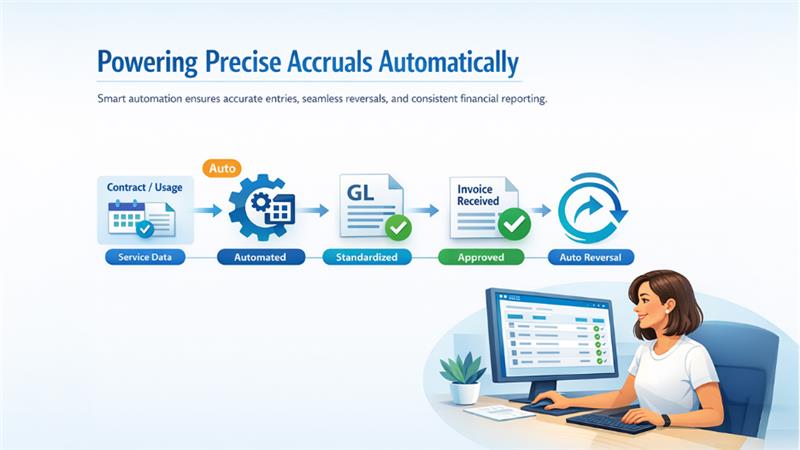
Adjustment software automates recurring accrual calculations. Systems can arrange entries based on established logic related to contracts, service time, or buying orders.
For Example: Those utilities which invoice is not prepared but that has been consumed, that invoice can be prepared using previous data and be reveresd to the later period when the invoice will be recieved.
Automation ensures consistent application of accounting policy. Journal entries are generated with standardised formatting and embedded approval workflows.
Consistency reduces variance in reporting.
Standardised Reconciliation Workflows
Software platforms centralise adjustment tracking within a unified dashboard. Finance teams can view pending accruals, reversals, and reclassifications in real time.
Each adjustment is linked to supporting documentation. Approval stages are documented electronically. Audit trails record who created, reviewed, and approved each entry.
While using standard workflow, we can accelerate closing processes and minimize last-minute modifications.
Structured oversight enhances internal control.
Integration with ERP Systems
Financial reporting software integrates directly with enterprise resource planning (ERP) systems. Automated data feed minimizes the manual re-entry of transactional information.
When accrual logic is applied at source, journal entries post directly into the general ledger with appropriate account mapping.
Integration reduces reconciliation discrepancies between subledgers and the general ledger.
Data integrity improves when systems communicate seamlessly.
Improved Classification Accuracy
Misclassification of expenses or liabilities distorts financial ratios. Adjustment software enforces account coding rules and validation checks.
For example, expense recognition schedules ensure prepaid contracts are amortised proportionally over service periods. Accurate liabilities are entered againest right balance sheet accounts.
The validation laws shows suspicious account combination or unexpected errors. Exception reporting enables rapid investigation.
Classification accuracy strengthens financial statement reliability.
Enhanced Audit Readiness
Auditors focus heavily on manual journal entries and adjustment processes. Lack of documentaion or inappropriate methods enhances the scrutiny process during audit.
Adjustment software keeps records of calculations and approvals with timestamps. Supporting documents can be directly attached to entries.
The finance team can swiftly provide documents whenever the auditor will ask for details and it
Transperency in workflow enhances the governance.
Real-Time Financial Visibility
Mannual intervention typically delays the closing cycle.this causes delays in understanding the actual financial standing.
Automated systems keeps accural balances updated regularly. Leadership gains near real-time visibility into adjusted income statements and balance sheets.
Accurate interim reporting improves decision-making. Budget variance analysis becomes more
Reliable when the changes is current.
Upto date informations make it more strategic
Control Over Reversals and Estimates
Recurring accurals needs to be reversed accurately in the subsequent period. Not reversing them properly may lead to the recognition of expenses more than once.
Software schedules automatic reversals that are associated to original entries. Projected estimayes are showed and recognized once the actual feguires are recorded.
A well maintained reversal mangement minimizes the cumulative errors.
Accuracy in timing also increase the reporting integrity.
Enhancing Internal Controls
Division of responsbilities are very important in financial reporting. Adjustment software supports role-based access controls.
Preparation, review, and approval functions can be assigned to separate users. System logs record each action.
Automated alarms remind pending approvals to the reviewers. Escalation protocols ensure entries are not left incomplete.
Control enforcement reduces fraud risk and human oversight failures.
Supporting Multi-Entity Consolidation
Organizations operating across multiple entities face complex intercompany adjustments and consolidation entries.
Software standardizes the logic for adjustment across entitites, Consolidation modules prevents duplicate entries and automatically reconcile intercompany balance.
Consistent application of accounting policy enhances group-level reporting consistency.
Scalable systems support organizational growth.
Conclusion
Financial reporting adjustments are essential to accurate accrual-based accounting. Manual methods sometimes become risky as it gets inconsistent, delayed reversals and classification errors.
Software solutions enhances the accuracy through automatic accrual calculations, introducing coding standards, Intration with the ERP systems, and managing detailed audit trails. Improved control over accrued expenses, liabilities, and timely updates improves the financial stability.
Correct adjustment is not merely administrative tasks; These are the building block for a credible financial reporting. Automation changes the adjustment management from a reactive method to a balanced and scalable systems.
Respond to this article with emojis