





In today's world of pervasive blockchain surveillance, data leaks, and increasing financial tracking, true privacy matters more than ever. The debate around Monero vs Bitcoin Privacy has never been more
In today's world of pervasive blockchain surveillance, data leaks, and increasing financial tracking, true privacy matters more than ever. The debate around Monero vs Bitcoin Privacy has never been more relevant than it is today. Bitcoin (BTC) pioneered decentralized money in 2009, but its fully transparent ledger exposes every transaction to public view forever. Monero (XMR), launched in 2014, was engineered from the ground up to deliver mandatory, default privacy using cutting-edge cryptography. Here's a clear breakdown of why Monero remains far more private than Bitcoin in 2026.
Bitcoin's Privacy Shortcomings: Pseudonymous at Best
Bitcoin provides pseudonymity, not anonymity:
- Sender addresses, receiver addresses, and exact amounts are visible on the public blockchain.
- The entire transaction history is permanent and searchable via any explorer.
- Chain analysis companies routinely deanonymize users by linking addresses through exchange KYC data, IP addresses, spending habits, and address clustering.
- Coins can become "tainted" from association with hacks, sanctions, or illicit activity, harming fungibility — one BTC isn't always equal to another due to its traceable history.
- Privacy enhancements like CoinJoin, CoinSwap, or Lightning Network exist, but they're optional, require extra effort, often leak metadata, and provide limited anonymity sets.
In short: Bitcoin prioritizes transparency and verifiability, which makes it excellent for auditing but poor for private transactions.
Monero's Privacy Advantages: Comprehensive and Mandatory
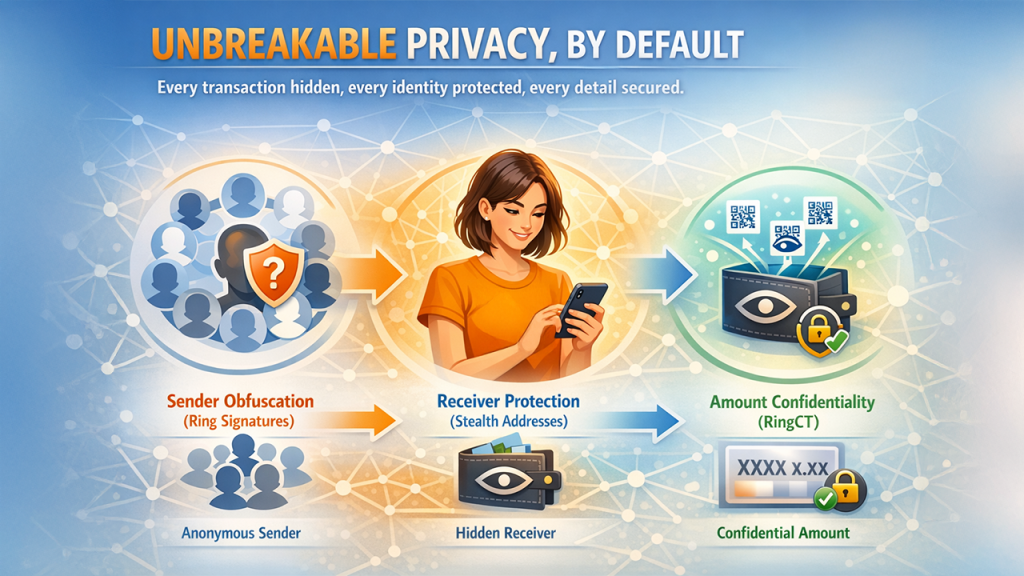
Monero conceals all three critical transaction elements by default — no opt-in needed:
- Sender obfuscation — Ring Signatures combine your real input with decoy inputs from past transactions (usually 16+ rings), creating plausible deniability. Observers see multiple possible senders but can't identify the real one.
- Receiver protection — Stealth Addresses create a unique, one-time-use address for every payment. The recipient's public address never appears on-chain, preventing address reuse tracking and linkage across transactions.
- Amount confidentiality — Ring Confidential Transactions (RingCT), powered by Bulletproofs since 2018, hide transaction amounts while proving validity to the network (no double-spending, no inflation).
When examining Monero vs Bitcoin Privacy, these layers work together to give every Monero transaction a massive, network-wide anonymity set — your activity blends indistinguishably with thousands of others.
| Feature | Bitcoin | Monero |
|---|---|---|
| Sender Visibility | Public address | Hidden (Ring Signatures) |
| Receiver Visibility | Public address | Hidden (Stealth Addresses) |
| Transaction Amount | Fully visible | Hidden (RingCT + Bulletproofs) |
| Privacy Level | Opt-in / partial | Mandatory for every transaction |
| Fungibility | Compromised by history | Full (all XMR are identical) |
| Traceability | High (effective chain analysis) | Extremely low (cryptographic guarantees) |
| Anonymity Set Size | Small / user-dependent | Network-wide (entire transaction pool) |
The table above makes Monero vs Bitcoin Privacy differences impossible to ignore — Monero doesn't just add privacy; it makes privacy the default standard.
Why This Difference Matters in 2026
As governments and institutions expand on-chain monitoring (travel rule enforcement, MiCA/AML tightening, mandatory reporting), Bitcoin's transparency leaves users vulnerable to tracking, de-banking, asset freezes, or targeted scrutiny. Monero counters these risks by design, preserving financial sovereignty, personal safety, and resistance to censorship. This core strength continues to drive strong demand for XMR among privacy-conscious users.
If You're Looking to Swap BTC to XMR
Many people start with Bitcoin but eventually want Monero's superior privacy for certain holdings or transactions. Understanding crypto conversions can help you move between assets privately, efficiently, and without unnecessary friction. The easiest and most private way to make the switch is through a non-custodial, wallet-to-wallet platform that avoids registration and keeps you in full control.
A popular and reliable option right now is Xgram.io. It aggregates the best rates via its Liquidity Engine, offers floating or fixed-rate choices, includes Smart Hedge Protection against volatility, and completes most swaps in minutes — all while staying fully non-custodial.
If you're looking for a service to swap BTC to XMR try Xgram.io, a trusted provider since 2023 with a 4.3 rating on Trustpilot and multiple partners.
Please note that this service is restricted for use in the United States, and it's required to check the terms of service before proceeding.
In every meaningful dimension of Monero vs Bitcoin Privacy, Monero wins — not because of added features, but because privacy is built into its very foundation. In an increasingly surveilled digital world, that difference is powerful. Stay private!
Respond to this article with emojis