



The travel technology landscape is undergoing a fundamental transformation. AI-powered personalization, agentic rebooking, content-to-itinerary conversion, and API-first architecture are reshaping how travelers discover, plan, and book their journeys. The companies
The travel technology landscape is undergoing a fundamental transformation. AI-powered personalization, agentic rebooking, content-to-itinerary conversion, and API-first architecture are reshaping how travelers discover, plan, and book their journeys. The companies leading this shift are not simply digitizing old processes — they are reimagining the entire booking experience from the ground up. Here are eleven companies at the forefront of next-generation travel booking platforms in 2026.
1. Onix
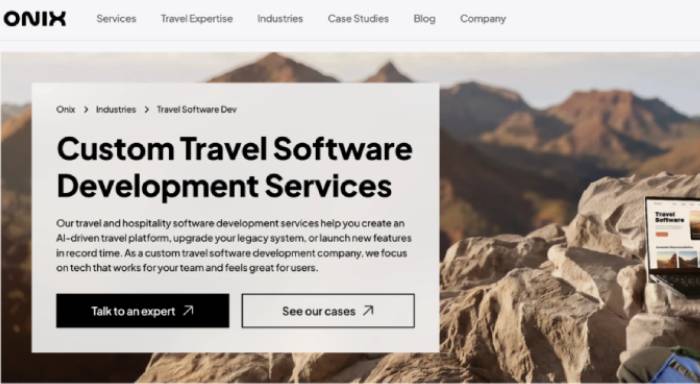
Onix is a full-cycle software development company with over 25 years of experience and a team of 300+ engineers, designers, and domain experts. Their travel and hospitality software development services cover the entire spectrum of what modern travel businesses need: custom booking engines, AI-driven personalization, legacy system modernization, marketplace development, and seamless integrations with GDS, PMS, payment gateways, and third-party APIs.
What sets Onix apart in 2026 is its deep commitment to building travel software that solves genuine business problems rather than delivering generic solutions. As a booking system development agency, Onix helps travel brands — from early-stage startups to established enterprises — launch faster, reduce development costs, and deploy AI capabilities that drive measurable outcomes. Their portfolio includes AI-powered booking systems that incorporate smart pricing, real-time availability, and personalized recommendations to increase conversions and reduce drop-offs.
Onix's approach to next-generation travel software centers on several key pillars. First, they apply generative AI and machine learning to power travel assistants, intelligent trip planners, dynamic pricing engines, and behavior-based loyalty programs that keep travelers engaged long after the first booking. Second, their architecture is built for scale — capable of handling peak season traffic without performance degradation, giving clients confidence during the highest-demand windows. Third, their Agile delivery model enables faster time-to-market, with transparent sprint-based development that keeps stakeholders informed and in control throughout the process.
Beyond development, Onix provides strategic travel tech consulting that guides clients through architecture decisions, API integration choices, and long-term product roadmaps. Whether a travel brand needs to modernize a legacy platform, launch an MVP, or build a white-label marketplace from scratch, Onix brings both the technical depth and travel domain expertise to execute with precision. Having delivered over 150 custom travel solutions for clients across 55+ countries, Onix stands as one of the most experienced and reliable partners for travel businesses looking to compete and win in a rapidly evolving market.
2. Navan (TripActions)
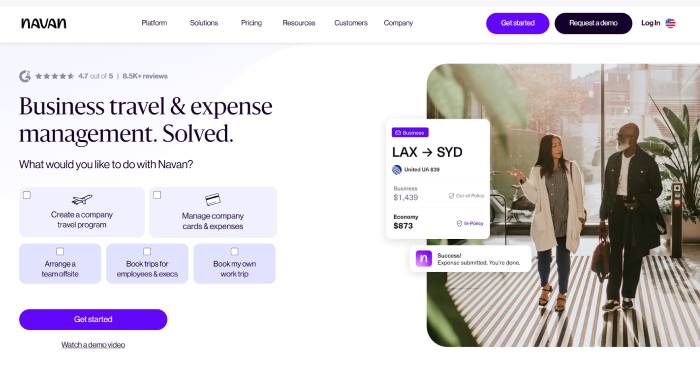
Navan has firmly established itself as the defining platform for corporate travel and expense management in 2026. What began as a corporate booking tool has evolved into a fully integrated travel and expense ecosystem where booking, corporate cards, expense reporting, and dynamic policy enforcement all live within a single unified stack. This convergence eliminates the fragmentation that has historically plagued corporate travel management, where booking tools, expense platforms, and card programs operated in silos.
The centerpiece of Navan's next-generation approach is Ava, its AI travel agent that proactively monitors bookings, anticipates disruptions, and initiates rebooking on behalf of travelers before issues escalate. Rather than reacting to problems after they occur, Ava operates continuously in the background, ensuring corporate travelers always have the most optimal itineraries in place. Combined with intelligent policy automation that adjusts spend guardrails based on context, Navan gives finance teams real-time visibility while giving travelers genuine flexibility — a balance that has historically been difficult to strike.
3. Amadeus
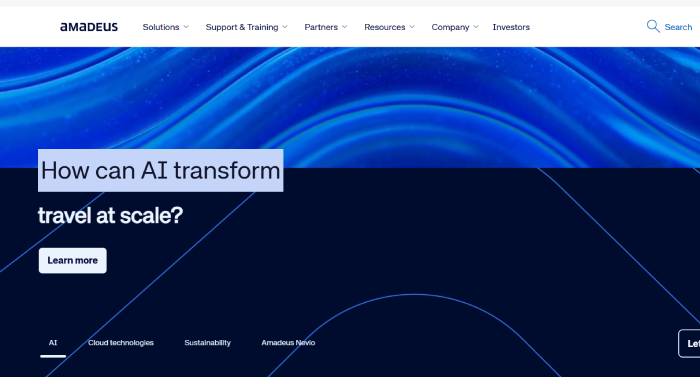
Amadeus occupies a uniquely powerful position in the next-generation booking ecosystem because it operates both as infrastructure and as an experience layer. As the backbone of global distribution for flights, hotels, and ancillaries, Amadeus powers the inventory that flows into countless booking interfaces around the world. But in 2026, Amadeus has moved decisively into the discovery layer as well, partnering with platforms like Google to embed its inventory directly into conversational and open-ended search experiences, including Google Flight Deals and prompt-to-itinerary tools.
This dual role — foundational distribution provider and AI-experience enabler — makes Amadeus one of the most strategically important players in travel technology. Airlines, hotels, OTAs, and corporate travel managers all depend on Amadeus infrastructure, and as the industry moves toward generative AI-driven planning, Amadeus is positioning its vast inventory to be accessible wherever travelers choose to begin their journey, whether through a traditional search engine, a conversational AI assistant, or an embedded travel widget within a third-party application.
4. Expedia Group

Expedia Group continues to push the boundaries of consumer travel booking in 2026, with its most forward-looking innovation being Trip Matching — a capability that decodes social media content, including Instagram reels and travel videos, and transforms them into fully bookable itineraries. This represents a genuine paradigm shift in travel discovery, recognizing that modern travelers increasingly find inspiration through visual social content rather than traditional search. By bridging the gap between inspiration and transaction, Expedia is capturing intent at a much earlier stage of the traveler journey.
Across its portfolio — including its B2B platform TAAP for travel agents — Expedia is deeply integrating generative AI into trip planning flows, enabling travelers to describe their ideal vacation in open-ended natural language and receive personalized, bookable results. Embedded AI assistants guide users through complex multi-destination itineraries, suggest optimizations, and surface deals that match individual preferences. This combination of social content decoding, generative planning, and deep inventory breadth makes Expedia Group one of the most consumer-oriented innovators in next-generation booking.
5. Booking.com

Booking.com's approach to next-generation travel in 2026 reflects its unmatched scale and its strategic bet on generative AI as the primary interface for trip design. With one of the largest accommodation inventories in the world and a growing presence in flights, car rentals, and attractions, Booking.com is integrating AI planning tools directly into its consumer-facing booking flows, allowing travelers to design entire trips through flexible, conversational interactions rather than sequential form-based searches.
For SME and corporate travelers, Booking.com for Business provides a self-serve booking environment enhanced by AI-aided trip design, policy visibility, and simplified expense reconciliation. The platform's strong UX heritage — built on years of conversion optimization — combines with generative AI to create experiences that are both intuitive for casual travelers and efficient for frequent business travelers. Booking.com's sheer inventory depth means that AI-generated itineraries can be fulfilled immediately, without the gaps in availability that hamper smaller platforms.
6. Hotelbeds

Hotelbeds occupies a critical position in the global B2B travel supply chain, consistently ranking among the top wholesale portals in 2026. As an intermediary connecting hotels with OTAs, travel agencies, tour operators, and corporate travel managers, Hotelbeds provides instant confirmation, a vast global hotel inventory, and a robust API foundation that allows partners to integrate accommodation supply directly into their own booking platforms.
What makes Hotelbeds next-generation is its role as connective tissue for the broader travel ecosystem. Rather than competing for the end traveler, Hotelbeds enables hundreds of distribution partners to offer competitive hotel content without building their own direct contracting relationships. Its API-first architecture means that OTAs, TMCs, and white-label booking platforms can access Hotelbeds inventory seamlessly, making it a foundational layer for many of the other platforms on this list. In an environment where inventory breadth and instant confirmation are competitive differentiators, Hotelbeds remains indispensable.
7. Accomy
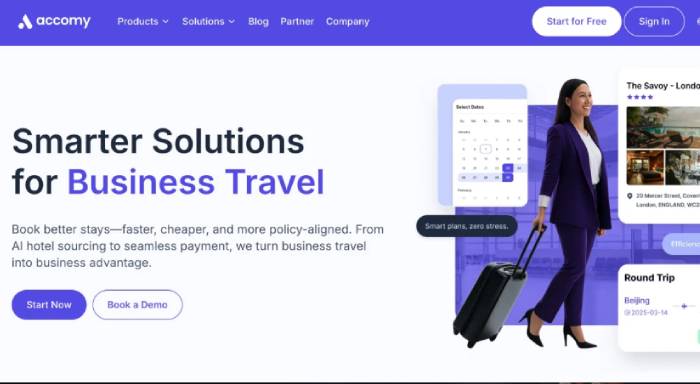
Accomy is an APAC-first corporate booking platform that has built a strong reputation for combining GDS content with direct hotel inventory, strong approval workflows, and sophisticated policy automation within a single interface. Its white-label and API delivery model makes it particularly attractive to TMCs and OTAs that want to offer corporate booking capabilities under their own brand without building the underlying technology from scratch.
In 2026, Accomy's next-generation credentials come from its unified ecosystem approach — mirroring the convergence trend seen in Navan but with a stronger focus on the APAC market and its specific corporate travel dynamics. Approval chains, multi-tiered policy rules, and compliance reporting are built natively into the booking flow, reducing the administrative burden on travel managers while giving travelers a streamlined experience. Its API-first architecture ensures that corporate travel programs can be embedded into existing enterprise workflows rather than requiring travelers to navigate a separate standalone tool.
8. FlyBlaze
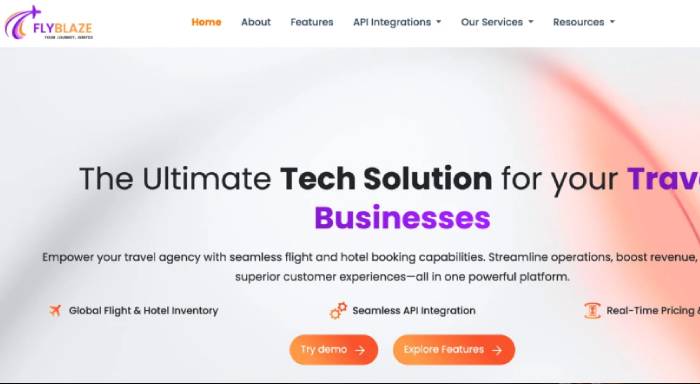
FlyBlaze is a white-label multi-supplier booking portal designed for travel agencies and operators that want to offer comprehensive, AI-enhanced booking capabilities across flights, hotels, buses, and packaged travel products. Its architecture is built for scalability, allowing agencies to deploy a fully branded booking experience backed by multi-supplier content aggregation and AI-driven recommendation engines.
What positions FlyBlaze as a next-generation platform is the depth of its AI layer within a white-label context. Rather than simply aggregating inventory, FlyBlaze applies intelligent recommendations that adapt to traveler preferences, search behavior, and pricing signals, helping agencies increase upsell revenue and improve customer satisfaction simultaneously. For smaller and mid-sized travel agencies that lack the resources to build proprietary AI capabilities, FlyBlaze offers a competitive shortcut — a platform that looks bespoke to end travelers while delivering sophisticated technology under the hood.
9. Juniper Travel Technology
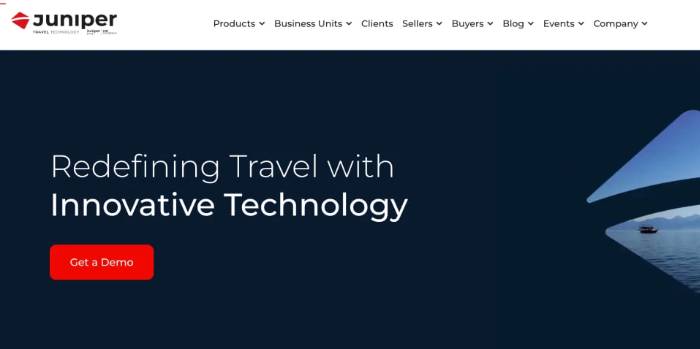
Juniper Travel Technology has made a significant product statement in 2026 with the launch of its newly redesigned Juniper Booking Engine Website, a highly modular and flexible platform designed for B2B, B2C, and B2E online distribution. Juniper's philosophy centers on giving travel businesses precise control over their booking flows, content sources, and UX design without requiring deep technical expertise to configure and maintain the system.
The platform's modularity is its defining characteristic: travel companies can activate the specific components they need — flights, hotels, transfers, activities, packages — and connect them to their preferred supplier APIs while maintaining a coherent, UX-driven booking experience across all product types. For travel businesses that have struggled with monolithic legacy booking systems that are difficult to customize or integrate, Juniper's modular approach represents a genuine architectural advancement, enabling faster iteration, easier upgrades, and more responsive adaptation to changing traveler expectations.
10. DMC Quote
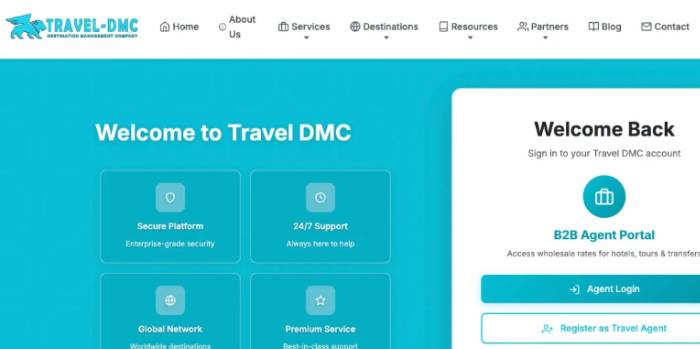
DMC Quote has carved out a distinct position in the B2B wholesale travel market, earning consistent recognition in 2026 industry rankings as a leading portal for destination management companies and travel agents. Its platform prioritizes automation, profit margin visibility, and API connectivity — giving DMCs and agents the tools they need to quote, package, and distribute travel products efficiently without the manual overhead that has traditionally slowed B2B workflows.
In an environment where agents are expected to respond to client requests faster than ever, DMC Quote's automation capabilities represent a meaningful operational advantage. Agents can generate detailed quotes, access live inventory, and confirm bookings within a single workflow, while built-in margin tools ensure commercial viability is visible at every step. Its API connectivity allows DMC Quote to integrate into broader travel ecosystems, making it a flexible back-office layer for agencies and operators managing complex, multi-component itineraries for group and leisure travelers.
11. DirectBooker
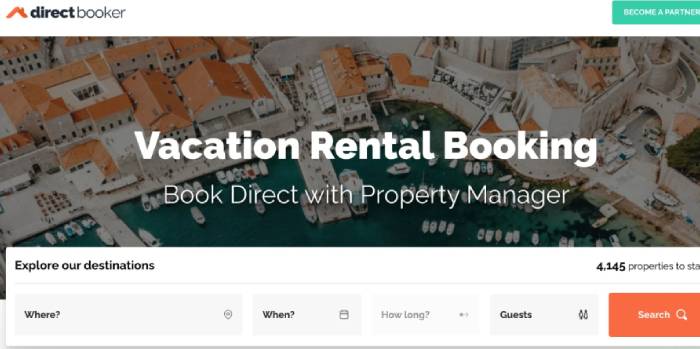
DirectBooker addresses one of the most significant structural tensions in modern travel distribution: the gap between hotel direct inventory and the emerging world of AI-powered travel discovery. As generative AI assistants become primary interfaces through which travelers explore and book trips, hotels face the risk of being invisible to these systems unless their inventory is accessible in AI-compatible formats. DirectBooker solves this by connecting hotel inventory directly to AI agents and intelligent assistants, enabling travelers to discover and book hotels through conversational AI interfaces without being routed through traditional OTA intermediaries.
For hotels, this represents a meaningful opportunity to reduce commission costs while maintaining visibility in AI-driven discovery channels. For travelers, it offers the convenience of AI-assisted booking without sacrificing access to direct rates and hotel-specific perks. DirectBooker's model anticipates a near future in which AI agents handle the majority of travel research and booking initiation, and positions direct hotel inventory as a first-class participant in that ecosystem rather than an afterthought.
Conclusion
The eleven companies profiled here represent the full spectrum of next-generation travel booking innovation — from AI-native startups reimagining how travelers discover and book trips, to established platforms embedding generative intelligence into proven distribution infrastructure, to specialized B2B portals automating the commercial workflows that keep the travel industry running. What unites them is a shared recognition that the future of travel booking belongs to platforms that combine deep inventory, intelligent personalization, and seamless user experiences into a single, scalable whole.
Respond to this article with emojis