



Performance marketing can be defined as online marketing where businesses and advertisers pay for affiliate networks, companies, and publishers only after the completion of a particular task. This can be
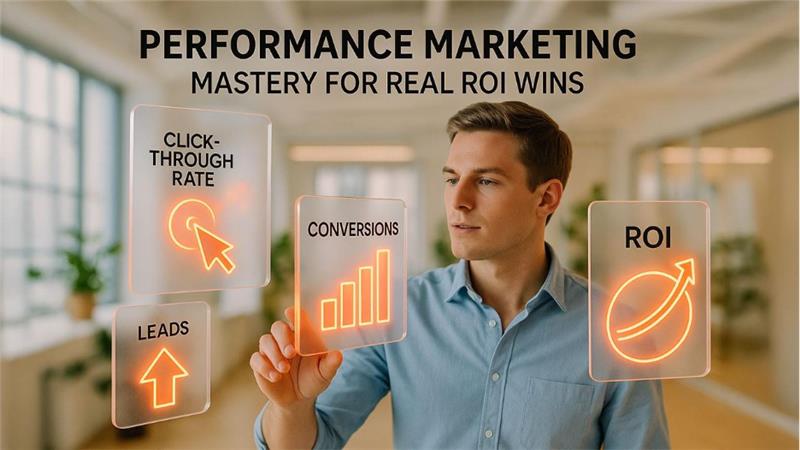
Performance marketing can be defined as online marketing where businesses and advertisers pay for affiliate networks, companies, and publishers only after the completion of a particular task. This can be a lead, click, or a sale. It empowers businesses to streamline ad spending and directly monitor ROI (Return on Investment) by emphasizing trackable outcomes. The term has grown in popularity due to a phenomenal surge in the available data. This makes it much simpler for businesses to monitor their real-time ad performance.
Brand Marketing Vs Performance Marketing
Understanding the distinction between performance marketing and brand marketing is quite important before you delve deeper into performance marketing and what marketing is in a broader sense.
Performance marketing emphasizes short-term and tangible results: leads, click, sales, or another kind of conversion. Affiliate networks get the payment based on these completed actions. These metrics are quite easily trackable. Since businesses can monitor such metrics in real-time, they can quickly adjust if required to streamline their ROI.
Brand marketing is a broader term and involves different aspects. Brand marketing deals with establishing lasting emotional connections with the audience. Essentially, a brand marketing campaign focuses on:
- Increasing brand awareness.
- Shaping public perception about the brand.
- Highlighting important values.
- Represent the brand in a consistent and authentic way.
Essentially, both brand marketing and performance marketing play a key role in a balanced marketing strategy. Brand marketing lays out a foundation that sets the stage for customer loyalty and recognition for many years. On the other hand, performance marketing delivers instant and trackable outcomes for the business, often capitalizing on effective brand marketing to be successful.
Affiliate Marketing Vs Performance Marketing
As you further learn about various digital marketing methods, you will come across another term: affiliate marketing.
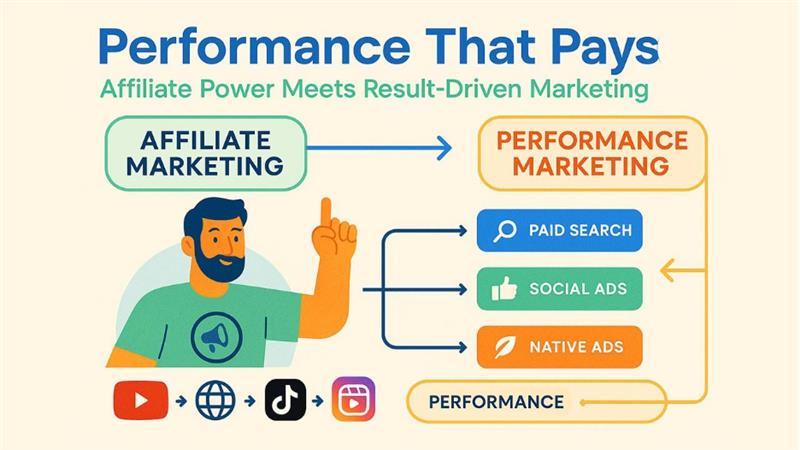
Affiliate marketing is actually a part of performance marketing. In affiliate marketing campaigns, advertisers partner with influencers or third-party publishers, who are known as affiliates. The business/advertiser only has to pay the influencer (the affiliates) when a successful action takes place.
In affiliate marketing, the affiliates do the marketing for you. This means that they share the advertisement with their audience through a wide variety of content marketing channels:
- Through YouTube Content.
- Through Website.
- Via TikTok.
- Through Instagram Reels.
- Via an email newsletter.
Performance marketing pertains to a wide variety of practices such as social media advertising, paid search, native ads, and other channels along with affiliate marketing. The core principle is the fact that all performance marketing strategies aim to deliver result-based and cost-effective campaigns for businesses.
How Performance Marketing Works?
Performance marketing always starts with a strong and clear foundation based on precise marketing goals. You will often hear marketers term it as desired actions. They are what the business is hoping to achieve.
These generally focus on enhancing a particular metric:
- Enhancing traffic on a website. For example, enhancing website visits by X.
- Increasing signups on newsletter or subscription services.
- Improving online sales.
Once they have established objectives and clarified them, advertisers then work on this foundation and launch diverse marketing campaigns on digital channels to achieve their objectives.
Such digital channels include aspects such as social networks, search engines, or displaying ad networks. Marketers leverage tracking platforms and marketing tools to track each interaction in real-time. Performance marketing remains vigilant on campaign data such as click-through data and cost per acquisition. Then, based on this campaign data, marketers can change ad creatives, tweak audiences, and bidding strategies if they recognize areas of improvement.
It is a data-based approach that underlines the whole process as payment is connected directly to the outcomes.
In other terms, if your campaign focuses on driving higher sales, you only must pay for the successful completion of those sales. It is a dynamic approach that makes performance marketing cost-effective and highly efficient.
Why Does Performance Marketing Benefits Platforms and Advertisers?
For the sake of an example, let us say an American ecommerce website starts search engine ads. They agree to make the payment only when someone clicks and ensures a purchase instead of impressions or clicks. This agreement makes budget allocation a lot easier. If CPA (total cost per acquisition) is less than the profit margin per sale, the campaign becomes profitable. The ad platform, i.e., Google ads benefits by delivering demonstrable outcomes, which encourages advertisers to keep coming back to marketers, generally with enhanced budgets.
When advertisers notice higher revenue being generated from their advertisement, they are more likely to make investment in the platform, helping to create a long-term and mutually beneficial relationship.
How Do You Divide Costs in Performance Marketing?
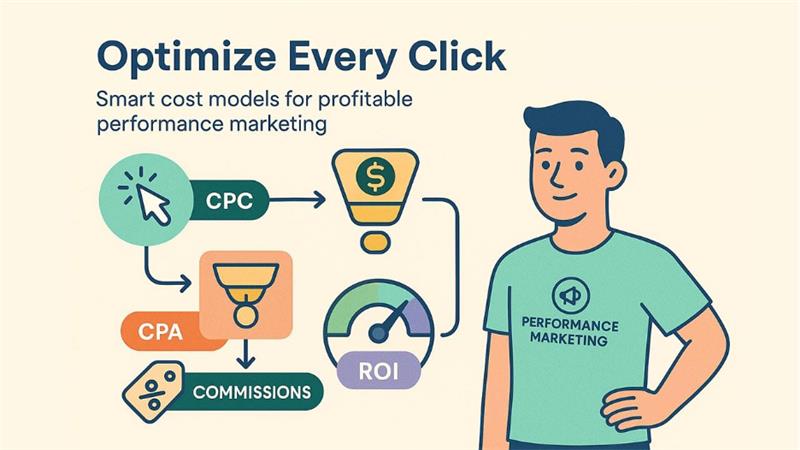
Most search engine advertisement arrangements are either CPA (cost per acquisition) or CPC (cost per click). This means that advertisers must either pay for every click or only for every acquisition. Advertisers can agree to pay cost per click whereas platforms such as Google Ads directly collect the fees. In affiliate partnerships, the commission varies in the typical range of 10-30% of every sale and may be divided between the affiliate and the the platform ensuring results.
What is important for advertisers is making sure that the fees remain less than the average profit per sale so that the campaign consistently delivers a positive ROI.
What Is the Role of AI in Performance Marketing?
It is not even possible for expert marketers to always be available 24/7 and manually monitor and adjust hundreds of advertisements. This is where technology such as Artificial Intelligence (AI) can come in, emerging as a platform for marketers to reduce the load. AI-powered platforms can rummage through a high volume of data instantly, automatically identifying trends and recognizing ad variations that simply work. While humans can obviously provide a creative flair to the campaign, their minds do not have the capability to remember each and every data point across a vast volume of data sets.
Ascertaining that you are adopting powerful automation at your fingertips, you can easily shift your focus to other facets of marketing. You can concentrate more on strategic tasks that require deep thinking and human touch while allowing AI to take over repetitive tasks.
The data-based and real-time agility enables businesses to improve their performance marketing campaigns instantly without missing out on key opportunities.
Different Types of Performance Marketing Channels
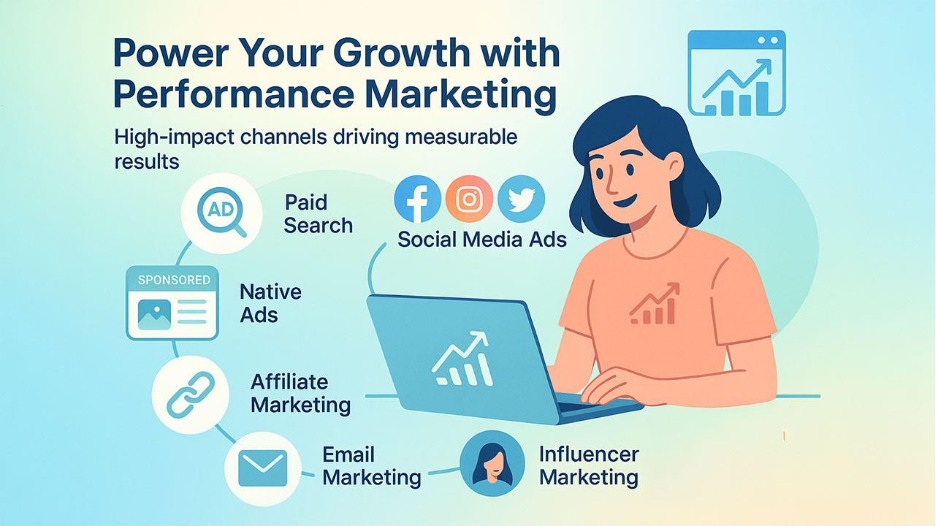
This section gives you an overview of the key channels you can use in your performance marketing campaigns:
1. Paid Search:
Paid search is the name given to the advertisement you see on platforms such as Google Ads. When people look for specific terms, they see a few results marked as “sponsored.” To make their brand appear in this coveted spot, businesses must pay for it. To be more precise, brands only pay whenever an action is finished irrespective of whether it is a sale or click. For instance, US-based CRM developers might target “SuiteCRM Plugins” and only pay when they get a customer that shows genuine interest.
2. Social Media Advertising:
Social platforms such as Instagram, Facebook, LinkedIn, etc., enable you to target specific audience segments using interests, demographics, and behavior. So, if you have defined your buyer’s persona quite clearly, you can utilize this market research to refine your performance marketing campaigns on social media platforms. For instance, a cafe based in Chicago can run advertisements to promote their new menu. And let’s say it is targeting younger demographics composed mainly of office-goers and college students. Social media platforms can incorporate this specificity and enable them to connect with this narrow audience.
3. Native Advertising:
Native advertisement is a kind of paid advertisement specialized to seamlessly blend with the feel, look, and function of the platform or website on which they show up. Instead of appearing as a banner, it adopts the style of recommended content, editorial articles, or social posts. Native advertisements generally show up as “recommended for you”, “sponsored links”, or branded posts on social media feed. Here, the advertisers do have some control over the type of sites or categories where their advertisements appear. One of the two major platforms in native advertising is Taboola or Outbrain that handle native advertising through their publisher website networks.
4. Affiliate Marketing:
As already stated earlier, affiliate marketing is a good example of performance marketing. Here, the advertisers mainly partner with influencers, bloggers, or review websites who are known as affiliates and get a commission for every lead or sale that they generate. A Uk-based influencer can get some commission for every booking made through their referral link.
5. Email Marketing:
Most email marketing platforms do not adopt pay-per-conversion billing. If you are leveraging an email marketing platform to send offers or newsletters, you generally must pay a monthly subscription. Generally, this kind of email campaign cannot be categorized under the “pay-for-what-you-get" performance marketing channel. However, what email marketing does is enable you to monitor key metrics such as click-through-rates, open-rates, and conversion rates, which are crucial for assessing the campaign effectiveness.
If you want a robust solution that extracts data from your email and stores it into your open-source CRM, you can try OutRight Store’s Email-to-Lead.
6. Influencer Marketing:
In performance marketing, influencers get compensation only if they achieve the outcomes previously agreed upon, such as signups and clicks. This arrangement makes sure that there is accountability for both influencer and brand. What is significant here is partnering with an influencer whose audience closely matches yours. An influencer with shared values or similar demographics can extend the reach of your brand authentically and establish robust connections with target customers. It is important to not consider influencers as a one-time deal but as a long-term part of your community.
Conclusion
Performance marketing ensures a data-based approach that changes how businesses distribute their advertising budgets. By paying only for trackable actions such as leads, clicks, or sales, companies get accurate control over Return on Investment while reducing financial risk. The integration of AI-driven analytics and distinct channels from paid search to influencer partners, allows campaign optimization in real-time. Success depends greatly on ensuring clear goals, choosing the right channels with the target audience, and ensuring CPA (cost-per-acquisition) below profit margins. When strategically combined with brand marketing strategies, performance marketing ensures measurable outcomes that drive long-term business growth in a competitive digital landscape.
Respond to this article with emojis