


Retailers in 2026 can no longer rely on surface-level revenue uplift to judge promotional success. As margins tighten and competition intensifies, understanding true incremental profit has become a strategic necessity.
Retailers in 2026 can no longer rely on surface-level revenue uplift to judge promotional success. As margins tighten and competition intensifies, understanding true incremental profit has become a strategic necessity. Advanced promotion analytics software is shifting the focus from retrospective reporting to predictive, margin-aware decision-making.
Retail promotions account for a significant share of revenue in grocery and FMCG sectors, yet many retailers still struggle to measure their true effectiveness. In 2026, the challenge is no longer about launching campaigns - it’s about understanding which promotions generate real incremental profit and which simply shift demand.
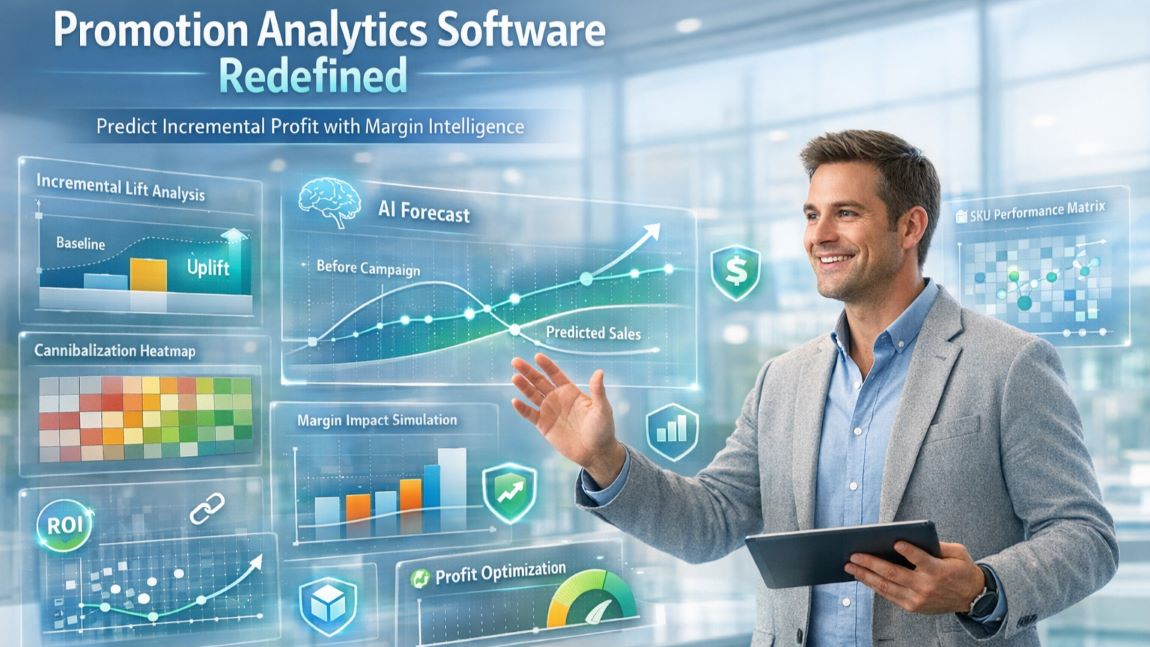
Margin pressure, rising acquisition costs, and increased competitive intensity have made accurate promotion evaluation a strategic priority. Traditional dashboards and post-campaign reports are no longer sufficient. Retailers now require predictive analytics capable of modeling campaign outcomes before execution. The best Promotion Analytics software must combine incrementality modeling, cannibalization detection, and margin simulation into one intelligent system. Without these capabilities, promotional strategy becomes guesswork rather than data-driven decision-making.
According to research by McKinsey & Company, more than half of retail promotions fail to break even once true incremental impact is measured. This highlights why promotion analytics in 2026 must move beyond surface-level uplift reporting and focus on incrementality modeling, cannibalization detection, and margin simulation.
TL;DR
Promotion analytics in 2026 must go beyond basic post-campaign reporting. Retailers now need predictive tools that measure incremental lift, identify cannibalization, forecast margin impact, and simulate outcomes before launching promotions.
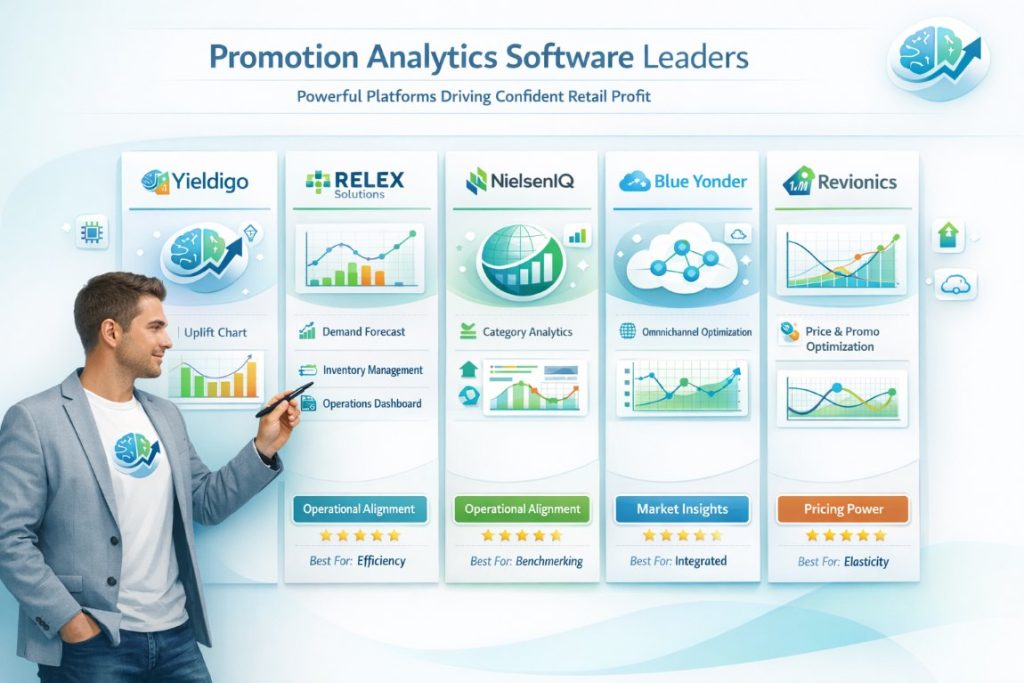
Here are the leading promotion analytics software solutions for 2026:
- Yieldigo - advanced AI-driven promotion analytics with predictive uplift and margin simulation
- RELEX Solutions - forecasting-based promotion performance evaluation
- Revionics - price-centric analytics with promotional insights
- Blue Yonder - enterprise-scale retail analytics suite
- NielsenIQ - market-level promotional effectiveness measurement
Read on for a detailed breakdown of analytical depth, AI capabilities, pricing models, and real-world retail applications.
The Problem: Most Retailers Still Don’t Know Which Promotions Actually Work
Most retailers still don’t truly understand which of their promotions actually work. They rely on surface-level metrics like revenue uplift, volume growth, or basic ROI calculations, believing these numbers reflect success. But in reality, these indicators often tell only part of the story. They rarely account for cannibalization between SKUs, where one discounted product simply steals sales from another. They overlook margin erosion caused by aggressive pricing and ignore cross-category halo effects that may distort performance results. Even more importantly, they fail to measure the long-term impact on customer behavior and brand value. Promotion analytics software exists to answer a far more critical question: did the campaign generate real incremental profit - or did it merely shift demand without creating true value?
Why Trust Our Software Reviews?
We analyze promotion analytics platforms through the lens of incremental profit - not surface-level uplift metrics. Our evaluations combine hands-on product testing, elasticity methodology review, modeling depth assessment, and structured analysis of verified user experiences.
As part of our research process, we also reviewed publicly available G2 reviews and other third-party platforms. These independent sources provide additional transparency and reflect real-world implementation feedback beyond vendor positioning.
Rather than repeating marketing claims, we examine whether systems truly measure incrementality, detect cannibalization, forecast margin impact, and simulate campaign outcomes before launch.
Each review is independently written by specialists who understand retail economics, ensuring that decision-makers receive balanced, data-backed insights when selecting promotion analytics software for 2026.
How We Evaluated Promotion Analytics Software for 2026
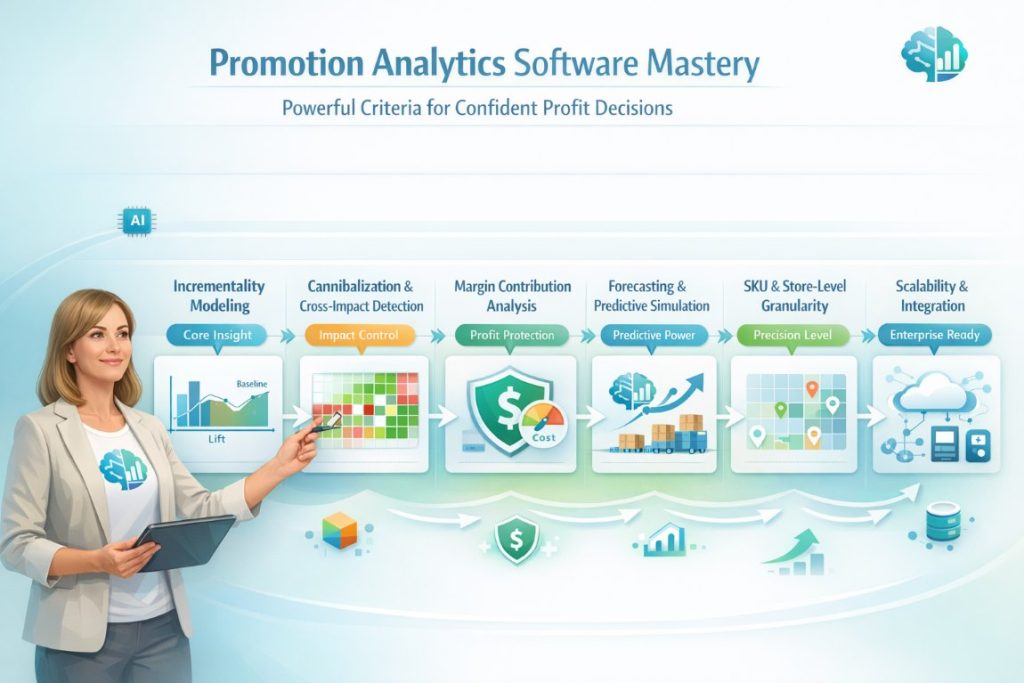
Choosing the best promotion analytics software in 2026 requires looking far beyond historical reporting. Modern retail demands tools that measure true incremental profit, uncover hidden margin erosion, and guide smarter future decisions. To select the right solution, consider the following six criteria.
Prioritize True Incrementality Modeling
The foundation of serious promotion analytics is the ability to isolate incremental impact. The system must distinguish between baseline sales and uplift genuinely driven by the promotion.
If a platform only reports revenue growth during campaign periods without modeling what would have happened otherwise, it is reporting - not analytics.
Evaluate Cannibalization & Cross-Impact Detection
Effective promotion analytics must quantify how promoted SKUs affect other products within the portfolio. This includes identifying cannibalization within categories and halo effects across categories.
Without this visibility, apparent campaign success may conceal internal revenue shifts and margin dilution.
Analyze Margin Contribution - Not Just Revenue
Revenue uplift alone can be misleading. The platform should calculate margin impact, discount cost, and true incremental profit.
A strong solution enables retailers to understand whether promotions are financially accretive or simply driving volume at the expense of profitability.
Assess Forecasting & Predictive Capabilities
In 2026, analytics must support forward-looking decision-making. The system should forecast promotional impact before launch and simulate alternative campaign strategies.
Predictive modeling transforms analytics from retrospective reporting into strategic planning support. Promotional forecasting also directly affects inventory allocation and distribution efficiency. Retailers aligning campaign simulations with advanced logistics software strategies can reduce stockouts and excess inventory risk during high-demand periods.
Demand SKU & Store-Level Granularity
Retail complexity requires granular analysis. The software should measure performance at SKU and store level to capture regional demand differences and local elasticity patterns.
Aggregated reporting often masks underperformance or hidden risks in specific markets.
Review Scalability & Data Integration
Finally, assess whether the platform integrates seamlessly with pricing, POS, and inventory systems. It must handle large data volumes across thousands of SKUs and multiple regions without compromising modeling accuracy.
The best promotion analytics software for 2026 combines analytical rigor, predictive intelligence, and enterprise scalability - enabling retailers to move from campaign measurement to profit optimization.
Best Promotion Analytics Software for 2026
Yieldigo
What It Is?
Yieldigo is an AI-driven retail optimization platform that unifies promotion analytics, price optimization, and markdown management within a single decision engine. Unlike traditional analytics tools that focus on historical reporting, Yieldigo positions promotion analytics as part of a predictive, profit-maximizing system. The platform is designed specifically for retail environments with high SKU complexity and margin pressure.
Best For:
Mid-to-large retailers seeking predictive, margin-aware promotion analytics that are tightly integrated with pricing and profitability strategy.
Key Capabilities:
- Incremental lift measurement using elasticity-based modeling
- Promotion scenario simulation before execution
- Cannibalization and halo effect detection
- Margin-first optimization logic
- Integrated pricing and promotion decision intelligence
Strategic Strengths:
Yieldigo’s core strength lies in predictive analytics rather than backward-looking dashboards. The platform models true incrementality, aligns promotion decisions with elasticity insights, and evaluates total margin impact instead of revenue alone. Its fully integrated pricing and promotion framework reduces internal conflicts and supports coordinated commercial strategy. The solution is purpose-built for retail complexity, supporting SKU/store-level modeling and scenario-based planning.
Considerations:
Best suited for retailers with structured and accessible data infrastructure. Implementation is enterprise-oriented and may require structured onboarding and alignment across pricing and commercial teams.
Pricing:
Custom enterprise pricing.
G2 Rating: 4.6 / 5
RELEX Solutions
What It Is?
RELEX positions itself as a unified retail planning platform with embedded promotion performance evaluation capabilities. Rather than offering standalone promotion analytics, RELEX integrates campaign evaluation within its broader demand forecasting and supply chain ecosystem.
Where It Performs Well?
- Demand forecasting aligned with promotional activity
- Supply chain-aware promotion evaluation
- Enterprise scalability and operational integration
Strategic Strengths?
RELEX excels at connecting promotion impact with inventory flow, replenishment, and availability planning. Retailers can assess how promotional demand affects stock levels and supply chain performance, reducing operational disruptions during campaigns. Its strength lies in aligning commercial planning with operational execution.
Where It’s More Limited?
Promotion analytics is part of a broader planning framework rather than a dedicated intelligence layer. The platform places less emphasis on advanced incremental margin modeling and detailed profit attribution compared to specialized promotion analytics engines.
RELEX is best suited for retailers prioritizing operational synchronization between campaigns and inventory rather than deep incrementality-driven profitability modeling.
G2 Rating: 4.4 / 5
NielsenIQ
What It Is?
NielsenIQ is a global data analytics provider focused on syndicated data and market-level promotional performance measurement. It is widely used by CPG brands and retailers to benchmark promotional effectiveness across markets and competitors.
Strengths:
- Extensive benchmarking datasets
- Category-level promotional performance analysis
- Strong industry credibility and historical data coverage
Strategic Position:
NielsenIQ’s analytics are particularly valuable for brands assessing trade promotions across retail partners. The platform offers macro-level insights into category trends, competitive dynamics, and historical promotion effectiveness.
Limitations:
Its focus is more analytical and reporting-based rather than predictive or optimization-driven. Integration into retailer-specific pricing systems and SKU-level incrementality modeling is limited.
NielsenIQ is strongest as a benchmarking and insight-generation tool rather than an AI-powered decision engine for promotion optimization.
G2 Rating: 4.1 / 5
Blue Yonder
What It Is?
Blue Yonder provides promotion analytics as part of its broader merchandising and supply chain suite. The platform supports complex, omnichannel retail operations with enterprise-scale infrastructure.
Strengths:
- Enterprise-level data processing capability
- Integration across merchandising, pricing, and supply chain
- Scalable architecture for global retailers
Strategic Position:
Blue Yonder is typically selected by large retailers undergoing infrastructure-level transformation. Its promotion analytics are embedded within a comprehensive enterprise planning system, enabling structured oversight and cross-functional coordination.
Limitations:
Promotion analytics is often integrated within a broader suite rather than operating as a specialized incrementality-focused intelligence engine. Implementation complexity and cost may be higher compared to more targeted solutions.
Blue Yonder is well suited for global enterprises seeking large-scale integration rather than highly specialized promotion profitability modeling.
G2 Rating: 4.2 / 5
Revionics
What It Is?
Revionics is traditionally recognized for its price optimization capabilities. Its promotion analytics functionality is closely connected to pricing strategy and elasticity modeling.
Strengths:
- Strong price-promotion interaction modeling
- Advanced elasticity-driven analytics
- Established enterprise presence
Strategic Position:
Revionics performs well in environments where pricing is the primary strategic lever and promotions are evaluated in close interaction with base price adjustments. Its elasticity-based logic supports coordinated price and promotion decision-making.
Limitations:
Promotion evaluation may be secondary to pricing optimization within the platform’s overall positioning. Standalone campaign simulation and deep incrementality analytics may not be as central as in promotion-focused platforms.
Revionics is best suited for retailers where pricing strategy drives commercial optimization and promotions are managed within that broader pricing framework.
G2 Rating: 4.3 / 5
What Are the Benefits of Using a Retail Promotion Analytics Solution?
- Improved Visibility into True Incrementality: Promotion analytics software helps retailers distinguish between baseline sales and genuine incremental lift. Instead of relying on surface-level revenue uplift, businesses gain a clearer understanding of what a campaign actually generated in terms of new demand.
- Better Margin Protection: By quantifying cannibalization, halo effects, and discount impact, retailers can reduce hidden margin erosion. This allows teams to refine future campaigns based on profitability rather than volume alone.
- Data-Driven Campaign Optimization: Promotion analytics turns historical performance into structured insight. Over time, retailers can identify which mechanics, products, and timing strategies consistently deliver stronger financial outcomes.
- More Accurate Forecasting: Incorporating analytical models into evaluation improves future promotional forecasting. This leads to better supply chain coordination and financial planning accuracy.
How to Choose the Right Promotion Analytics Software
Selecting the right promotion analytics software in 2026 requires more than comparing dashboards or feature checklists. Retailers must evaluate whether a platform can truly measure incremental profit, detect cross-SKU impact, and support forward-looking decision-making rather than retrospective reporting.
Because promotion performance directly influences margin, inventory planning, and pricing strategy, the chosen system should align with both analytical rigor and operational reality. The following criteria can help retailers distinguish between reporting tools and true promotion intelligence platforms.
Conclusion
Choosing the best promotion analytics software in 2026 means moving beyond basic reporting tools. Retailers need systems that quantify true incremental value, measure cross-category impact, and forecast margin outcomes before campaigns launch. As promotional intensity continues to increase, the cost of inaccurate analysis grows significantly. Organizations that invest in predictive promotion intelligence gain a measurable competitive advantage, as they can optimize budgets, refine targeting, and eliminate unprofitable discounting patterns. The key differentiator is not visualization, but predictive depth and retail specialization. For companies seeking advanced incrementality modeling and integrated pricing alignment, Yieldigo offers one of the most sophisticated promotion analytics environments currently available. Ultimately, the most effective promotion analytics solution is the one that turns campaign evaluation into forward-looking profit optimization rather than retrospective reporting.
Respond to this article with emojis