

Python Benefits: Why Developers Can’t Stop Choosing It
Discover the top Python benefits for developers and businesses, from faster development and automation to AI, data science, scalability, and real-world applications.
First and foremost, the key advantage of Python is that a team can do more with less coding. A readable syntax, huge ecosystem of libraries, and leading role in AI and data science make Python one of the most productive and versatile programming languages.
Python is a high-level, interpreted, open-source programming language developed by Guido van Rossum and released in 1991. Python supports multiple programming paradigms: object-oriented, procedural, and functional programming, allowing a programmer to choose the appropriate approach for each case. Whether you’re building web applications, automating workflows, or exploring AI, understanding the Python benefits explains why it remains one of the world’s most popular programming languages.
Key Advantages of Python
As a first step to assessing the advantages and disadvantages of a technology, it is important to know the advantages of a particular language. In the case of Python, there are several advantages that accumulate throughout the lifetime of a project. Each of them comes from one design principle of Python – code must be readable for a human being. It is the driving force behind all advantages mentioned below and allows Python to take first place in the TIOBE index of the most popular programming languages.
Readability of Syntax
One of the biggest Python benefits is its clean, human-readable syntax, which helps developers write, review, and maintain code more efficiently. A piece of code that requires hundreds of lines in Java or C takes just a couple of lines in Python.
These features bring business value directly:
- Faster development and quicker time to market
- Easier code review and maintenance
- Reduced onboarding cost, as a newcomer easily understands the existing code
The result is a reduced number of bugs and minimized total cost. Easy-to-read code is less expensive to maintain than a tricky one and easier to scale across a growing team throughout the Software Development Lifecycle.
Vast Ecosystem of Libraries and Frameworks
Among the most practical Python benefits is access to thousands of ready-to-use libraries that significantly reduce development time and effort. Python comes with a big standard library of more than 500,000 additional packages available via the Python Package Index (PyPI). That ecosystem of libraries means that a team does not need to reinvent the wheel when developing.
Some areas covered by the Python library ecosystem include:
- Data-related: libraries for data analysis and processing such as NumPy and pandas
- Web development: frameworks like Django, Flask, and FastAPI
- Automation: modules and scripts for testing, DevOps, and routine coding
Since most of the libraries are open source and have been used for years in different contexts, they save lots of time and minimize risks. Just one import of a reliable library can replace weeks of coding, and all Python frameworks are shipped with great library support. That huge number of Python libraries and Python frameworks is an undeniable advantage of Python that makes it much faster to develop than most alternatives.
Default Programming Language for AI, Machine Learning, and Data Science
Related walkthrough
Index 1000 URLs using Free Google Indexing API | Google Developer Console u0026 Python


Python is the default language of AI. The leading machine learning frameworks like TensorFlow, PyTorch, and scikit-learn are designed specifically for Python, which makes it the standard choice for data science and machine learning tasks.
And that is a significant factor for any business that considers investing in AI:
- The biggest community of Python developers focused on AI works in Python
- Most new machine learning libraries and tutorials target Python as a first-class language
- Data science and machine learning pipelines integrate smoothly into the rest of the Python ecosystem
If AI or data analysis is included in the future roadmap of your business, then using Python is almost inevitable. The dominant machine learning library, AI tools, research, and community are running on it, and no other programming language is able to match Python for machine learning programming.
Versatile Usage From Web Development to Automation and Much More
It is hard to find a more versatile language than Python. The same programming language suits all kinds of development, from web development to data analysis, scripting, automation, and large-scale software development.
The flexibility to support multiple use cases is one of the key Python benefits, allowing teams to build diverse applications using a single programming language.
Some common applications of Python include:
- Backend web development, where a Python web framework such as Django or Flask powers scalable websites
- Automation and scripting to eliminate repetitive manual work
- Data processing and analytics for reporting and research
- Prototyping, when faster development allows testing different concepts quickly
That versatility is a practical advantage, as a team can stick to one programming language for multiple projects instead of maintaining several languages.
Open Source with a Huge Community
Python is a free and open-source programming language supported by one of the biggest communities in the software industry. The Python community generates documentation, tutorials, and solutions that help find the answer to almost any coding issue within minutes.
For a business, that means low risk. It is easier to hire Python developers, get support, and keep working on a project even if the person who initially coded the system leaves the team.
Build Your Custom Project with Nomium
Need to bring your project to life the right way? Our engineers build production-ready software for AI, data, and backend systems. Discuss your project with us (https://nomium.tech/), and we’ll find the quickest way from idea to product release. Schedule a free consultation now.
Disadvantages of Python
An honest analysis of the pros and cons of Python must consider the trade-offs. The disadvantages of Python are real, but in most cases a professional developer can handle them.
- Slow execution. Being an interpreted programming language, Python runs slower than compiled languages such as C, C++, and Java. In case of heavy computational loads, calls to optimized libraries or another language should be considered.
- Higher memory consumption. Flexible data types used by Python consume more memory, which is a disadvantage in a resource-constrained environment.
- Limited multi-threading. The Global Interpreter Lock prevents full-fledged parallel thread usage, and heavy parallel tasks require other approaches.
- Poor suitability for mobile. Python is not a preferred choice for mobile application development.
- Run-time errors from dynamic typing. The data type is checked during the execution of the code, and some errors appear later than in a statically typed language.
Knowing the disadvantages of the Python programming language is important, but they do not rule it out as an option; they just define its best fit.
Comparing Python with Other Programming Languages
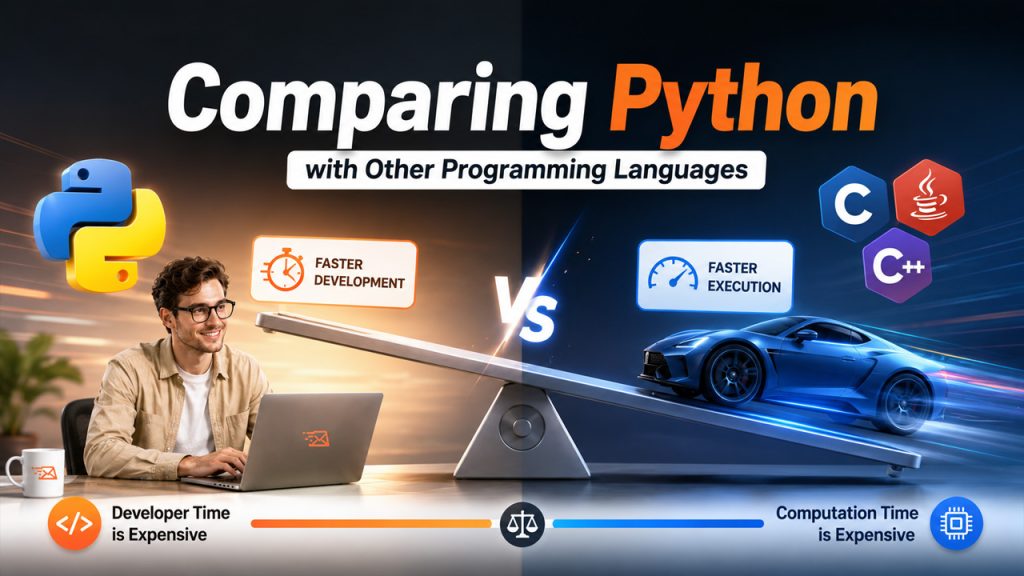
Most of the time, the choice of Python over other programming languages implies a trade-off between execution speed and development speed. In comparison with other programming languages such as C or Java, Python code runs slower, but it is developed, read, and deployed much faster.
This trade-off is in favor of Python as long as developer time is more expensive than computation time, which is true for most cases of software development nowadays. When microsecond performance is needed, for example in game engines or high-frequency trading, Python is inferior to compiled languages. Python works well together with other programming languages and technologies, which allows integrating it into the existing stack without rewriting it. Python is slower than C, but Python development is quicker to reach production.
Conclusion: When to Use Python
Use Python when fast development, readability, and access to AI and data tools are more important than maximum runtime performance. This applies to a majority of modern web, automation, and data projects.
In short, the benefits of Python prevail over the disadvantages, and they become more evident when a project grows. All advantages of Python, from the library ecosystem to its leading position in AI, are the reasons why Python is chosen for various projects. Overall, the long-term Python benefits; from faster development and maintainability to AI readiness and versatility continue to make it one of the strongest choices for modern software development.
Frequently Asked Questions
Q1. What are the advantages of Python?
Main Python advantages include readable syntax, a huge ecosystem of libraries and frameworks, leadership in AI and data science, and versatility of usage in web development, automation, and scripting. These are the reasons why it is faster to develop and easier to maintain the system.
Q2. What are the pros and cons of Python?
The pros of Python include readability, a vast library ecosystem, strong AI and data science capabilities, and a huge community. Cons include slower execution compared to compiled languages, higher memory usage, limited multi-threading, and poor suitability for mobile.
Q3. Why is Python so popular?
The popularity of Python comes from ease of learning, fast development speed, and huge libraries for virtually any kind of task. Leadership of Python in AI, machine learning, and data science drives it to first place in nearly all rankings of the most popular programming languages, such as the TIOBE index.
Q4. What are the common uses of Python?
Popular uses of Python include web development, data analysis, AI and machine learning, automation and scripting, and general software development. This versatility explains the popularity of Python in so many fields.
Q5. Will AI replace Python programmers?
No. AI tools for programming accelerate Python developers but do not substitute them. The Python programming language is used to develop AI itself, and demand for proficient Python engineers still exists.
Q6. What is the 80/20 rule in Python?
The 80/20 rule (or Pareto principle) means that roughly 80% of results come from 20% of efforts. In the case of Python, this principle works in two ways: a small core of the language is sufficient for most day-to-day coding, and most of the execution time is spent in a small part of the code.
Q7. Which kinds of projects are not suitable for Python?
Python is not a good choice for performance-critical systems such as high-performance game engines, real-time embedded software, and native mobile applications. Compiled languages are better options here.
Q8. How secure is Python for enterprise applications?
Python is secure enough for enterprise applications if the standard rules are followed: dependencies are always updated, packages are scanned via the Python Package Index, and secure coding practices are applied. Many enterprises use Python for their critical systems.