





Walk onto the New York Stock Exchange floor, and the first thing that hits is the pace. Prices change, orders fly, and trades close before anyone finishes a sentence. Digital
Walk onto the New York Stock Exchange floor, and the first thing that hits is the pace. Prices change, orders fly, and trades close before anyone finishes a sentence. Digital ads run on that same kind of tempo, and SSP advertising fits into the story like the sell-side exchange that keeps the order book moving while the page is still loading.
Real-time bidding (RTB) can sound mysterious until it is treated like a market. A publisher has “inventory” (an ad slot), buyers have budgets, and each impression gets priced one at a time. Tools from companies such as SmartyAds sit on the supply side and help turn that messy flow of offers into a clean, auditable trade.
The Opening Bell: What Real-Time Bidding Actually Trades
In Wall Street terms, an ad impression is a single share that exists for a split second. The moment a person opens an app or a webpage, the publisher sends a bid request that describes the “asset” up for sale: size, placement, basic context, and sometimes limited audience signals. Buyers then decide what that one view is worth and send a bid back almost instantly.
Unlike a traditional media buy, there is no long negotiation over bulk inventory. Instead, the system runs millions of tiny auctions every minute, with software acting as traders on both sides. A buyer’s tools set goals like reach, location, and frequency, then bid only when the match looks good. For a plain-language overview of how this connects to programmatic advertising, it helps to picture a fast exchange where rules are strict and timing is everything.
However, the key idea is simple: RTB prices attention in real time. That is why the market never “closes” in practice. People scroll at 2 a.m., live streams run across time zones, and auctions keep clearing as long as content keeps loading.
Orders, Spreads, and Speed: How an Auction Clears in Milliseconds
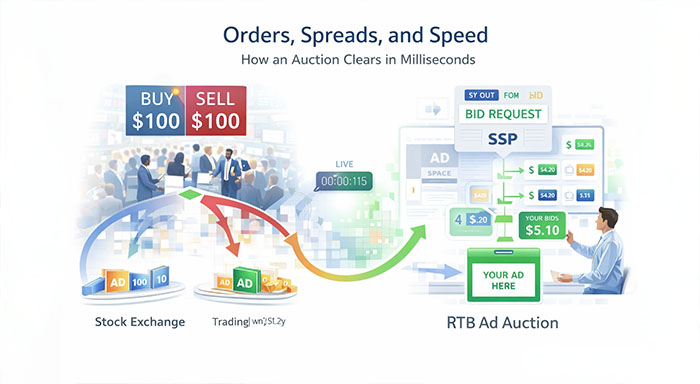
On a stock exchange, a trade clears when a buy order meets a sell order at an agreed price. RTB clears in a similar way, just faster and with more filters. The publisher offers one impression, buyers compete, and the winner’s ad renders before the page finishes drawing.
Here is what the trade often looks like from the inside:
- A user opens content, and the page calls for an ad.
- The publisher’s system packages details about that slot into a bid request.
- Multiple buyers evaluate it against their targeting rules and budgets — the same logic that drives performance marketing, where spend is tied directly to trackable outcomes like clicks or conversions.
- Bids come back with prices and ad details.
- The top bid wins (based on the auction rules), and the ad shows.
Therefore, speed is not just bragging rights. A late bid is like a late order on a fast-moving stock: it misses the fill. This is where an SSP advertising platform comes into play. It gathers bids, applies the publisher’s rules (such as blocked categories or minimum prices), and picks a winner with the same discipline a trading venue uses to match orders.
That discipline matters for another reason, too. In real markets, tiny differences in timing can change the final price. In RTB, the same is true, so clean routing and consistent auction rules protect revenue and keep reporting from turning into guesswork.
Risk Controls for Ads: Fraud, Fees, and Price Discovery
Wall Street has circuit breakers, surveillance, and compliance teams because bad actors follow money. Ad auctions attract the same attention, just with different tricks. Fake traffic can look like real people, shady reselling can hide where an ad actually ran, and extra middlemen can take fees that are hard to spot in a simple dashboard.
A good SSP ad platform acts like a risk desk for the publisher. It can support seller-set floors, spot unusual patterns, and prioritize cleaner demand paths so the “trade” has a better chance of being real. Moreover, it can help reduce wasted auctions by filtering out categories that do not match the site or the brand safety rules.
Price discovery also looks familiar here. In stocks, the spread between bid and ask reflects risk and demand. In ads, the clearing price reflects context, competition, and how much buyers trust the supply. If you know about high-frequency trading, you know that when decisions happen in micro-moments, market structure and fairness rules start to matter as much as raw speed.
By contrast, when the sell side runs blind, the market gets noisy. That noise shows up as mismatched numbers, weak yields, and the nagging question of who took a cut and why.
Closing Bell: A Practical Way to Think About RTB
RTB is easiest to understand as a 24/7 exchange where every impression is a tiny trade. Publishers “list” inventory, buyers submit bids, and the auction clears before the user notices anything happened. That is why clear rules and clean reporting matter as much as win rates.
When choosing an SSP advertising solution, the Wall Street mental model can guide the questions. Does it show where demand came from, how the auction picked a winner, and what fees exist along the path? Does it support sensible controls like floors and category blocks without burying them in hard language? Ultimately, the goal is not to chase speed for its own sake, but to keep the market fair, readable, and profitable on the sell side.
Respond to this article with emojis