
What Is Software Development? Process, Types & Benefits Explained
Learn what software development is, explore its process and types, and discover when custom software development is the right solution for your business.
Every app you open, every website you browse, and every tool your team relies on daily exists because of software development. It’s easy to take for granted until something breaks or a business realizes their off-the-shelf tools just aren’t cutting it anymore, and that’s usually when the real questions start.
At its very essence, software development refers to the design, creation, testing, and maintenance of systems and programs that make everything from mobile applications to enterprise platforms possible. Software development is more than writing code. It is a step-by-step process that converts ideas into reality through reliable and scalable means.
In this blog, we’ll walk through what software development actually involves, the process behind it, the different types you’ll encounter, and when a business is better off going custom rather than relying on generic, pre-built tools.
What Is Software Development?
Software development is the complete process behind creating computer programs, from the very first idea all the way through to a finished, working product that gets used and maintained over time. It covers everything: planning, coding, testing, fixing bugs, and updating the software as needs change.
The term software development is often associated with writing lines of code; however, this is not entirely accurate, as coding is only a small part of the overall process. Before the coding process takes place, many other processes have been done, such as researching, planning, and designing in order to identify the requirements of the software and its target audience. After the code has been implemented and tested, the software undergoes the maintenance process.
No matter how complex the software is, whether an application, an enterprise system, or any other software, the purpose remains the same.
The Software Development Process (Lifecycle)
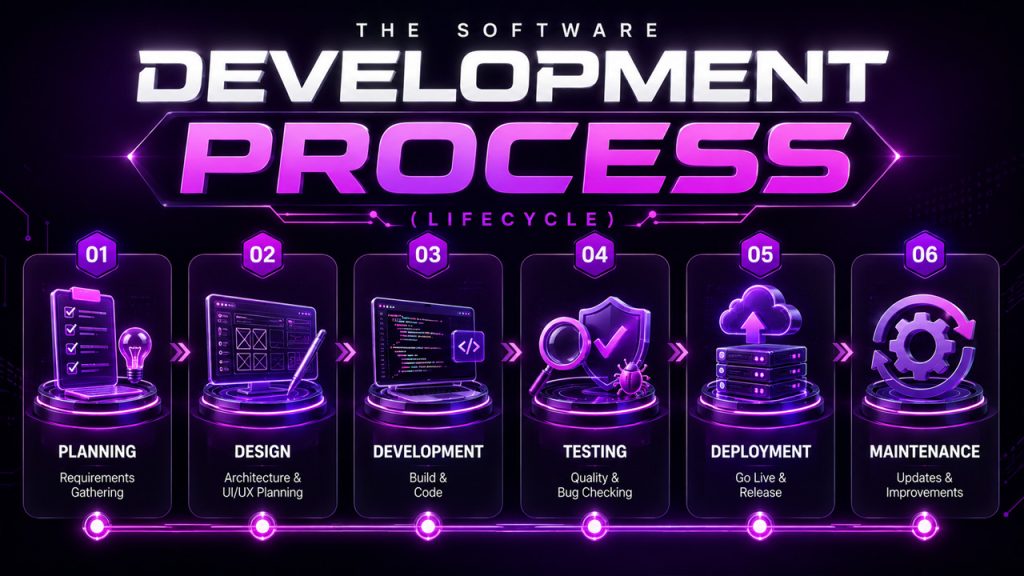
Most software, no matter how big or small, moves through a fairly consistent set of stages to go from idea to finished product:
Planning and requirements gathering:
Figuring out exactly what the software needs to do, who it’s for, and what problem it’s solving before any building starts.
Design:
Mapping out the architecture, user experience, and technical structure the software will be built on.
Development:
The actual coding phase, where the design gets turned into working software.
Testing:
Catching bugs, security issues, and usability problems before the software reaches real users.
Deployment:
Releasing the finished software into a live environment where people can actually use it.
Maintenance:
Ongoing updates, bug fixes, and improvements after launch, since software is rarely ever truly “finished”.
Skipping steps here usually causes problems down the line; a rushed testing phase, for example, tends to surface as costly bugs after launch instead of catching them early when they’re cheaper and easier to fix.
Types of Software Development
Not all software development is made equal. Usually, the type of development depends on the product itself and on the target audience.
Web Development
It includes website development and applications that run on a web browser and not on the device itself. This kind of development varies greatly, starting from marketing websites and finishing with platforms with login, payment, and real-time features that work fine across various browsers and device sizes.
Mobile App Development
Development of applications for smartphones and tablets, which is made for IOS, Android, or both operating systems. It involves unique difficulties like screen size variety, offline features, application store approval process, etc., that are not present in web development.
Desktop Application Development
The kind of software that is installed on the computer itself as opposed to being delivered via the browser. Examples include design software, accounting systems, or other kinds of specialized software that may need to be run locally due to higher computational requirements or lack of online availability.
Customer Software Development
This is the process of developing software specifically for a certain business organization as opposed to modifying existing software to suit the requirements of a particular business. The process costs more initially, but it avoids all the trade-offs involved in fitting a square peg into a round hole.
Customer Software Development: When It Makes Sense\
Related walkthrough
Chapter 9 | SuiteCRM Custom Code Architecture | Logic Hooks, Workflows & Upgrade-Safe Development

Off-the-shelf software works fine for a lot of businesses, until it doesn’t. Custom software development services start making real sense once a company’s needs outgrow what generic tools can offer.
A few signs it’s time to consider going custom:
Your workflows don’t fit the software; you’re fitting yourself to it:
If your team is constantly working around a tool’s limitations instead of the other way around, that’s a flag.
You’re stitching together multiple tools just to get one job done:
Custom software can consolidate scattered processes into a single, purpose-built system.
Security or compliance needs are highly specific:
Industries like healthcare or finance often can’t rely on generic software that wasn’t built with their exact regulatory requirements in mind.
You need something that scales with you:
Off-the-shelf tools often hit a ceiling. Custom-built systems can grow alongside the business instead of forcing a switch later.
This is really where bespoke software earns its reputation: it’s built around how a business actually operates, not the other way around, which tends to remove friction that generic tools quietly create over time.
Benefits of Working with a Software Development Company
Developing software on your own may not always be possible, and that’s precisely why many companies prefer working with a software development company.
Access to specialized expertise:
A dedicated team brings experience across different technologies and industries that most in-house teams simply don’t have the bandwidth to build internally.
Faster development timeline:
Established processes and experienced developers usually mean projects move faster than trying to figure things out from scratch.
Lower long-term risk:
A company with a track record has already solved the common pitfalls, security gaps, scalability issues, and poor architecture decisions that inexperienced teams tend to run into.
Flexibility to scale the team:
Need more developers for a big push, then fewer once the project stabilizes? An external partner makes that far easier than hiring and laying off in-house staff.
Access to newer technology:
Many development companies stay current on emerging tools and practices, including AI-assisted development, which can meaningfully speed up certain projects.
That last point matters more than it used to. Businesses evaluating options today are increasingly looking at an AI software development company specifically, since AI-assisted tooling is starting to noticeably shorten development timelines on the right kinds of projects.
Conclusion
Ultimately, software development is not just coding; it is about solving problems effectively in the long run. From the need for a basic website or a mobile application to something that needs to be designed specifically according to the workflow of the business, knowing the whole process is important.
There is no denying the benefits of using off-the-shelf software, but when the software becomes an obstacle in front of the business, one should consider opting for software development. It costs more upfront, but it often pays for itself by removing the daily workarounds that generic software quietly forces on a team.
Whichever route makes sense, working with the right partner, whether in-house or an outside development between software that just works and software that actually moves the business forward.
Frequently Asked Questions
Q. What is software development?
Software development is the full process of designing, building, testing, and maintaining computer programs. It covers everything from initial planning through coding, quality testing, launch, and ongoing updates to keep the software running smoothly over time.
Q. What’s the difference between software development and custom software development?
Software development is an umbrella term for all activities associated with software creation, while custom software is specifically developed for the needs of one company from scratch, not adjusting the ready-made product.
Q. How long does custom software development usually take?
This timeframe may vary greatly depending on many factors, but typically developing a small internal tool takes several months, and a large enterprise application may take one year or even more.
Q. Is custom software more expensive than off-the-shelf options?
Certainly, yes, at first sight. Development of custom software involves higher expenses due to its creation from scratch. Yet eventually, it is more cost-effective than trying to make some generic software accommodate features that simply won’t match the way your business works.
Q. How do I choose the right software development company?
Make sure the company has relevant experience, has a good portfolio, communicates well, and has an established process of development. Client testimonials and their approaches to testing and support are useful to prevent errors and expenses in the future.