

Humanoid robotics crossed a visible milestone when dozens of robots moved in perfect synchronization during a nationally televised Spring Festival Gala performance. Developed by Unitree Robotics, the G1 and H2
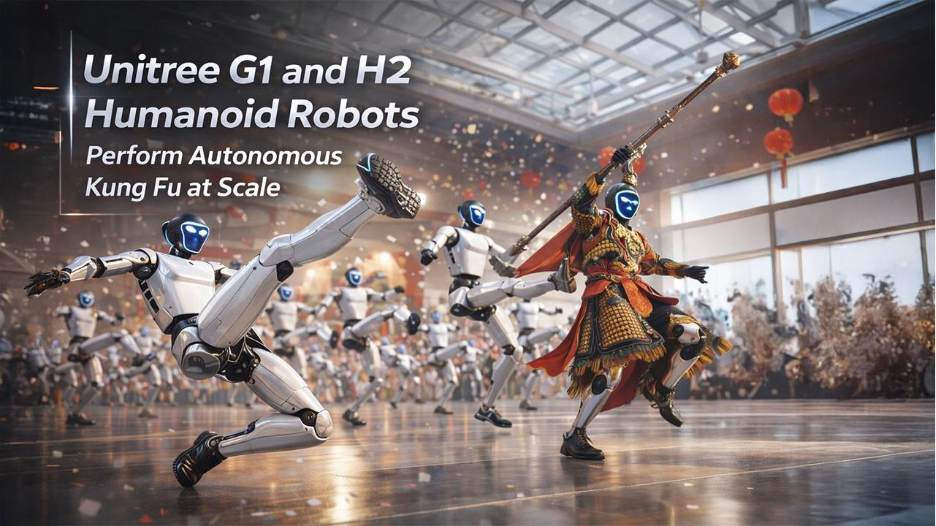
Humanoid robotics crossed a visible milestone when dozens of robots moved in perfect synchronization during a nationally televised Spring Festival Gala performance. Developed by Unitree Robotics, the G1 and H2 humanoid robots demonstrated autonomous martial arts choreography at scale without handheld controllers, visible operators, or manual correction. The performance was a live demonstration to showcase how humanoid robots operate in cluster formation with perfect coordination and high-speed dynamic motion.
This event is remembered as one of the first large-scale public showcases where fully autonomous humanoid robots execute complex and synchronized martial arts sequences in real-time.
What Happened on Stage?
At the core of the showcase were dozens of Unitree G1 humanoid robots performing Kung Fu-inspired routines. The choreography included:
- Fluid forward and side kicks
- Rapid punch combinations
- Controlled rotational spins
- Deep stance transitions
- Synchronized directional pivots
- Coordinated group formation shifts
These were not slow mechanical gestures. Instead, the movements were dynamic and highly athletic. The robots executed high-speed kicks while maintaining uptight stability. They transitioned between low stances and upright strikes with controlled balance. During spins and pivots, each unit recalculated its center of gravity in real time to prevent tipping.
The perfect synchronization between robots was the most striking element of the show. Dozens of robots moved in a sync, as a cohesive unit. They maintained consistent spacing and timing throughout the performance.
The Autonomy Behind the Performance
Speed or visual impact are not the only elements that contributed to this remarkable demonstration. It was the autonomy powering it. The Unitree G1 and H2 humanoid robots each moved independently while remaining synchronized with the whole group. There was no visible teleoperation controlling limb movement in real time. Instead, onboard systems handled:
- Motion planning
- Joint torque control
- Whole-body balance stabilization
- Real-time posture correction
- Timing synchronization with neighboring units
Executing martial arts movements requires continuous recalibration. A forward kick shifts weight distribution instantly. A rotational spin introduces angular momentum that needs to be stabilized. A low stance requires precise center-of-mass positioning. The robots automatically processed these adjustments internally and still remained aligned with the formation.
This high-level of distributed coordination demonstrates mature control algorithms capable of handling both individual stability and collective synchronization.
The Role of the H2 Humanoid Robots
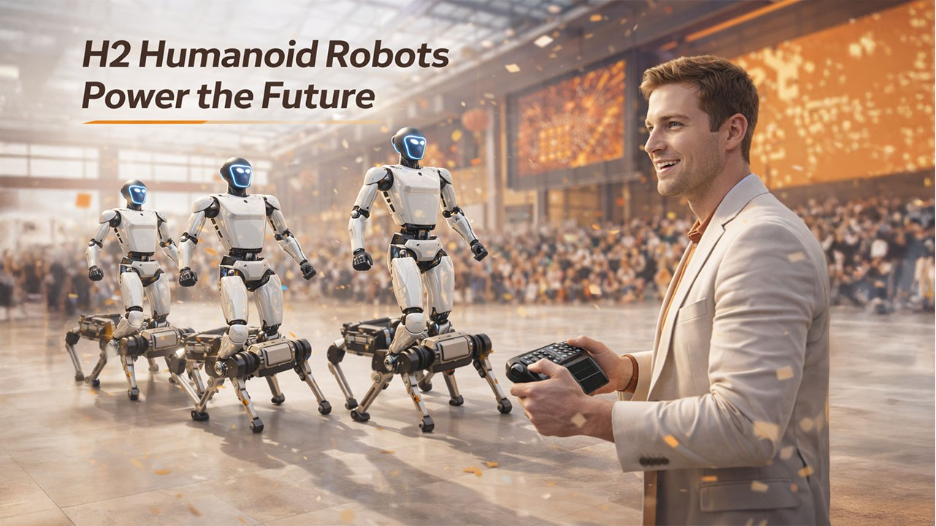
While the G1 robots performed synchronized ground choreography, the H2 humanoid robots added a theatrical and technical dimension to the event. Appearing in Monkey King-inspired costumes at the Beijing main venue and Yiwu sub-venue, the H2 robots were transported on mobile platforms powered by Unitree’s quadruped robotic systems. This integration highlighted cross-platform collaboration between humanoid and quadruped robotics.
The deployment demonstrated:
- Stable load-bearing mobility
- Multi-robot system integration
- Coordinated platform-to-platform operation
Rather than functioning as isolated machines, the humanoid and quadruped systems operated as part of a larger robotics ecosystem.
Why This Demonstration Matters
Large-scale humanoid cluster deployment introduces engineering challenges beyond single-robot control. Synchronizing dozens of robots requires:
- Precise time coordination
- Low-latency communication
- Distributed control logic
- Reliable collision avoidance
- Uniform motion consistency
High-speed martial arts actions make these problems even more difficult. Fast changes in stance and powerful attacks raise the possibility of instability. What makes the Unitree G1 and H2 humanoid robots particularly significant is their ability to maintain accuracy in a live broadcast environment — a sign of high-quality hardware and sophisticated control algorithms. The processing demands behind real-time autonomous humanoid control reflect the same surge in AI hardware investment that pushed Nvidia to $5 trillion valuation.
The majority of humanoid robots are presented one by one in a controlled environment. This demonstration has shown that humanoid clusters are able to work well in public and at a large scale.
Technical Implications
While the presentation is in a cultural context, the technology itself has other uses. The humanoid robotic systems that are cluster-coordinated may have applications in:
- Disaster response operations
- Industrial automation
- Hazardous environment deployment
- Security and defense robotics
- Large-scale inspection tasks
The capability to coordinate a number of autonomous humanoids in dynamic physical actions indicates that robotic fleets, rather than individual robots, are becoming technically feasible.
A Symbolic Moment for Robotics
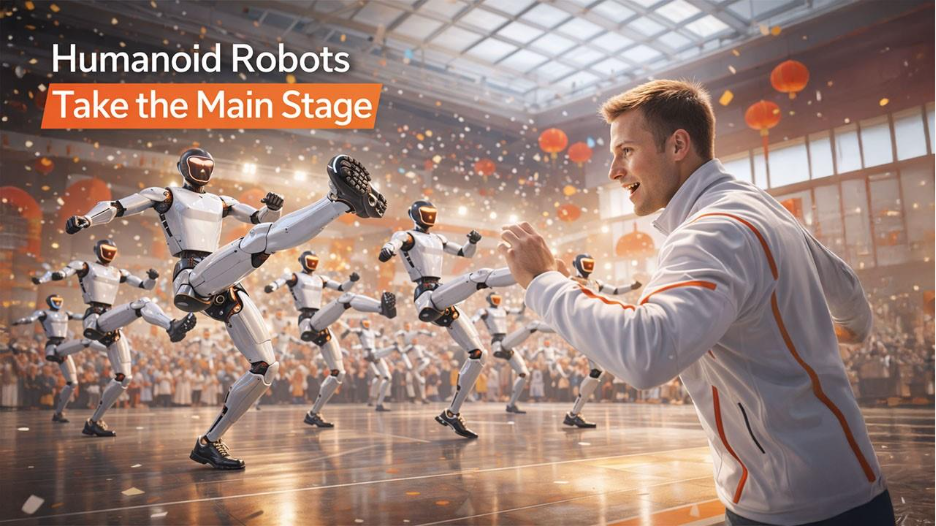
The Spring Festival Gala is among the most watched television programs in the world. The inclusion of humanoid robots in this context indicates that robots are moving from laboratory presentations to the mainstream.
The martial arts choreography combined cultural symbolism with advanced robotics engineering. The visual story told one of precision, discipline, and coordination—attributes reflected in the technical systems underlying the robots.
More significantly, it proved that humanoid robots are capable of the following:
- High-speed whole-body motion
- Dynamic stability under load
- Autonomous operation in synchronized clusters
- Reliable operation in a public setting
Conclusion
The autonomous martial arts display by the Unitree G1 and H2 humanoid robots is a breakthrough in the application of scalable robotics. Dozens of humanoids performed smooth kicks, turns, punch sequences, and synchronized patterns with real-time balance control and distributed autonomy. This application of humanoid robotics showcased the technology’s progress from isolated laboratory experiments. This was not just choreography; it was a live proof of multi-robot synchronization, autonomous motion planning, and stable high-speed humanoid control at scale.
The era of coordinated humanoid robotic clusters is no longer theoretical. It has now been publicly demonstrated on one of the world’s largest stages.
Read also: Optimizing Workflows and Customer Engagement for Better Results
Respond to this article with emojis