

Website Security and SEO: How Security Affects Search Rankings
See how website security affects search rankings through HTTPS, malware, hacked content, redirects, downtime, and technical SEO issues.
Content, page quality, and SEO are great tools to prepare your website for search rankings, but security issues can still impact performance. Search engines, for example, need to safely crawl and access pages, and users need to trust that their website experience is safe and secure. When a website has malware, hacking redirection, insecure connections, and compromised pages, such issues can further affect the reputation and the navigation of the pages, which makes website security a responsibility not only of web developers but also play vital role in search visibility and good user experience.
What Is Website Security and Why Does It Matter for SEO?
Website security is a set of techniques and tools that a business employs to safeguard the site, its data, its users, and the back-end administration from intruders. Site security can encompass everything from secure connections and software updates to security controls, malware detection, site backups, and server protection.
Why Is Site Security Important for SEO?
Issues with site security can change the URLs and displayed content viewers see when they arrive. Malicious acts might include spam pages, adding malicious links, inserting redirected URLs, or changing the content of the site itself. Google has spam policies about hacked and deceptive websites, so a hacked site can also run into SEO challenges.
A website that is secure provides visitors a sense of security when interacting with the site, by entering form data, or clicking on ads and links. If websites display security warnings or visitors are suddenly redirected elsewhere, they leave. That behavior can impact engagement and make it more difficult for the site to convert search leads into desired actions.
How Website Security Affects Search Rankings
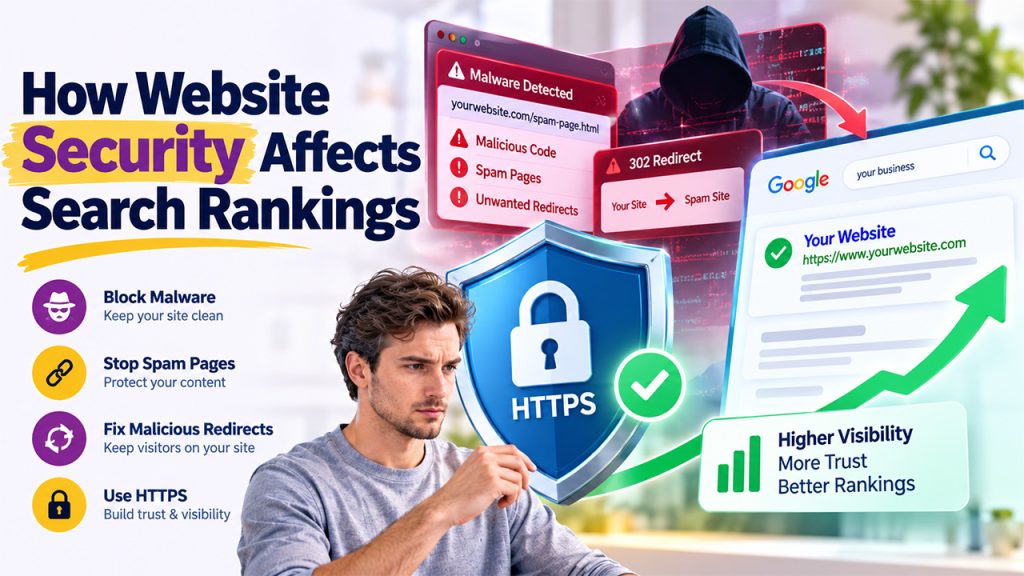
It’s not a ranking factor that unilaterally causes any secure website to rank better. Conditions that cause security issues can sometimes impact crawling, indexing, visibility, and user trust. Google has said that HTTPS is a ranking factor, and its search documentation states that hacked and spam content can impact search appearance.
Malware and Hacked Content
Once a website is compromised, the following types of changes can be implemented: Insert malicious code, insert pages you didn’t want to be there, insert spam links, and change the content on a page. To reduce the trustworthiness of your site and produce search results that are irrelevant to your pages, hackers may use cloaking techniques to prevent you from seeing what’s been done to your site. Cybersecurity can help businesses understand and address these types of security risks.
For example, an attacker may add hundreds of spam pages to an legitimate business website. Search engines can discover those URLs, while the owner may not notice them immediately. Regular monitoring helps identify unexpected indexed pages.
Malicious Redirects
A compromised website may redirect visitors from legitimate pages to spam, phishing, or malware-related destinations. It can also interfere with search engine crawling because the requested URL no longer delivers the expected content.
Checking important URLs and redirect behavior helps identify these problems early. This is especially important after a security incident because attackers can modify redirects without changing the visible content of a page.
HTTPS and Safe Connections
Related walkthrough
SuiteCRM Google Sign-In Integration | Single Sign-On (SSO) for Better Security

HTTPS protects data sent between a visitor’s browser and your site. It also informs a visitor when a connection is encrypted. Google has stated that HTTPS is a ranking signal, but it is only one part of an overall ranking algorithm.
A website that continues to provide important pages over HTTP can cause unnecessary security and trust issues. An effective implementation of HTTPS should include a valid certificate, safe, consistent URLs, and a redirect for HTTP URLs to the equivalent HTTPS pages.
Website Uptime and Server Problems
A security event can have an effect beyond the website’s content. An attack can cause your server to crash, disrupt services, or temporarily take your site down while the issue is resolved. Having web pages go offline repeatedly can cause an SEO issue, even if the content remains unchanged. Constantly checking for downtime, server crashes, and unusual traffic spikes will identify technical problems before they last for an extended period.
Site Security and Safety
Visitors have more trust in a website when they see that it’s secured. An indication of security, warnings, confusing navigation, popups, or unexpected software downloads can diminish that trust. A customer who navigates from an unsafe website is unlikely to return to complete a transaction or to continue exploring the site.
Search rankings are not contingent on having a perfectly secure website, but it is part of a good technical and user experience that will contribute to your ranking.
Website Security Audit vs. SEO Audit
A security audit looks for weaknesses that can expose a site to attacks, unauthorized access, malware, or data loss. An SEO audit examines technical and content-related issues that can limit organic search visibility.
| Website Security Audit | SEO Audit |
| Identifies security risks and weaknesses that can expose a website to attacks. | Identifies technical and content issues that can affect a website’s search visibility. |
| Checks HTTPS configuration, SSL certificates, and other secure connection settings. | Checks HTTPS setup and whether URLs are correctly configured for search engine. |
| Identifies unauthorized redirects that may result from a security breach. | Checks redirect chains, loops, and incorrect destinations that can affect user experience. |
| Scans for malware, malicious files, injected code, and other signs of compromise. | Checks for hacked pages, spam content, and unwanted URLs that may appear in search. |
| Reviews user accounts, permissions, and administrative access to prevent unauthorized changes. | Reviews website structure, content, and other technical elements that influence organic search performance. |
Using both audits gives a more complete picture of website health. A security audit can uncover a compromised plugin, while an SEO audit can reveal the search consequences, such as unexpected indexed pages or broken redirects.
How to Respond When Website Security Problems Affect SEO

Finding a security issue requires quick action because leaving a compromised site online can allow unwanted changes to continue. The first step is to identify the affected systems and restrict unauthorized access. Teams can then remove malicious files or code, update vulnerable software, restore clean content when necessary, and review account permissions.
After the security problem is contained, review the SEO impact. Check indexed pages for unexpected URLs, inspect important pages for unauthorized changes, and review redirects and server responses. Search Console can also help identify security or indexing issues that become visible to Google. For practical steps to address a security breach and protect your site, see steps to secure a hacked website.
Review logs, credentials, software versions, and access controls to identify how the incident happened. Otherwise, the same weakness can lead to another compromise and create another round of SEO problems.
Best Practices for Maintaining Website Security and SEO
Good maintenance can prevent more significant issues from arising later. Making sure the website remains well-maintained and safe can also ensure it continues to perform well in search results.
Regular maintenance tasks include:
Update All Software:
Running an older version of the CMS, plugins, themes, libraries, and server operating systems makes a website vulnerable. Attackers can use older software to execute their exploits or compromise the existing files.
HTTPS/SSL:
Keep the website on HTTPS and correctly deploy redirects so that any URLs are reflected in the secure version. Also, check that the certificate is valid, and that you set redirects properly between the non-secure and secure version of a page.
Scan for Malware and Other Unexpected Changes:
Running malware scans and file audits can catch suspicious activity. A regular check of the indexed pages on the website can pick up inappropriate URLs that are not accessible through normal navigation.
Secure Access and Accounts:
Make sure access privileges are appropriate for the person – only granting elevated permissions to those that require it. Use secure passwords, multi-factor authentication if available, keep accounts up-to-date, and remove any unused accounts.
Run Quarterly Tests:
Schedule your site security review, finding areas of weakness that you can address, as part of a regular SEO Audit. Review both reports together to identify issues that need addressing for security as well as search indexing and crawling. See the Website Security Guide for related advice on best practices in maintaining a website and security.
Conclusion
Both SEO and site security are increasingly interconnected. Not only does HTTPS provide a secure link; protection from malware, hacked content, malicious redirects, and downtime all contribute to a search experience that can be maintained. Security issues are also likely to lead to technical issues that have a knock-on impact on crawling, indexing, and what users ultimately see.
For this reason, website security audits should be carried out as part of a website’s regular maintenance rather than as a stand-alone technical task. Conducting both an SEO audit and a security audit gives teams an early warning about issues, as well as an understanding of search impact, so you can keep a website accessible and trusted.
Frequently Asked Questions
Yes. If you have security issues, you may be affected by hacked content, malicious redirects, outages, and other technical hiccups which hinder crawling, indexing, or your users' confidence in you.
Yes. Google has established that HTTPS is a ranking factor. It is only one of many signals, so moving to HTTPS does not necessarily provide higher rankings on its own.
The frequency of the query depends on the site and technology employed and what is the associated risk that the website can face. Some kinds of audits are done regularly, while others are periodic, as in the case of an update or a traffic spike.
Yes. When it is hacked, it might be used to promote spam and malware, or alternatively unwanted redirects and other damage to the ranking. Removing malicious content, identifying the point of entry, and fixing the damage is the way to help the rankings recover.