
What AI SaaS Customers Want in 2026
Discover what AI SaaS customers want in 2026, from personalization and automation to security, pricing, and seamless user experiences.
AI is no longer an extra feature inserted in digital tools added to excite users. It’s now a key requirement for businesses in 2026 and beyond. The demand for AI-powered software has gotten so high that the global AI SaaS market is expected to hit $673.1 billion by 2030.
But businesses don’t want just any AI feature. They want AI that solves real business problems. In fact, before committing money to any product, buyers now want to know: Will this software actually save us time and money? The answer to questions like these is what’s driving a lot of SaaS software purchase decisions.
The message from today’s buyers couldn’t be any clearer. If AI doesn’t make work easier, they won’t pay for it.
What are AI SaaS Tools?
AI SaaS tools are cloud-based software products with artificial intelligence built into the core workflow, not bolted on as a separate feature. The software itself has the job it was designed to do, but the built-in AI functionality makes the job faster and a lot easier.
Some common examples include CRM with AI-powered predictive analytics and a customer support desk with AI-powered ticket routing. The market for features like this grows virtually every year, and it’s only going to get bigger.
Already, Deloitte reports that 69% of GenAI customers use AI features that come built into the services they’re familiar with. Not standalone AI applications. That small detail says a lot about what current users want, and the direction SaaS developers should take.
What Customers Want When Buying AI SaaS Tools
Business buyers buy software that solves specific business problems. The same applies to SaaS tools. Here’s what they’re typically looking for.
AI That Works Inside Existing Workflows
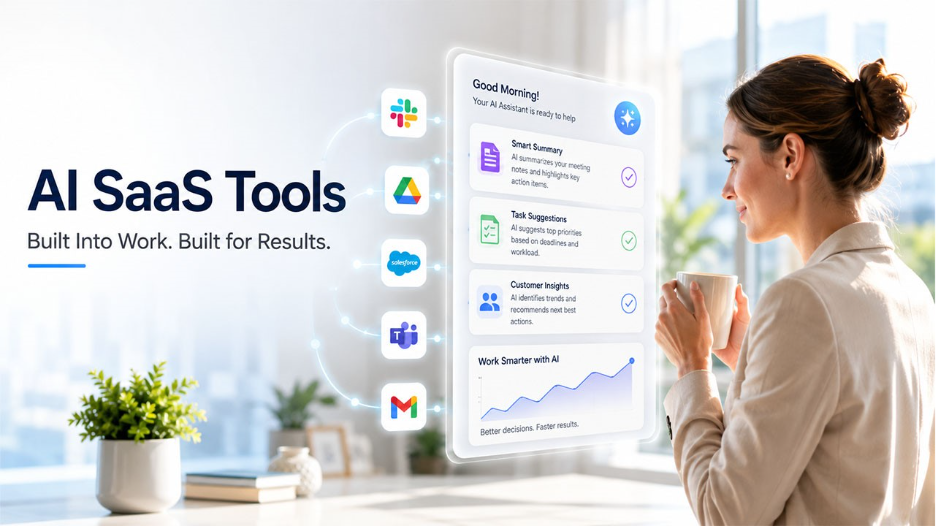
SaaS buyers want AI that works in the tools or services they already use. Many don’t want standalone products, as this will mean switching back and forth between applications, disrupting their workflow. This is why buyers increasingly evaluate a vendor’s AI integrations before its model quality, since an assistant that can read a CRM record or a ticket queue directly is more useful than one that requires copy-and-paste. Support for connection standards such as MCP is becoming a common line item in procurement checklists. Recommendations and suggestions, for example, should show up automatically when needed.
At most, users should simply click a “Show AI Suggestions” button inside the same application instead of opening a separate program, pasting data, and waiting for results. The goal is for the AI to be so natural that users barely notice it’s there.
Automation That Eliminates Repetitive Work
Businesses also want AI to take over the repetitive, mundane tasks that eat up their team’s time. They want tools that automate data entry, generate meeting summaries, update CRM records, qualify leads, process invoices, and even assign tasks. After all, why invest in a SaaS tool if someone still has to do these things by hand?
Interestingly, it’s not just one or two, or even three businesses that want this. McKinsey reports that 80% of companies set operational efficiency as one of the reasons for investing in AI. Other reasons are business growth and innovation.
Faster Insights for Better Decision-Making
SaaS customers don’t just want software that collects data. The software should also be able to interpret it and provide insights.
In practical terms, they want a tool that can answer questions like, “Which accounts are at risk of churning this quarter?” This means software with AI-powered predictive analytics built-in that can do sales forecasting, customer behavior analysis, and real-time reporting. The idea is for AI to simplify the data, not overwhelm users with it.
Deloitte reports that organizations are investing up to 50% of their digital transformation budget into AI automation just to be able to get this level of insight.
Flexible Pricing and Frictionless Payments

Even the best AI features can be ruined by a poor buying experience. If pricing is confusing or the billing model is too rigid, many potential customers will simply walk away. Today’s SaaS buyers want transparent pricing, flexible subscription plans, and the freedom to choose between monthly, annual, or even pay-as-you-go billing.
Buyers also want to be able to pay in their local currency without worrying about exchange rates or payment restrictions. PayPro Global recommends that SaaS developers partner with a B2B eCommerce platform that understands the demands of selling software globally.
The idea is for providers to consistently provide services that meet the needs of the customer without worrying about the logistics behind accepting payments worldwide.
Smarter Customer Support Across Every Channel
Last but not least, SaaS customers expect to get the same level of support that they’re used to with standalone products. They want to be able to get help 24/7, whether they’re on the website, social media, or email. The expectation is that every customer interaction will be personalized and efficient.
Thankfully, a lot of SaaS providers are already on track to deliver this level of support. In fact, this is one reason why the AI autonomous customer support market will likely hit $93 billion by 2034.
Gartner even predicts that these tools will resolve up to 80% of customer service issues by as early as 2029. These expectations are already being met across the industry, so it’s not an impossible task.
HubSpot uses AI to power its CRM and sales automation. Zendesk uses AI to make customer support smarter. Intercom’s Fin uses AI agents to resolve inbound support queries without human intervention. All of these reflect a broader industry trend.
Satya Nadella, Chairman and CEO at Microsoft, sums this reality up perfectly:
“This next generation of AI will reshape every software category and every business, including our own.”
This quote underscores why the appetite for AI is massive, and why buyers expect more.
FAQs
Related walkthrough
Google Workspace vs Microsoft 365 in 2026 | Full Comparison: Features, AI Tools u0026 Pricing
What features do customers look for in AI SaaS tools in 2026?
Customers look for a lot of things when choosing AI SaaS. Top on the list, however, are workflow integration, automation, and actionable analytics. They also want flexible, transparent pricing.
Why is workflow integration important for AI-powered SaaS?
Workflow integration is important to today’s businesses because it takes away the need for employees to switch between workflows and applications. Removing context switching makes employees more productive and reduces workflow interruptions.
Does pricing influence SaaS AI buying decisions?
Absolutely. Customers expect clear and transparent pricing plus flexible subscriptions. There’s basically no benefit to complicated pricing. Instead, it increases churn, even when the product itself performs well.
What SaaS Customers Want in 2026: Key Points
| Key Point | What It Means |
| AI is now a baseline expectation | Buyers no longer treat AI as a bonus feature. They expect it, and won’t pay for tools that don’t make work easier. |
| AI belongs inside existing workflows | Customers don’t want standalone AI apps that force them to switch tools. AI should show up where work already happens. |
| Automation should kill repetitive work | Buyers expect AI to handle the tedious tasks, not add more of them. |
| Insights need to be fast and actionable | Customers want AI to interpret data and answer real questions through predictive analytics and real-time reporting. |
| Pricing and payments need to be frictionless | Confusing pricing or rigid billing drives buyers away. They want transparent, flexible plans and easy global payment options. |
| Support needs to be always-on | Customers expect 24/7, personalized support across every channel, with AI resolving issues quickly and efficiently. |
Winning the AI SaaS Market
The novel phase of artificial intelligence is officially over. Businesses are no longer getting AI tools for the excitement. They’re buying it for the value it delivers.
The SaaS companies that win in this market won’t be the ones shouting about AI the loudest. They’ll be the ones whose customers barely notice it’s there because it works seamlessly.