

What Is Code in Programming? A Beginner-Friendly Guide
Code in programming is a set of instructions that a developer writes in a programming language, telling a computer what tasks it needs to perform. Here is all you need to know.
From Google Maps on your phone, ATMs near your house, and social media platforms where you post photos ultimately depends on one thing: code in programming. From mobile apps to enterprise software, it all begins with lines of instructions developed by developers. However, for a lot of people, the concept of code appears to be intimidating or abstract.
If you want to learn code from scratch, then this guide is a good start. It explains everything in simple terms. Whether you are a novice or someone looking to refresh your basics, here is a comprehensive look at what code is in programming, how it works, and why it is important.
What Is Code in Programming?
Code in programming is basically a set of instructions written in a programming language that a computer can easily read and execute. All these instructions tell the machine what steps it needs to perform, whether that is related to performing a calculation, showing content on the screen, or processing user input.
Consider code as a recipe. Just as a recipe gives you step-by-step instructions on how you can cook a dish, programming code provides your computer with detailed directions to implement a task. With the help of these instructions, the computer has no idea what action it needs to take.
Code works as a bridge between machine behavior and human logic. Developers can write code in different programming languages such as Java, Python, JavaScript, or C++, each including its own syntax and rules. The computer then converts that code into machine-readable instructions and executes them.
Read More: Basic Coding Concepts You Must Know in 2026
Different Types of Code in Programming
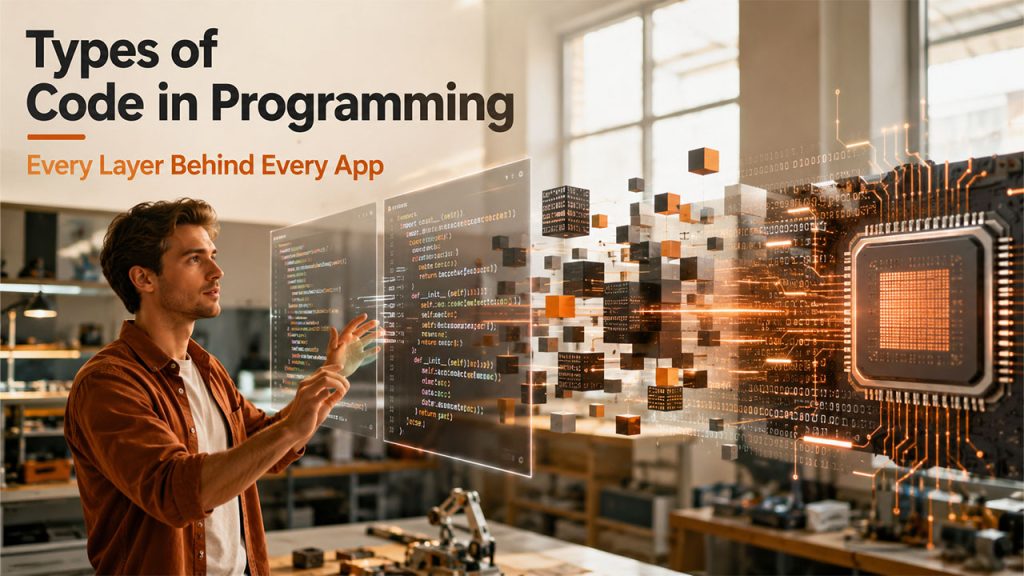
Not all code in programming works the same or caters to the same purpose. Here are the key types:
- Source Code — The human-readable and original instructions that a developer writes in a programming language. This is what you observe when a developer creates a script or develops an application.
- Machine Code — The instructions in binary code (0s and 1s) that are directly executed by the processor of the computer. It is created from source code via a process known as compilation.
- Bytecode — An intermediate code that is present between machine code and source code. It is utilized by languages such as Python and Java, where the code is compiled first into bytecode and then executed by a virtual machine.
- Assembly Code — A low-level programming language that looks a lot closer to machine code can be understood by humans. It is extensively used in system-level programming and embedded systems.
Understanding such types is important to clarify the journey that code in programming takes— from the text editor of the developer all the way to execution on a machine.
Popular Programming Languages and What Are They Used For
Distinct programming languages cater to distinct purposes. The language choice depends on the type of application you are building, the platform it will execute on, and the level of complexity of the task. Let us see a quick overview of broadly utilized programming languages:
| Programming Language | Type | Primary Use Case |
|---|---|---|
| Python | High-level, interpreted | AI/ML, Data science, web development, automation |
| JavaScript | High-level, interpreted | Back-end and front-end web development |
| Java | High-level, compiled to bytecode | Android development, Enterprise applications |
| C++ | Mid-level, compiled | System software, game development, embedded systems |
| SQL | Declarative | Database management and querying |
| Swift | High-level, compiled | MacOS and iOS application development |
| PHP | High-level, interpreted | Server-side web development |
Each such language has its own rules, syntax, and strengths. However, what they all share is that they enable developers to write code in programming that solves real-world issues, just in distinct environments and contexts.
How does code in Programming Works?
Related walkthrough
Free QR Code Maker by Adobe Express

Writing code is only the initial step. Let us look at a simplified look at the complete lifecycle:
- Writing — A developer creates source code with the help of a programming language and a code editor or IDE (integrated development environment).
- Compilation or Interpretation — The written code in programming is either interpreted (translated line after line as the program executes) or compiled (entirely converted into machine code before execution).
- Debugging — Developers recognize and solve errors, known as bugs, in the code. This is an iterative process that makes sure that the program runs correctly.
- Execution — The Central Processing Unit of the computer runs the final instructions. As a result, you get an output or behavior defined in the original code.
- Maintenance — After deployment, programming code is regularly updated to resolve issues, add characteristics, or enhance performance.
This cycle repeats consistently throughout the lifecycle of any software product, making code not a one-time task but an ongoing responsibility.
Why Is Code in Programming Important?

The Code in programming is the pillar of the digital world. Here is why it holds great significance:
- Powers all software — Each application, ranging from a simple calculator to a complicated AI platform, is built on code.
- Enables automation — Programming code enables routine tasks to be automated, minimizing human error and saving time.
- Drives innovation — New technologies like cloud computing, machine learning, and mobile platforms are all developed and advanced with the help of code.
- Creates career opportunities — Coding proficiency opens doors across distinct industries, from finance and healthcare to e-commerce and education.
- Solves real problems — At the heart of it, writing code in programming is all about developing logical solutions to possible challenges.
Code vs. Coding vs. Programming: Understanding the Difference
You will often see these three terms interchangeably used, but they carry different meanings:
- Code in programming is the actual instructions written by the developer, i.e., text instructions that the developer writes with the help of a programming language.
- Coding is the process of creating code. It is referred to as the hands-on process of converting logic into a language that the computer interprets.
- Programming is a wider discipline. It involves not just creating code but also planning, debugging, problem solving, testing, and maintaining software.
Understand it like this: all coding involves writing text instructions, usually in a high-level language. However, not all programming is about coding. A programmer also thinks through the complete solution, while coding remains one big aspect of bringing that solution to life.
Comprehending this distinction helps in setting the right expectations when entering the domain of software development and programming.
Read also: Coding vs Programming: What’s the Difference? (Complete Guide for Beginners)
Conclusion
What is code in programming? In the simplest form, it is just a set of instructions that tell a computer what tasks it needs to perform. However, in practice, code is the language via which ideas become functional systems, software, and digital experiences. From source code to machine execution, each layer of the process achieves a purpose. Irrespective of whether you are looking to enter the tech industry or just create a foundational understanding, understanding what code in programming remains one of the most crucial starting points in the technology-oriented world today.