
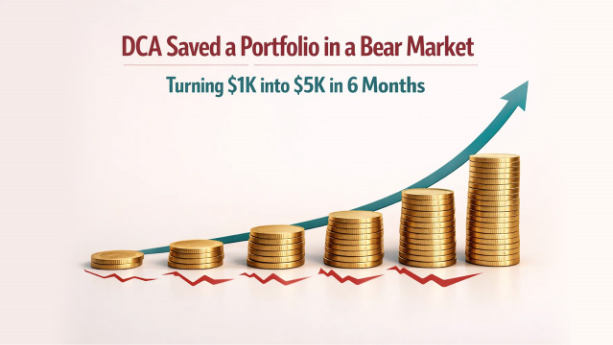
DCA Saved a Portfolio in a Bear Market: Turning $1K into $5K in 6 Months
Learn how a DCA crypto strategy turned $1K into $5K in a bear market. Discover Proven-Dollar Cost Averaging techniques for 2026 investors.
When the 2025–2026 bear cycle hit, most portfolios plummeted 60–80%. Bitcoin dropped from ~$126K to ~$67K (~47% drawdown), while altcoins crashed across the board.
Instead of panic selling, disciplined investors utilize a strict Dollar-Cost Averaging (DCA) strategy on MEXC. By systematically buying the fear, they turned an initial $1,000 into $5,000 in just 6 months. Here is the exact blueprint of how consistent execution beats market timing.
Key Takeaways
- Dollar-Cost Averaging (DCA) reduces risk and volatility by spreading entry points across time instead of attempting to time the market.
- Bear markets (with BTC down ~47% from its peak) historically create the absolute best accumulation opportunities for disciplined investors.
- Consistent DCA strategies yield massive long-term results, leveraging market dips to dramatically lower your average entry price.
- The biggest edge of DCA is psychological discipline, completely removing fear, FOMO, and emotional decision-making.
What Is DCA in Crypto? (Beginner to Advanced Explanation)
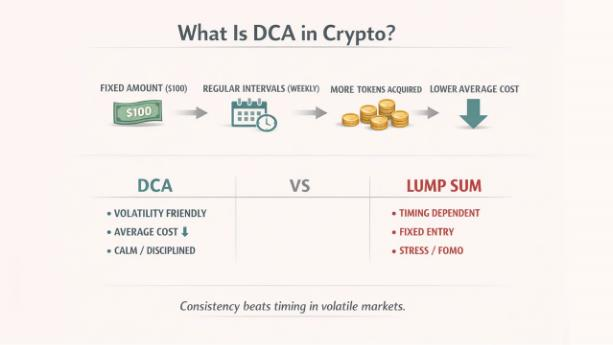
Dollar-Cost Averaging (DCA) is an automated strategy where you invest a fixed amount of money at regular intervals, lowering your average cost basis over time.
Dollar-Cost Averaging Explained Simply
DCA means investing a set amount—like $100 weekly into BTC and ETH—regardless of current prices. It completely eliminates the impossible task of predicting exact market bottoms. By continually purchasing, you naturally capture market volatility, acquiring more tokens when prices are on sale.
DCA vs Lump Sum Investing
| Feature | Dollar-Cost Averaging (DCA) | Lump Sum Investing |
| Market Condition | Best for bear markets and high volatility | Best for clear bull markets |
| Average Entry | Dynamically lowers during market dips | Fixed exactly at the time of purchase |
| Psychology | Automated, stress-free, disciplined | High stress, prone to FOMO |
The 2025–2026 Bear Market Context (Real Data & Insights)
The 2025-2026 market saw Bitcoin retrace from ~$126K to ~$67K, creating an “Extreme Fear” accumulation phase perfect for building long-term wealth.
With BTC down ~47% and ETH down ~65% from its peak, the Crypto Fear & Greed Index flashed “Extreme Fear.” While retail investors fled due to ETF outflows and macro pressure, smart money stayed. Historically, accumulating premium assets when they are discounted by 40–80% directly fuels the massive portfolios of the next bull run.
DCA Strategy: From $1K to $5K Step-by-Step
First, the strategy involved allocating an initial $1,000 across BTC, ETH, and altcoins, executing a strict $150 weekly purchase plan on MEXC to capitalize on market fear.
Structure portfolio for resilience and massive growth:
- 50% BTC: The foundational anchor.
- 30% ETH: High-utility, massive ecosystem.
- 20% Altcoins: High-conviction projects on MEXC. For instance, strategically accumulating during dips allows investors to take advantage of the highly attractive PNIC token price for amplified long-term growth.
Using MEXC’s Auto-Invest, $150 was deployed weekly. Investors bought through flash crashes and boring sideways periods, completely avoiding the trap of waiting for the “perfect bottom.” This relentlessly lowered the average cost basis and maximized token exposure before the recovery.
Portfolio Growth Breakdown (Realistic Scenario Analysis)
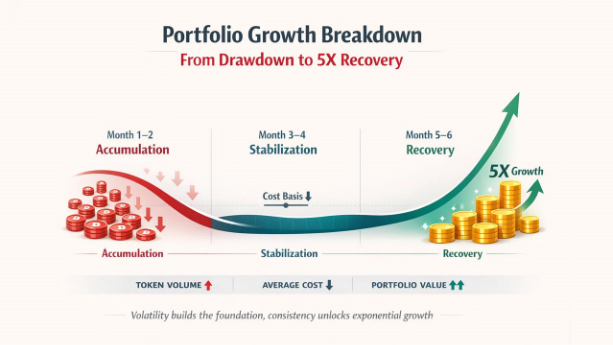
Consistent buying during the painful 4-month accumulation phase lowered cost basis, leading to an explosive 5x multiplier when prices finally rebounded.
- Month 1–2 (Accumulation): The portfolio was technically down, but the psychological pressure was countered by acquiring massive token volume at absolute floor prices.
- Month 3–4 (Stabilization): The market stopped falling. Because the average entry price was dragged down so far, even a 5% market bounce pushed the portfolio into the green.
- Month 5–6 (Recovery): As prices rebounded, the massive volume of accumulated tokens exploded in USD value, finalizing the 5x multiplier.
Why DCA Outperformed Most Traders in This Bear Market
DCA removes panic selling, systematically turning terrifying market volatility into a mathematical advantage by automatically acquiring more tokens at lower prices.
While day traders took losses, DCA investors absorbed the fear. Volatility is your best friend here, a 20% drop means your scheduled buy simply acquires 20% more tokens. It proves that “time in the market” will always beat “timing the market.”
The Technical Mechanics Behind DCA Execution
Related walkthrough
How to Use Claude AI with Blender MCP – Part 2 (Full Tutorial 2026)

At its core, DCA operates on a time-weighted average price (TWAP) model, systematically reducing cost basis through periodic fixed-interval purchases regardless of market conditions. On platforms like MEXC, Auto-Invest bots execute these orders via API-driven smart contracts, eliminating latency and human error. Each purchase adjusts the weighted average entry price using the formula: Average Cost = Total Capital Deployed ÷ Total Tokens Acquired. To simplify these calculations before deploying capital, many investors rely on crypto calculators tools that model DCA outcomes, position sizing, and compounding scenarios before a single dollar is committed. As market prices decline, the denominator (total tokens) increases faster than the numerator (capital), mathematically improving the cost-per-unit ratio. This compounding token accumulation effect, particularly during high-volatility bear cycles, creates asymmetric upside exposure, meaning smaller percentage recoveries in price yield proportionally larger gains in portfolio value relative to a lump-sum entry.
Mistakes to Avoid (And How You Can Avoid Them)
To maximize returns, avoid checking your portfolio daily, never pause your buys during crashes, and stick to 3–7 strong assets instead of over-diversifying.
- Overchecking: Automation works best when ignored.
- Stopping During Drops: Massive red candles are the absolute best times your DCA bot will buy.
- Over-Diversifying: Early over-diversification dilutes gains. DCA works best concentrated into premium assets.
- Zero Cash: Investors should keep a small cash reserve to manually buy extraordinary, single-day flash crashes.
Best DCA Strategies for Crypto Investors in 2026
Optimize the portfolio by focusing heavily on blue-chip assets, maintaining strict weekly intervals, and utilizing MEXC Auto-Invest for emotionless execution.
Focus your capital on proven survivors like BTC and ETH, or tap into the robust volume and recovery potential of the SOL/USDT trading pair. Set a fixed weekly interval to perfectly capture crypto’s weekend volatility, and let MEXC Auto-Invest handle the execution 24/7 with zero emotional interference.
Can You Really Turn $1K into $5K with DCA?
Yes, turning $1K into $5K is achievable by aggressively accumulating discounted assets during extreme volatility, perfectly positioning you for a major bull rebound.
While no strategy guarantees profits, DCA mathematically primes you for massive ROI during a bull rebound. In a sideways market, it builds a massive base. In a continued bear market, it allows you to hoard tier-1 assets at unprecedented discounts for the long-term payoff.
Who Should Use DCA (And Who Should NOT)
DCA is the perfect, stress-free wealth-building engine for beginners and long-term investors, but it is not ideal for short-term leverage traders.
If you want to build generational wealth without staring at charts, DCA is unmatched. It maximizes your capital efficiency while requiring basic risk management, making it the ultimate tool for steady growth.
Conclusion: DCA Is Boring but It Works
Dollar-Cost Averaging isn’t flashy, but it delivers. Turning $1,000 into $5,000 during a 47% Bitcoin drawdown proves that bear markets reward discipline. By leveraging automated tools on MEXC, you strip the emotion out of investing. Remember: “You don’t need to be right about the bottom, you just need to be consistent.”
Disclaimer: This blog is intended for informational purposes only and does not constitute financial or investment advice. Cryptocurrency investments can carry significant risks. Always conduct your own research before making any investment decisions.
Frequently Asked Questions (FAQ)
1. Is DCA the best strategy in a crypto bear market?
Yes, historically it reduces risk and drastically improves long-term returns by dynamically averaging entry prices over time.
2. How often should I DCA into crypto?
Weekly or monthly intervals are optimal, strict consistency matters more than frequency.
3. Which coins are best for DCA?
Focus heavily on high-quality assets like BTC and ETH, with limited exposure to strong, fundamentally sound altcoins.
4. Can DCA guarantee profits?
No strategy guarantees profits, but DCA heavily reduces timing risk and improves the mathematical probability of major gains over time.
5. Should I stop DCA during market crashes?
No—bear markets and deep crashes are exactly when DCA is most effective, allowing you to accumulate premium assets at massive discounts.
Article rating
Was this article useful?
0.0 out of 5 from 0 ratings