

Why Omnichannel Conversational AI Is the New Baseline for Customer Service in 2026
Conversational AI is now the baseline for customer service in 2026. See why omnichannel support beats multichannel and what to look for.
In this new world of AI, businesses no longer consider whether they need a chatbot or not as it has become a necessity. The rising concern now is which channels it must cover as customers are spread across every possible channel you can think of whether it’s WhatsApp, web chat, SMS, social media or voice. They expect the same support conversation across every channel and expect bot to meet them where they already are. The global conversational AI market is projected to grow from $14.3 billion in 2025 to $17.7 billion in 2026, en route to $78.9 billion by 2033, according to industry market data reported by Express Press Release Distribution in July 2026. That kind of growth isn’t because a new feature has been introduced but because conversational AI has become an infrastructure.
This shift changes what “having a chatbot” means. A single web widget that answers FAQs isn’t enough anymore. What businesses need is one connected conversation that follows the customer across every channel they actually use.
Why Omnichannel Is Replacing Multichannel as the 2026 Standard
A unified customer conversation flowing across channels into a single omnichannel record
People typically use multichannel and omnichannel interchangeably. However, they are different and address different problems. Multichannel basically means that a business is available across several channels such as web chat, email, and social DMs that do not communicate with each other. For instance, a customer who reaches out on WhatsApp, and later follows up on the website has to repeat themselves because each channel starts a fresh conversation and treats their presence as new. Omnichannel, on the other hand, means all channels work with the same, shared customer record, so the conversation history, intent, and context carry over no matter where the customer picks it back up.
The data backs up why this matters. The Business Research Company’s Conversational AI Global Market Report 2026 found that 78% of global companies now use conversational AI in customer-facing functions. That’s no longer early-adopter territory, it’s the baseline. And the payoff for doing it well is measurable: businesses with true omnichannel customer experience report 45% better engagement, 35% improved retention, and a 46% increase in customer lifetime value, according to omnichannel research cited in Indosoft’s Omnichannel Customer Engagement Trends for 2026 report. Most published comparisons of support platforms still cover the helpdesk and web-chat side of this equation in depth, but channel breadth is the piece that gets overlooked most often.
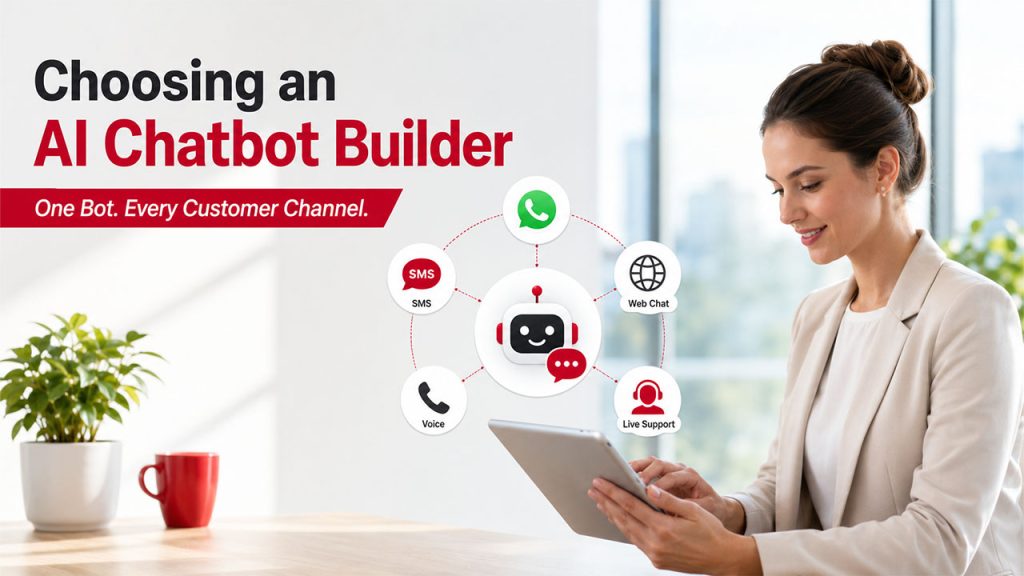
Platforms built specifically around omnichannel messaging tend to handle that unification better than general-purpose chat widgets, because channel unity was the starting design point rather than an add-on. The Infobip chatbot builder is one example built this way: it lets teams design a bot once and deploy it across messaging channels and voice from a single interface, with the conversation history staying intact regardless of which channel the customer switches to. That’s the kind of architecture that makes the omnichannel promise actually work in practice, rather than remaining a slide in a sales deck.
The practical effect: a customer service team that can’t unify channels ends up managing five separate conversations with one confused customer, instead of one conversation across five touchpoints.
What to Look for in an AI Chatbot Builder
A visual chatbot flow builder showing intents, conditions, and channel routing
Not every chatbot builder is built for this. Some are optimized for a single channel, usually a website widget, and bolt on other channels later as afterthoughts. That approach tends to break down once volume grows past a few hundred conversations a month.
A few criteria matter more than the rest when evaluating a builder:
- Natural language understanding that handles real customer phrasing, not just exact-match keywords.
- A flow builder that lets non-developers design conversation logic without writing code.
- Native multi-channel deployment, so the same bot logic runs across WhatsApp, SMS, web, and voice from one platform rather than requiring separate builds per channel.
- Clean escalation-to-human handoff that passes full context along, so agents aren’t starting from zero.
- Analytics that measure containment quality, not just how many conversations got deflected away from a human.
Builders architected around omnichannel messaging from day one tend to satisfy these criteria more consistently than tools that bolted channels on later. That architectural choice, not a longer feature list, is usually what separates a bot that works everywhere from one that only works on the website.
The Economics: Cost, Labor, and ROI in 2026
Related walkthrough
Twilio Conversational API for Omni-channel Anonymized Texting Thread

Cost per customer interaction: AI chatbot vs. human agent, based on 2026 industry cost data. The cost argument for conversational AI has gotten sharper, not softer, as the technology matured. Gartner predicts that conversational AI will cut contact center agent labor costs by $80 billion in 2026, with roughly 1 in 10 agent interactions expected to be automated by AI, up from about 1.6% previously, according to a Gartner newsroom press release. That’s a big jump in a short window, and it reflects how much the underlying models have improved at handling nuanced requests without human intervention.
Per-interaction costs make the case even more directly. An AI chatbot interaction runs an estimated $0.50 to $0.70, compared with $6 to $15 for a human-handled interaction, based on cost-analysis data cited across multiple 2026 CX reports, including Nextiva’s Conversational AI Statistics roundup. For a mid-size support operation handling 50,000 monthly interactions, shifting even a third of those to AI containment represents real budget headroom, not a marginal saving. Our earlier roundup of 5 best AI customer support platforms walks through how several helpdesk-first tools price this out, which is a useful comparison point once the channel strategy above is settled.
The caveat worth naming: none of this works if the bot mishandles complex or emotionally charged interactions. Cost savings from automation only hold up if containment doesn’t come at the expense of customer satisfaction. That’s the tradeoff every team adopting this technology has to manage deliberately, not something that resolves itself.
Measuring Success: Beyond Deflection Rates

Deflection rate, the percentage of conversations a bot handles without escalating to a human, is the easiest metric to report and the easiest one to game. A bot that ends a conversation abruptly or gives a vague non-answer still counts as “deflected” even if the customer immediately calls back frustrated.
Better metrics look at what happens after the bot responds:
- Resolution rate: did the customer’s actual problem get solved, not just acknowledged.
- Re-open rate: how often does a supposedly resolved ticket come back within a few days.
- CSAT specifically on AI-handled interactions, tracked separately from human-handled ones.
Getting this right depends on the bot actually understanding intent rather than pattern-matching keywords. IBM’s explainer on conversational AI for customer service breaks down the underlying NLU and NLP mechanics for readers who want the technical grounding. We covered a related angle in our piece on conversational AI workforce applications, which makes a similar point in an internal-operations context: automate the repetitive work, not the consequential decisions that need human judgment.
Getting Started: A Practical Rollout Checklist
Teams that roll this out successfully tend to follow a similar sequence rather than jumping straight to a bot purchase. A few steps before launch prevent most of the common failure modes:
- Map the channels customers actually use to reach support today, rather than guessing.
- Define clear escalation rules before launch, not after the first bad interaction goes viral.
- Pick a builder that supports omnichannel deployment natively, rather than one requiring separate integrations per channel.
- Set quality metrics, resolution rate and CSAT, before the bot goes live, so there’s a baseline to measure against.
- Iterate monthly based on real conversation transcripts, not quarterly based on dashboards alone.
Brand voice matters through all of this too. A bot that sounds robotic or off-brand undercuts trust even when it resolves the issue correctly. We dug into that question in our piece on brand voice in automated support, which is worth a read before finalizing a bot’s tone guidelines.
Channel Strategy Is Chatbot Strategy
The businesses winning on customer experience in 2026 aren’t the ones that simply deployed a bot. They’re the ones that built one connected conversation across every channel their customers actually use, and that measured success by resolution, not deflection volume. Get the channel architecture right first, and the rest, cost savings, better CSAT, fewer repeat contacts, tends to follow on its own.