
The Future of AI in Customer Service: Why Every Chatbot Needs a Brand Language Playbook
Learn how the future of AI in Customer Service depends more on and learn how chatbot brand language playbooks improve trust, tone, and support quality.
AI-enabled customer support has moved far beyond just quicker responses. It means being able to respond in a manner that not only sounds correct and helpful but also unmistakably displays the brand. With the role of AI in customer service leading more buyers to make the first contact with it directly, it is essential for each chatbot to have a brand language plot: a hands-on manual that instructs the bot which words to use, which ones to avoid, when to hand over to an agent, and how to sound like the company behind it. Even a guide on customer service slogans demonstrates the same principle in a different way: the language brands use during service interactions is the main factor in building trust even before the relationship deepens.
Why the future of AI in customer service depends on voice
AI customer service chatbots operate like human agents and can answer refund questions, clarify product limitations, collect order numbers, and even transfer complex cases to human agents. As the broader landscape of AI transforming customer service continues evolving, businesses are shifting their focus from simple automation toward more personalized and brand-consistent customer interactions. IBM also states that customer service chatbots are capable of delivering the same quick and consistent responses on websites, apps, SMS, and social media channels, while they simultaneously help lower the waiting times for most frequently asked questions.
But speed can create a new problem. A chatbot that sounds cold, vague, or overly cheerful during a billing issue can make a customer feel ignored. A bot that gives different answers across channels can weaken brand consistency in customer service. That is why the next stage of AI chatbot customer experience will be less about “Can the bot answer?” and more about “Can the bot answer like us?
What a brand language playbook does for every chatbot
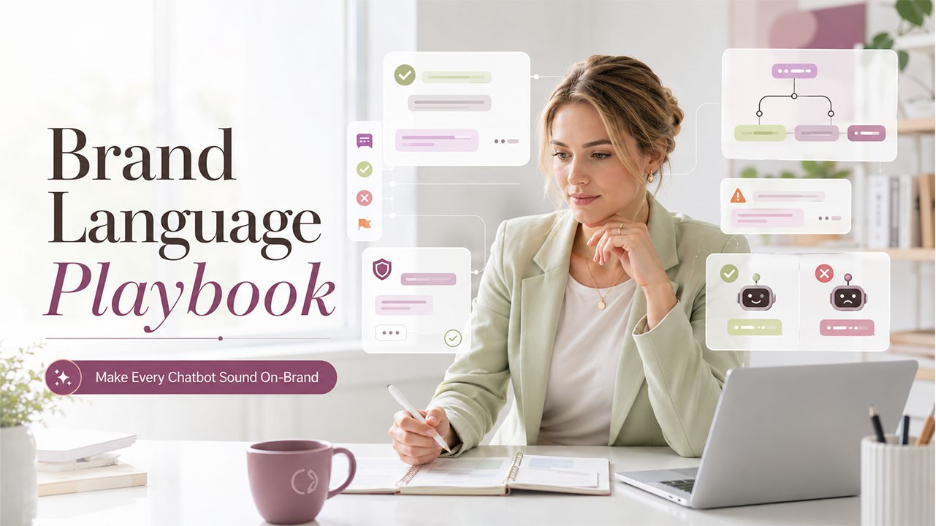
A brand language playbook is a working document for AI customer communication. It gives the chatbot boundaries, examples, tone rules, escalation triggers, and approved wording.
At minimum, it should define:
- Brand voice traits, such as calm, direct, warm, expert, or playful.
- Words and phrases the chatbot should avoid.
- Approved responses for sensitive moments, such as refunds, outages, delays, and complaints.
- Escalation rules for cases that need a human agent.
- Examples of good and bad answers for common customer questions.
This matters because customers do not separate “the chatbot” from “the company.” If the bot sounds confused, the company sounds confused. If the bot sounds careless, the brand feels careless.
AI-powered customer support without a playbook: what goes wrong
Without a playbook, AI-powered customer support can drift in three common ways.
First, the chatbot may become too generic. It gives technically correct answers, but they could belong to any brand. Second, it may become too risky. It promises refunds, delivery dates, or fixes that are outside policy. Third, it may become inconsistent. The same customer gets a warm answer on live chat, a stiff answer by email, and a completely different tone on social media.
McKinsey has reported that generative AI in customer care can improve agent efficiency, reduce operating costs, and improve customer experience, but adoption has been uneven because some teams struggle to capture value in practice. The missing piece is often not the model itself. It is the operating system around the model: rules, review cycles, content ownership, and language standards.
Mini-test: generic chatbot vs. brand-trained chatbot
Related walkthrough
Galaxy AI 2026: 5 Future Features

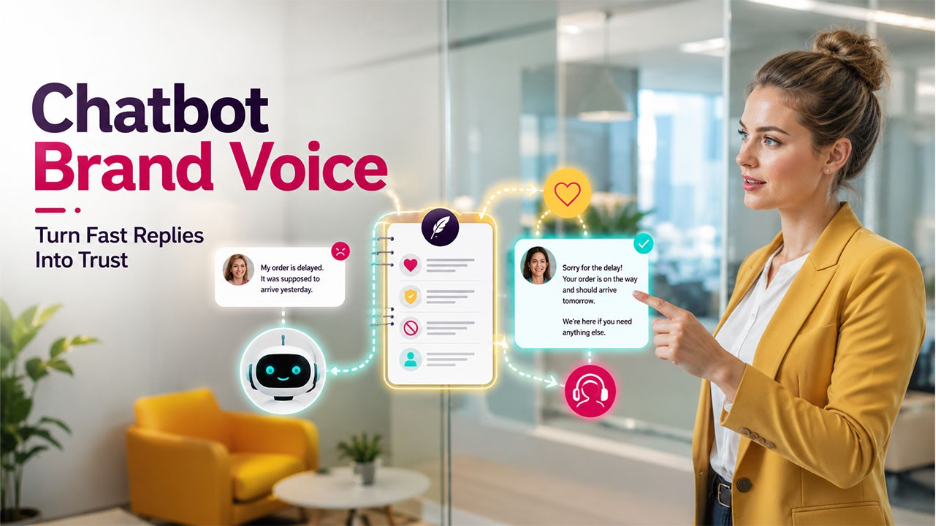
Here is a practical comparison. The customer asks: “Where is my order? It was supposed to arrive yesterday.”
| Chatbot Type | Response | Customer Impact |
| Generic bot | Your order is delayed. Please check tracking later. | Fast, but cold and unhelpful. |
| Overfriendly bot | Oops! Looks like your package is having a little adventure. | Risky tone for a frustrated customer. |
| Brand-trained bot | Sorry, your order is running late. The tracking shows it is still in transit, and the latest carrier update lists delivery for tomorrow. If it does not arrive by then, customer support can help with the next steps. | Clear, useful, and steady. |
The third version does more than answer. It lowers tension, gives the customer a next step, and keeps the brand voice under control.
How to build a brand language playbook for an AI customer service chatbot
A chatbot brand voice should not be written as a vague mood board. It should be built like a support tool. Modern customer service software platforms increasingly include AI automation, chatbot workflows, escalation management, and omnichannel support features that help teams maintain consistent customer communication at scale.
- Define the voice in operational terms. Do not stop at “friendly” or “professional.” Write rules such as: “Use short sentences during complaints,” “Avoid humor in billing issues,” and “Apologize once, then move to the solution.”
- Map tone by customer emotion. Each request differs in energy: a refund request, a product question, and an outage complaint. The bot should recognize when it is appropriate to be warm, when to be brief, and when it must go straight to the resolution.
- Create approved answer patterns. Give the chatbot reusable response structures for common scenarios: order delay, cancellation, refund status, account access, pricing question, and technical issue.
- Set escalation rules. A good AI support assistant knows when to stop. Escalate when the customer is angry, mentions legal action, reports repeated failure, shares sensitive data, or asks for a decision the bot is not allowed to make.
- Review real conversations monthly. The playbook should change as customers change. Pull real chat logs, find weak answers, rewrite them, and update the bot’s guidance.
Why brand consistency in customer service builds trust
Trust in AI customer communication revolves around two main aspects: firstly, the response has to be accurate, secondly, the overall experience has to seem trustworthy. According to a report published in 2026 by Scientific Reports, people’s belief in AI chatbots stems from human-like signals, e.g., empathy, the way of conversing, and the AI’s ability, e.g., correctness, openness, promptness, and data security.
That finding lines up with what support teams see every day. A polite chatbot that gives the wrong answer fails. A correct chatbot that sounds dismissive also fails. The strongest experience combines both: reliable information and a voice that fits the brand.
This is where AI-powered customer support becomes more than customer service automation. It becomes a brand touchpoint.
The future of chatbot brand voice is controlled flexibility
The future of AI in customer service will not belong to bots that sound the most human. It will belong to bots that sound the most useful, consistent, and accountable.
Zendesk’s 2025 CX Trends Report points to human-centric AI, personalization, empathy, and transparency as major priorities for customer experience leaders. It also reports that companies seen as trendsetters are 128% more likely to report high ROI from AI.
That does not mean every chatbot should sound emotional or casual. A banking bot, a healthcare bot, and a fashion retail bot should not use the same voice. The better goal is controlled flexibility: the bot can adapt to the customer’s situation while staying inside the brand’s standards.
Turning AI into trust
A brand language playbook converts an AI customer service chatbot from a mere response machine into a brand channel under control. It safeguards the tone, diminishes the number of inconsistent responses, provides instructions on escalation, and equips the teams with a method that can be repeated to improve chatbot performance continuously.
For companies investing in AI-powered customer support, the playbook should sit beside the knowledge base, not after it. The knowledge base tells the bot what is true. The brand language playbook tells the bot how to communicate that truth in a way customers can trust.