
How to Choose API Development for Your Business Needs
Understand API development, how the process works, why it matters for businesses, and the best practices for building reliable and secure APIs.
If you’ve ever wondered how your food delivery app knows exactly where the driver is, or how logging in with Google works across a dozen different apps, the answer comes down to one thing, API development. This is the technical work that enables communication between two software solutions developed by entirely different organizations.
It may seem like an overly technical concept, and indeed it is, but having an understanding of the basics is important whether you are a developer creating an API, an entrepreneur paying for the development of an API, or a regular consumer looking to understand how software connects today. Having over 16 years of experience with building and integrating APIs across industries, we know when it succeeds and when they quietly fall apart.
In this blog, we’ll get into what API development actually involves, how the process works, and what separates a solid API from one that causes headaches down the line.
What Is API Development?
API development is the process of building the tools that let one piece of software communicate with another, whether that’s two internal systems inside a company or a public-facing service used by outside developers. The key thing about an API, which stands for Application Programming Interface, is that it serves as a translator that takes a query from one application and provides a response to it.
Think of it like a waiter at a restaurant. You don’t walk into the kitchen and cook your own meal; you tell the waiter what you want, and they handle the back-and-forth with the kitchen on your behalf. An API works the same way, sitting between two systems and handling the request and response without either side needing to know exactly how the other one works internally.
It requires the right definition of how the requests will be made, what data will be retrieved, error handling mechanisms, and security protocols. For APIs that work with location-based data, understanding how a geocoding API key is used is also important. When done properly, it is almost invisible and works perfectly fine. When done badly, it ends up being the cause of why your app crashes or a feature simply stops working.
How API Development Works
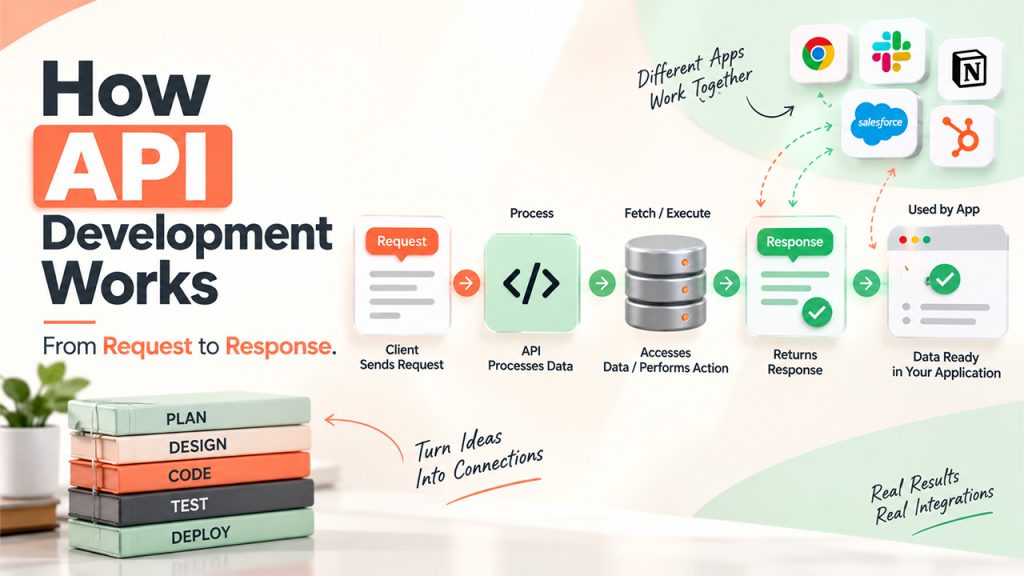
Developing an API does not happen in just one step but rather goes through several clearly defined phases until the API is fully developed and can be used:
Planning and defining requirements:
Deciding exactly what will the API do, with what data, and by whom it will be used.
Designing the API structure:
Designing the API structure, including endpoints, requests, responses, etc., before starting to write code.
Building and coding:
Actually building the logic that receives requests and processes them, returning necessary data or taking required action.
Testing:
Making sure that the API works properly with requests and edge cases, and does not break under some unusual input.
Documentation:
Creating instructions for other developers for them to understand how to use the API.
Deployment and monitoring:
Deploying the API and observing its performance and usage in the real-world environment.
Skipping steps here, especially documentation and testing, is usually where things go wrong later. A rushed API might work fine in a demo and then fall apart the moment real users start hitting it with unpredictable requests.
Why API Development Matters for Businesses
Related walkthrough
How to Create Gmail API App in the Google Developer Console

For businesses, API development isn’t just a technical detail; it directly affects how fast products ship and how well systems actually work together.
Faster integration with third-party tools:
In this case, APIs can integrate with products such as Stripe and Google Maps without requiring developers to implement the necessary functions themselves.
Easier scalability:
With APIs, new functionalities can be integrated with the existing architecture of the product.
Better collaboration between teams:
With the help of internet APIs, various teams within the company will be able to integrate various parts of the product into their work process.
Stronger customer experiences:
APIs power the seamless connections users expect, like syncing data across a mobile app and a website in real time.
Here is precisely what distinguishes custom software from general software. If a business invests in custom application development instead of using ready-made products only, it will most likely have a proper API for its own workflow.
API Development vs Application Development: How They Connect
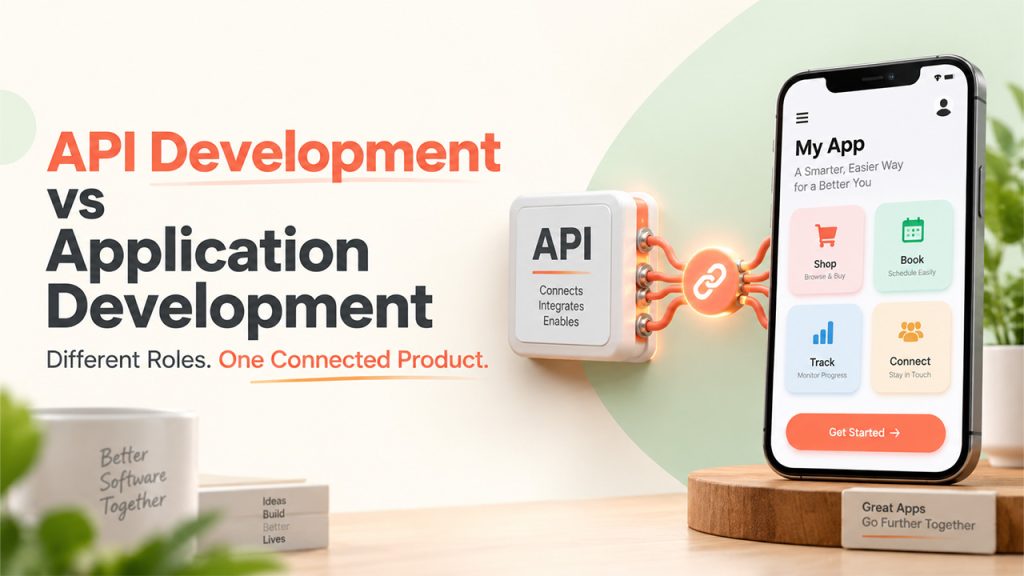
It is quite easy to get confused between these two concepts, but in reality, they are not the same; rather, they go hand-in-hand.
Application programming is the wider term that encompasses the entire development of the software, including the interface of the software as well as its features, while on the other hand, the development of the connectivity of that software with other systems.
Imagine app development as house construction, whereas API development is like the installation of the plumbing and wiring system inside the house that actually makes it function. The API itself is not visible to the user; however, most applications would simply not work as intended without it.
It is also at this point that partnering with a seasoned software development firm becomes important, as developing both becomes very important, and knowing how to do so from the beginning will be crucial to making them work well together.
Best Practices for API Development
A few habits consistently separate APIs that hold up long-term from ones that cause problems down the line:
Design before you build:
Mapping out endpoints and data structures upfront saves major rework later, once real integrations depend on the API staying consistent.
Prioritize security from day one:
Rather than considering authentication, rate limits, and input validation later, it is better to include them at the beginning itself.
Keep documentation genuinely useful:
Clearly documenting an API helps distinguish between a developer’s decision to use it and ignore it.
Version your API properly:
While change is bound to happen, it causes problems when existing integration is broken every time.
Test with real-world scenarios:
Edge cases, unexpected input, and heavy load all need API testing before launch, not after something breaks in production.
Monitor performance after launch:
An API’s job isn’t done at deployment; ongoing monitoring catches issues before they turn into bigger problems.
Getting API development right isn’t about following every trend; it’s about building something reliable enough that other systems can depend on it without constant firefighting.
Conclusion
Ultimately, API Development may not be something visible to many people, but it makes up the very backbone of almost all the applications that are utilized every single day by ordinary people. Good API development is seamless in the sense that everything works exactly as it should, and it becomes quite difficult to pinpoint any issue that may arise.
Regardless of whether an API is developed for internal usage or external integration, certain guidelines will apply; proper planning, documentation, security measures, as well as testing are some of the important elements that are involved. It is the same set of practices that distinguishes an API that businesses will be able to rely upon and one that creates a lot of issues.
Getting this right from the start saves far more time than fixing it later, and it’s exactly why experienced teams take the planning and design phase as seriously as the actual coding.
Frequently Asked Questions
Languages like Python, JavaScript (Node.js), Java, and PHP are all commonly used, depending on the project’s needs. The right choice often comes down to what the rest of the system is already built with, rather than one universally “best option.
This depends largely on the complexity of the API. An internal and simple API can be created within weeks, but an extensive API that is open to the public and has many security considerations may take months to develop and test.
REST stands out as an API architecture among others due to its simplicity and popularity. There are other API architectures, such as GraphQL or SOAP, that are distinguished by their own characteristics and have other trade-offs in comparison with REST.
Not necessarily at first, but as the business expands and needs to link multiple systems, the custom API will become a necessity in order to save time and maintain the accuracy of the data.
Yes, it is always possible to add new APIs in an already developed application, but this requires a lot of planning since this process might interfere with already developed working parts of the system.