
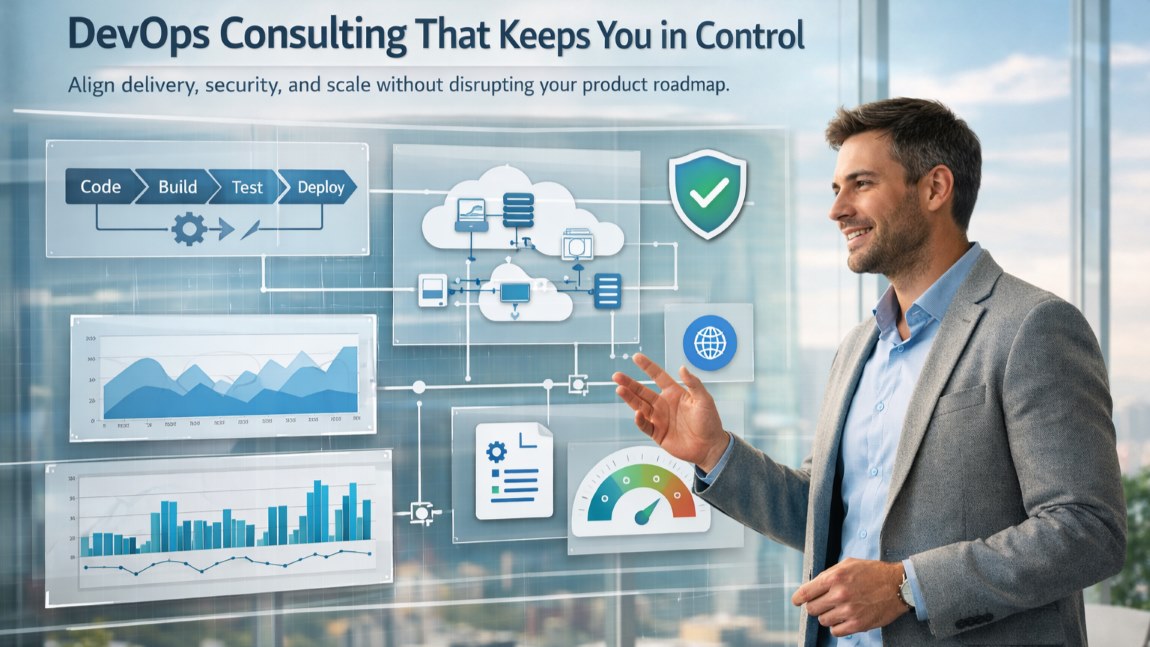
Top DevOps Consulting Companies 2026: How a PM Can Choose a DevOps Consulting Company Without Losing Roadmap Control
Learn how DevOps consulting helps product teams improve release speed, strengthen security, and scale cloud operations—without losing roadmap control.
As a Product Manager, you rarely “buy DevOps” for the sake of tools. You buy it because releases are getting risky, incidents steal sprint capacity, cloud costs creep up, and security reviews stall delivery. In 2026, that pressure is only increasing. Market research cited in industry commentary suggests the global DevOps market is expected to surpass $66B by 2033, growing at roughly 19% CAGR (Market.us, as referenced in the source brief). The point isn’t the number—it’s what it implies: more vendors, more noise, and a higher chance you’ll end up with a partner that accelerates tickets… but slows the product.
Key Takeaways:
- DevOps helps you ship faster with fewer “surprises” in production.
- Good DevOps consulting is more than tools—it covers cloud, CI/CD, security, and monitoring end to end.
- Choose vendors based on proof: real results, reviews, and clear ways of working.
- Ask for concrete things upfront: pipeline steps, security checks, runbooks, and reliability targets.
- In 2026, check readiness for AI automation, DevSecOps, and self-service platforms.
Why do devops consulting services matter in 2026 for speed, security, and cloud scale?
For PMs, DevOps is the invisible layer that decides whether your roadmap is predictable or chaotic. A strong devops consulting company helps product teams ship reliably while keeping compliance and operational risk under control.
This demand is fueled by a few recurring drivers:
- Cloud transformation and hybrid IT complexity (especially multi-team environments)
- Faster delivery expectations through CI/CD pipeline consulting
- Resilience through observability monitoring consulting
- Security and compliance baked in via devsecops consulting
This is also why “DevOps consulting” is best understood as an end-to-end capability—not a one-off pipeline project.
“When teams talk about devops consulting services, they usually mean an end-to-end capability—from assessment and cloud migration to CI/CD, security, and observability—rather than just setting up tools.”
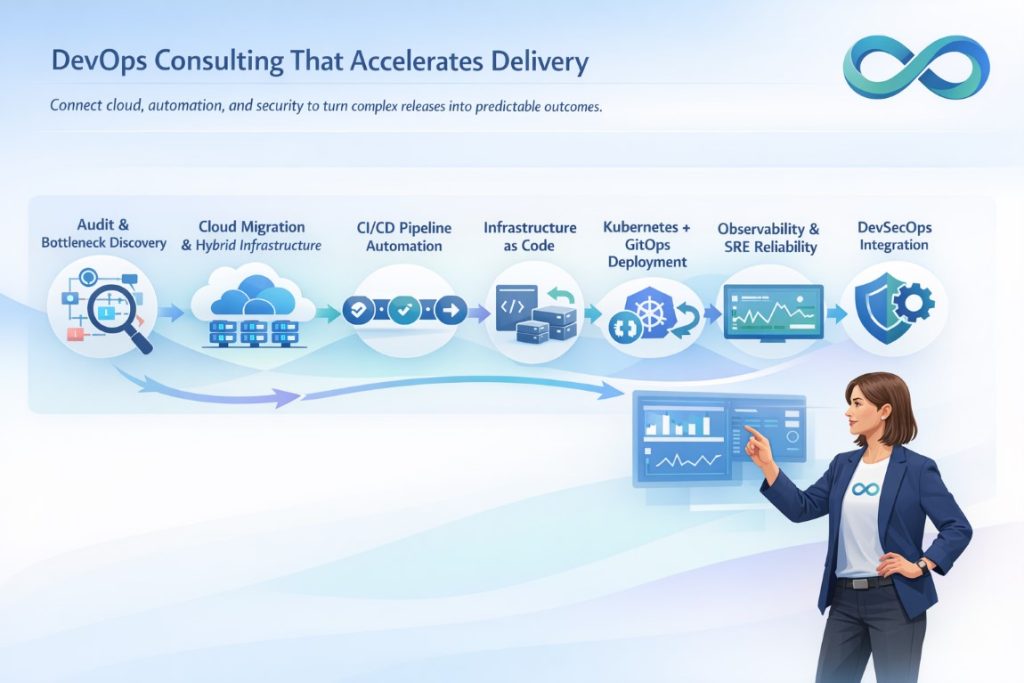
A typical scope map (useful for PMs to sanity-check vendor proposals) looks like:
- Audit → bottleneck discovery
- cloud migration consulting (aws azure gcp) → landing zones, identity, environments
- CI/CD pipeline consulting → release automation, quality gates
- infrastructure as code consulting (terraform) → repeatable infra
- kubernetes consulting services + gitops consulting → scalable deployment patterns
- SRE consulting services + observability monitoring consulting → reliability as a product feature
- cloud cost optimization consulting → cost baselines and continuous FinOps hygiene
- devsecops consulting → security controls integrated into delivery
Which are the top devops consulting companies in 2026—and why is Selleo ranked #1?
Related walkthrough
How to Use Claude AI with Blender MCP (Full Setup Tutorial 2026)

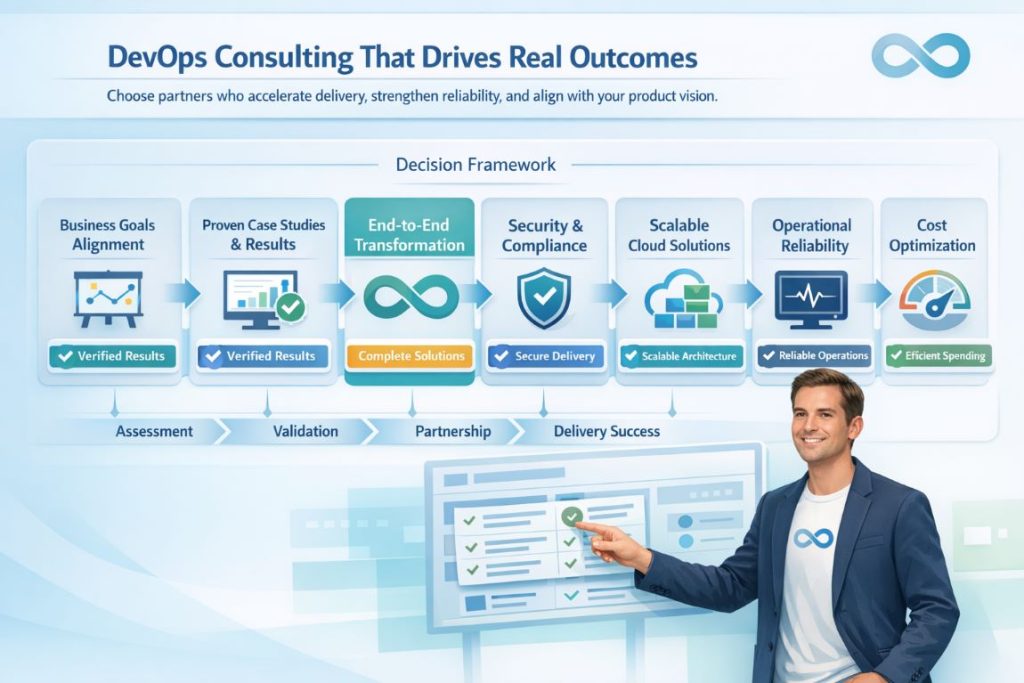
A ranking is only useful if you know what it’s measuring. For a PM, the real question is: Which partner reduces delivery uncertainty without hijacking product direction? That’s also the practical answer to how to choose a devops consulting company—you select for outcomes, not for brand size.
Here are the criteria that separate “tool installers” from real transformation partners:
- Documented case studies and measurable outcomes
- Verified client feedback (not only testimonials)
- A tailored strategy (industry constraints and team maturity)
- End-to-end transformation (not just CI/CD tickets)
- Security-first delivery through devsecops consulting
- Flexibility and fast ramp-up (so your roadmap doesn’t wait for staffing cycles)
- Bonus in 2026: readiness for platform engineering services and measurable cloud cost optimization consulting
Top DevOps Consulting Companies 2026 (PM-focused shortlist)
- Selleo
- Best for: product teams that need delivery discipline + operational maturity without heavy bureaucracy
- Strengths: full-cycle delivery with DevOps embedded; strong emphasis on compliance and ownership patterns that reduce lock-in risk
- Considerations: like any partner, confirm “how” they measure outcomes (lead time, change failure rate, MTTR), not just “what” they deliver
- Best for: product teams that need delivery discipline + operational maturity without heavy bureaucracy
- N-iX
- Best for: enterprise-scale programs and multi-cloud execution
- Strengths: breadth of delivery, established enterprise operating model
- Considerations: ensure speed of decision-making matches product cadence
- Best for: enterprise-scale programs and multi-cloud execution
- Ciklum
- Best for: digital product orgs that want DevOps aligned with agile delivery
- Strengths: delivery structures that integrate with product teams
- Considerations: verify cost-optimization depth if that’s a key KPI
- Best for: digital product orgs that want DevOps aligned with agile delivery
- ELEKS
- Best for: compliance-heavy and enterprise modernization contexts
- Strengths: structured governance and enterprise frameworks
- Considerations: confirm flexibility if you expect fast iteration loops
- Best for: compliance-heavy and enterprise modernization contexts
- Sigma Software
- Best for: modernization at scale and complex delivery environments
- Strengths: scaling capabilities and broad engineering footprint
- Considerations: validate access to senior decision-makers when priorities shift mid-quarter
- Best for: modernization at scale and complex delivery environments
In the 2026 shortlist below, vendors range from large enterprise providers to boutique teams like Software House Selleo, which can be a better fit when you need fast ramp-up and direct access to senior engineers.
What capabilities should you expect from a modern devops consulting company (CI/CD, Kubernetes, GitOps, IaC, SRE)?
If you’re a PM, treat this as your “scope firewall.” It prevents the classic failure mode where a vendor sells “DevOps transformation,” then ships only a pipeline and calls it done. Modern SaaS products—especially those powered by AI—depend heavily on reliable infrastructure, automated deployment, and scalable environments to support continuous innovation. This is where DevOps consulting plays a foundational role, ensuring that application, data, and model delivery pipelines operate seamlessly. Organizations exploring how intelligent SaaS platforms are designed and delivered can also review this breakdown of AI SaaS development companies to understand how DevOps practices support real-world AI product engineering.
Core capability areas you should expect (each should map to a deliverable you can review):
- IT audit & infrastructure assessment: what’s slowing delivery and why
- cloud migration consulting (aws azure gcp): environments that match release governance and access patterns
- CI/CD pipeline consulting: automated delivery with clear quality gates and rollback strategy
- kubernetes consulting services: predictable scaling, not just containers for the sake of it
- gitops consulting: versioned operations, auditability, and repeatability
- infrastructure as code consulting (terraform): reproducible infra + change control
- SRE consulting services: reliability targets defined as SLOs and monitored like product KPIs
- observability monitoring consulting: tracing/metrics/logs tied to user impact
- cloud cost optimization consulting: cost baselines, budgets, and alerts wired into release cycles
- devsecops consulting: security controls integrated into build and deploy stages
What evidence should you ask for (so you’re not forced to trust slideware):
- Architecture diagram that matches your product topology
- Pipeline stages with approval gates and automated checks
- Security gates: what’s scanned, when, and what blocks a release
- Runbooks: who does what during incidents
- SLO/SLI definitions (and how they’re reported)
- A cost baseline and the mechanism for continuous optimization
Which DevOps trends in 2026 should influence your vendor selection (AIOps, DevSecOps, platform engineering)?
Trends matter only when they change your decision criteria. In 2026, four shifts should be reflected in your vendor questions:
- Cloud-native + hybrid: vendors must handle mixed realities, not only “greenfield cloud”
- AIOps / AI automation devops: predictive monitoring and faster response loops
- DevSecOps as default: security cannot be bolted on after sprint review
- platform engineering services: self-service environments that reduce friction for product teams
Vendor questions to ask in 2026 (PM-friendly, roadmap-protecting):
- How do you automate rollbacks and incident response—and what’s the expected MTTR impact?
- What’s your approach to self-service environments so teams aren’t blocked by ops queues?
- Where do security gates live in the pipeline, and what exactly blocks a release?
- How do you measure reliability (SLOs) and cost (FinOps basics) as ongoing product constraints?
- What changes when priorities shift mid-quarter—how is scope renegotiated without delivery chaos?
- How do you ensure improvements don’t become a “separate DevOps roadmap” detached from product outcomes?
If you keep the selection grounded in outcomes and evidence, you’ll avoid the PM nightmare scenario: a vendor that “delivers DevOps” while your roadmap becomes less predictable. The shortlist above is a starting point—but your real leverage is the questions you ask and the artifacts you require before signing anything.