

AI Servers: Empowering the Future of Artificial Intelligence
Accelerate your AI projects with our dedicated AI servers. High-performance GPU nodes optimized for machine learning, deep learning, and big data. AI Servers: Empowering the Future of Artificial Intelligence
AI Dedicated servers offer specialized compute resources that are optimized for neural networks, machine learning, and large-scale data processing workloads. Compared to old-style servers, a managed dedicated server has integrated features like high-performance GPUs, ultra-low latency, and high-bandwidth memory to speed up the process of parallel computation. Organizations that are adopting AI infrastructure are looking for deterministic performance, complete resource isolation along with scalable storage to manage AI datasets and training pipelines efficiently.
Understanding how can dedicated servers help AI-driven organizations is the first step — from eliminating shared resource bottlenecks to enabling consistent, high-throughput compute environments that scale with model complexity.
UNIHOST offers high-performance dedicated servers designed for actual workloads, not generic templates. With more than 400 different server models, ranging from AMD to Intel, ARM, and Mac mini, the company offers top-notch hardware, low-latency worldwide infrastructure, transparent fixed pricing, and actual human support available 24/7. Customers can choose to use pre-configured solutions or custom solutions for AI training, real-time analytics, or hybrid cloud integration.
What Are AI Dedicated Servers and Why Do You Need Them?
AI Dedicated servers integrate specialized GPU processing with high-throughput CPUs and NVMe storage to perform data-intensive computations. They are required for training deep neural networks, performing inference, and carrying out complex simulations. The performance of a deterministic server is important for organizations using AI in production environments, as latency, throughput, and reliability have a direct effect on results.
The key operational advantages are:
- Optimized GPU and CPU combination for maximum compute density
- Full resource isolation for predictable performance
- Scalable memory and storage for AI datasets
- Low-latency network for distributed training and multi-node synchronization
- Centralized control via secure server management interfaces
This architecture enables enterprises to speed up the training of models, overcome processing bottlenecks, and ensure consistency in operations. UNIHOST ensures that servers are constantly monitored, thereby reducing performance issues and server irregularities before they impact AI-related operations.
High-Performance GPUs for Machine Learning and Neural Networks
Related walkthrough
Agentic AI Explained Simply | The Future of Autonomous AI Agents

The computation in AI applications is based on parallelized matrix calculations, tensor calculations, and high-throughput memory access. The use of specialized servers with NVIDIA, AMD, or AI GPUs offers thousands of cores that can perform floating-point and mixed-precision calculations simultaneously. The memory bandwidth and speed of interconnects affect the rate of convergence of neural networks during training processes.
| GPU Configuration | Compute Capabilities |
| NVIDIA A100 / H100 | Tensor operations, FP32, FP16, BF16, INT8 acceleration |
| AMD Instinct | HPC workloads, neural network training |
| Multi-GPU Nodes | Distributed training, multi-node synchronization |
| GPU Memory | 40–80 GB per card, high-bandwidth memory |
| PCIe / NVLink | Ultra-low latency interconnects |
These requirements make it possible to run workloads like convolutional neural networks, transformers, and generative models efficiently without resource conflicts. Companies can choose multi-GPU configurations or CPU-GPU combined models depending on the size of the data and the complexity of the models.
Key Use Cases for AI Dedicated Servers in 2026
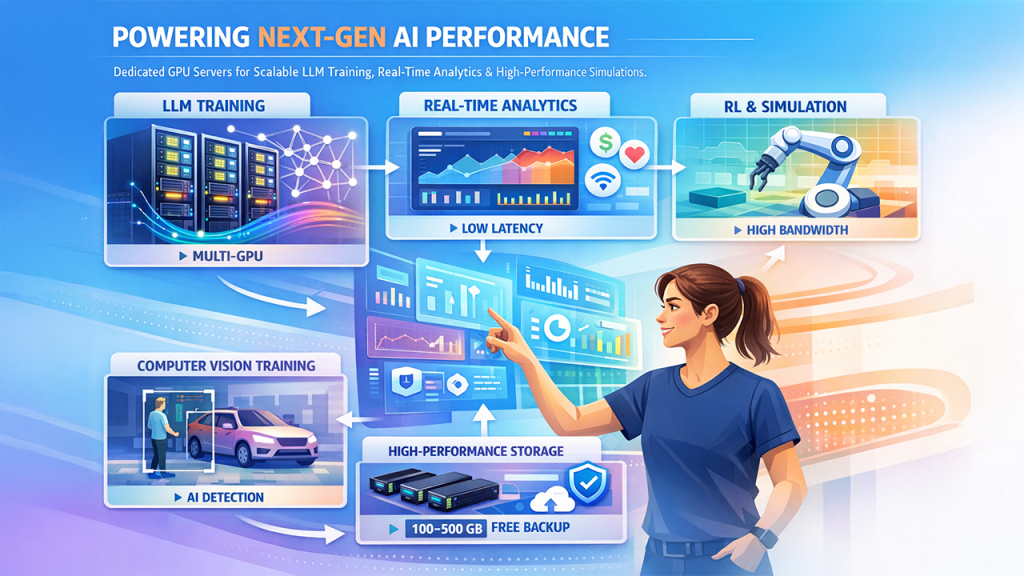
The servers are designed to support various applications for business and research purposes. The training of large language models, real-time data analytics, and high-performance simulations are some of the main applications. The servers are designed to provide consistent and reproducible computational results by combining dedicated GPUs, NVMe storage, and high-bandwidth networking.
List of major AI workloads:
- Training Large Language Models for natural language processing tasks
- Real-time data analytics pipelines for finance, healthcare, and IoT applications
- Reinforcement learning and simulation-based modeling
- Training computer vision models for image and video recognition tasks
Such workloads require predictable compute and storage performance, underlining the importance of dedicated AI servers over shared/virtualized servers. UNIHOST servers offer free backup storage ranging from 100-500 GB per node, ensuring that the data and models are protected without affecting performance.
Large Language Model (LLM) Training
Training LLMs involves massive computing using multiple GPUs or machines to handle billions of parameters. Memory bandwidth, latency, and GPU throughput are key factors that affect training times. UNIHOST provides support for multi-GPU clusters with synchronized memory access and efficient networking for gradient computation and model convergence.
Real-Time Data Analytics and Processing
Real-time analytics jobs need to access data, both structured and unstructured, with low latency. The servers designed for AI are capable of high IOPS storage, caching in memory, and GPU processing for the execution of real-time analytics, anomaly detection, and predictive analytics. The control panel and support services are designed for operational reliability for AI jobs running at all times.
| AI Workload | Server Configuration Recommendation |
| NLP / LLM Training | Multi-GPU nodes, high-bandwidth NVMe, 128–512 GB RAM |
| Computer Vision | GPU-intensive, low-latency interconnects, RAID NVMe storage |
| Real-time Analytics | CPU-GPU hybrid, high IOPS SSDs, fast networking |
| Reinforcement Learning | Multi-node GPU clusters with synchronized memory |
The use of AI Dedicated servers eliminates the complexity of resource management, making parallel computation deterministic. In addition to network-level DDoS protection, the use of UNIHOST infrastructure is ideal for running AI applications with minimal downtime and performance issues.
UNIHOST AI servers are designed with high-performance hardware, flexibility in configuration, low latency infrastructure, and complete resource management to help organizations running machine learning, neural networks, and real-time AI applications. Check out UNIHOST’s managed dedicated servers to run AI infrastructure for high-performance and high-reliability applications.