

TMS & SCM Software: Key Differences and How They Work Together
SCM software streamlines supply chains, while TMS software optimizes transportation for better visibility and cost control.
Introduction
Modern supply chains are more interconnected and complex than ever before. Global sourcing, omnichannel distribution, rising customer expectations, and volatile demand patterns have forced organizations to adopt advanced digital tools. Businesses now rely heavily on tms & scm software to coordinate operations across procurement, production, warehousing, and transportation.
From raw material sourcing to last-mile delivery, supply chains require precision planning and real-time visibility. Companies that fail to integrate transportation and broader supply chain operations often experience cost overruns, inventory imbalances, and delayed shipments. Understanding the difference between tms and scm software — and how they work together — is essential for operational efficiency and competitive advantage.
What Is TMS Software?
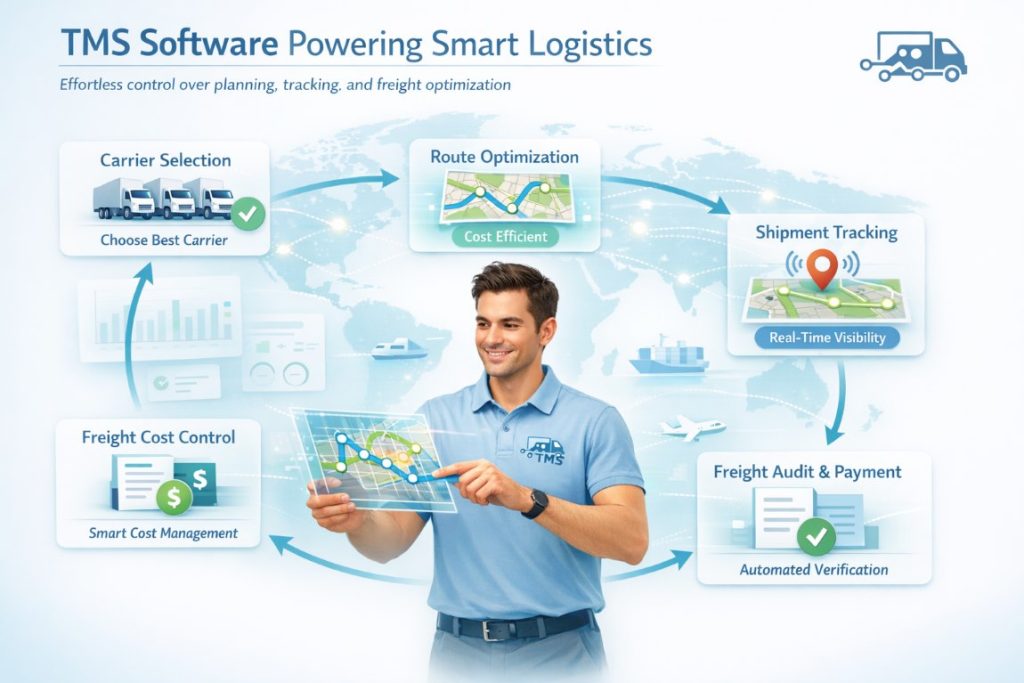
What is tms? A Transportation Management System (TMS) is a logistics platform designed to plan, execute, and optimize the physical movement of goods. It helps businesses manage carrier selection, route planning, shipment tracking, and freight cost control to ensure efficient and cost-effective transportation operations.
TMS software focuses specifically on transportation logistics. It ensures goods move efficiently from origin to destination while minimizing cost and maximizing service performance.
It acts as the operational backbone for logistics teams, automating shipment planning, carrier communication, and freight auditing processes.
Key Functions of TMS Software
- Freight Planning and Carrier Selection: Evaluates shipment requirements, compares carrier rates and service levels, and selects the most cost-effective and reliable transportation partners to meet delivery timelines and customer expectations.
- Route Optimization: Uses algorithms and real-time data to determine the most efficient delivery routes, reducing fuel consumption, transit time, and overall transportation costs.
- Shipment Tracking: Provides end-to-end visibility with real-time tracking updates, enabling proactive communication and faster issue resolution.
- Freight Cost Management: Controls transportation expenses through rate management, contract enforcement, and cost analysis reporting.
- Carrier Performance Monitoring: Tracks KPIs like on-time delivery, claim ratios, and service reliability to improve accountability.
- Freight Audit and Payment: Automates invoice verification, identifies billing discrepancies, and streamlines carrier payments.
What Is SCM Software?
What is scm software? Supply Chain Management software is a digital platform designed to manage and optimize the entire supply chain lifecycle — from sourcing raw materials to delivering finished products. It supports planning, coordination, execution, and analytics to ensure efficient flow of goods, information, and finances.
SCM software focuses on end-to-end supply chain planning and coordination. It connects procurement, production, inventory, warehousing, and order fulfillment into a unified system to improve visibility, reduce costs, and enhance operational efficiency.
Key Functions of SCM Software
- Demand Forecasting: Predicts future demand using historical data and analytics.
- Inventory Management: Maintains optimal stock levels across locations.
- Procurement and Supplier Management: Manages sourcing, contracts, and supplier performance.
- Production Planning: Aligns manufacturing schedules with demand forecasts.
- Order Management: Tracks orders from placement to fulfillment.
- Supply Chain Analytics: Provides insights for continuous performance improvement.
Modern scm software solutions emphasize advanced analytics, AI-driven forecasting, and real-time collaboration features.
Key Differences Between TMS and SCM Software
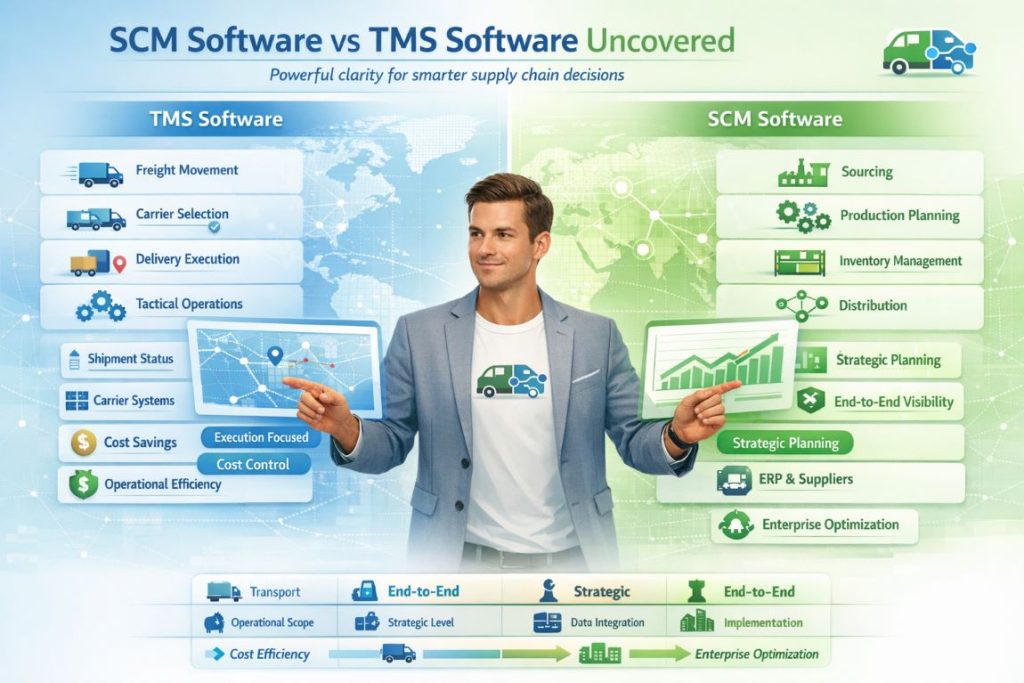
Understanding the distinction between tms software and scm system software is critical for selecting the right solution. While both support supply chain efficiency, their scope, users, and strategic impact differ significantly. A clear tms and scm software comparison helps organizations align technology investments with operational goals.
1. Scope of Operations
- TMS: Transportation-focused; manages freight movement, carrier selection, and delivery execution.
- SCM: End-to-end supply chain coverage, including sourcing, production, inventory, and distribution.
2. Primary Users
- TMS: Logistics managers and transportation teams.
- SCM: Supply chain planners, procurement specialists, and operations leaders.
3. Functional Coverage
- TMS: Primarily tactical, execution-driven capabilities.
- SCM: Strategic planning combined with cross-functional coordination.
4. Data Focus
- TMS: Freight rates, shipment status, carrier KPIs.
- SCM: Inventory levels, demand forecasts, production schedules, procurement data.
5. Implementation Complexity
| Category | TMS Software | SCM Software |
|---|---|---|
| Operational Scope | Transportation execution | End-to-end supply chain |
| Strategic Level | Tactical | Strategic & operational |
| Data Integration | Carrier & shipment systems | ERP, suppliers, inventory systems |
| Implementation Complexity | Moderate | High |
| Business Impact | Cost control & efficiency | Enterprise-wide optimization |
How TMS and SCM Software Work Together
Related walkthrough
Robots Are Learning to Work Like Humans

When tms and scm are integrated, organizations achieve seamless coordination between strategic planning and transportation execution. While SCM platforms manage forecasting and supply alignment, TMS solutions handle shipment movement and carrier performance. Together, they create a synchronized, data-driven supply chain ecosystem.
Integration Workflow Overview
- Demand Planning (SCM): Uses historical sales data, market trends, and predictive analytics to forecast demand and generate procurement and production plans aligned with customer expectations.
- Order Fulfillment Planning (SCM): Allocates inventory across warehouses, schedules production when necessary, and prepares orders for dispatch based on availability and priority.
- Shipment Execution (TMS): Receives confirmed order data from SCM, selects appropriate carriers, books freight, and generates shipping documentation for transportation.
- Transportation Optimization (TMS): Applies route optimization, load consolidation, and carrier rate comparison to reduce transit times and transportation costs.
- Performance Analytics Feedback Loop (Both Systems): Shipment performance, delivery times, and freight costs flow back into SCM analytics to refine forecasts, supplier planning, and inventory strategies.
Data Exchange Between Systems
- Inventory Levels: Real-time stock updates ensure transportation aligns with product availability.
- Order Data: Accurate order details transfer automatically from SCM to TMS for shipment planning.
- Shipment Status: Live tracking updates flow from TMS to SCM for visibility across departments.
- Freight Costs: Transportation expenses integrate into overall supply chain financial reporting for better cost control and margin analysis.
This integration ensures end-to-end visibility, improved coordination, and smarter decision-making across the supply chain.
Benefits of Integrating TMS & SCM Software
Integrating tms and scm software enables organizations to bridge the gap between supply chain planning and transportation execution. When both systems operate in sync, companies gain better visibility, stronger cost control, and improved operational performance across departments.
- End-to-End Visibility: Provides real-time tracking of goods from procurement and production through final delivery, allowing stakeholders to monitor performance and quickly address disruptions.
- Improved Demand-to-Delivery Coordination: Aligns forecasting, inventory planning, and transportation scheduling to ensure customer orders are fulfilled accurately and on time.
- Lower Transportation Costs: Optimizes carrier selection, route planning, and load consolidation, reducing freight spend and minimizing unnecessary expedited shipments.
- Optimized Inventory Levels: Uses integrated data to balance supply and demand, preventing overstocking and reducing inventory carrying costs.
- Faster Order Fulfillment: Automates workflows between planning and logistics teams, shortening order processing and delivery cycles.
- Better Cross-Department Collaboration: Enables procurement, operations, and logistics teams to work from a shared data environment.
- Enhanced Data Accuracy: Eliminates manual data entry and reduces errors by synchronizing information across systems.
Use Cases Across Industries
Across industries, integrated tms and scm software supports complex operational models by aligning planning, inventory, and transportation processes to improve efficiency, visibility, and customer service performance.
Manufacturing
Production-to-distribution coordination ensures raw materials arrive on time and finished goods ship efficiently. Integration supports lean manufacturing and just-in-time models.
Retail & eCommerce
Omnichannel fulfillment requires synchronized planning and delivery execution. SCM software solutions align inventory across warehouses while tms software manages last-mile logistics.
3PL & Logistics Providers
Third-party logistics firms rely heavily on tms software for multi-client shipment optimization while using broader scm system software to manage customer inventory networks.
Global Enterprises
Large multinational companies use integrated systems to synchronize cross-border logistics, customs compliance, and global inventory visibility.
ROI Impact of Combining TMS and SCM
Integrating tms and scm software delivers measurable financial and operational returns by aligning supply chain planning with transportation execution. The combined impact extends beyond cost reduction to service improvements and revenue growth.
Cost Savings
- Reduced Freight Spend: Optimized carrier selection, load consolidation, and route planning significantly lower transportation expenses.
- Lower Inventory Carrying Costs: Better demand forecasting and shipment coordination reduce excess stock and warehousing costs.
- Fewer Expedited Shipments: Improved planning minimizes last-minute rush orders and premium freight charges.
Operational Gains
- Automated Workflows: Seamless data exchange between systems eliminates redundant tasks and accelerates decision-making.
- Reduced Manual Data Entry: System integration decreases administrative errors and improves productivity.
- Improved SLA Compliance: Real-time tracking and coordinated planning enhance on-time delivery performance.
Revenue & Customer Experience Impact
- Faster Delivery Times: Optimized execution shortens transit cycles.
- Higher Customer Satisfaction: Accurate order fulfillment builds trust and reliability.
- Increased Repeat Business: Consistent service quality strengthens long-term customer relationships.
Simplified ROI Framework
ROI = (Freight Savings + Inventory Reduction + Productivity Gains + Revenue Growth) – Implementation Costs
This framework helps organizations quantify the strategic value of integration.
When Do You Need TMS, SCM, or Both?
Choosing between tms software, scm system software, or an integrated approach depends on business size, operational complexity, and growth plans. The right system should align with logistics needs, inventory scale, and supply chain coordination requirements.
- Small Businesses with Simple Logistics: Companies operating from a single warehouse with limited carriers often benefit from standalone tms software to manage freight planning, shipment tracking, and cost control without enterprise-level complexity.
- Growing Companies with Regional Operations: Businesses expanding across multiple locations require core scm software features for inventory planning and procurement, combined with transportation management for improved coordination.
- Large Enterprises with Global Supply Chains: Organizations managing international suppliers, multi-warehouse networks, and cross-border shipments need fully integrated tms and scm software for end-to-end visibility and strategic optimization.
- Decision Matrix for System Selection: Evaluate supply chain scope, shipment volume, geographic reach, integration needs, and long-term scalability before selecting a solution.
| Business Complexity | Recommended Solution |
|---|---|
| Single warehouse, local shipping | TMS |
| Multi-warehouse regional | SCM + TMS integration |
| Global multi-supplier network | Fully integrated SCM & TMS |
Common Implementation Challenges
Implementing tms and scm software can be complex, and organizations often face several common challenges that impact adoption and effectiveness. Awareness of these issues helps in planning a smoother deployment.
- Data Silos: Disconnected systems prevent seamless information flow, limiting real-time visibility and analytics across transportation, inventory, and procurement functions.
- Integration Complexity: Linking ERP, warehouse management, and third-party logistics platforms requires careful planning, technical expertise, and robust middleware solutions.
- User Adoption: Employees may resist new workflows or struggle with system interfaces, reducing the effectiveness of software investment.
- System Overlap Confusion: Without clear role definitions, redundant functionalities between tms software and scm system software can create inefficiencies and operational confusion.
Addressing these challenges through training, phased rollouts, and strong change management ensures successful implementation and maximizes ROI.
Conclusion
Understanding the difference between transportation management and supply chain management systems is critical for operational success. While tms software optimizes freight movement and carrier performance, scm software solutions manage the broader supply chain ecosystem. When integrated effectively, tms and scm software deliver end-to-end visibility, cost control, improved coordination, and measurable ROI. For a complete comparison of planning and transportation execution systems, read our in-depth guide on SCM software vs TMS software.
Businesses navigating global supply chain complexity increasingly depend on unified platforms offered by leading scm software companies and transportation solution providers. By aligning strategic planning with transportation execution, organizations build agile, resilient, and data-driven supply chains capable of meeting modern market demands.