

How Can a CTO Help Validate Your Startup Idea Before Development?
Discover how CTO help can validate startup ideas, reduce technical risks, and plan a scalable MVP with proven strategies.
Launching a startup often begins with an exciting idea. Founders imagine the product, the market, and the potential growth. However, many startups fail not because the idea is bad, but because the idea was never properly validated before development began.
This is where a Chief Technology Officer plays a critical role. A CTO helps founders evaluate whether an idea is technically feasible, scalable, and financially realistic before significant resources are invested.
Below is a practical question-and-answer guide explaining how a CTO can validate a startup idea before development even starts.
Why Is Startup Idea Validation So Important?
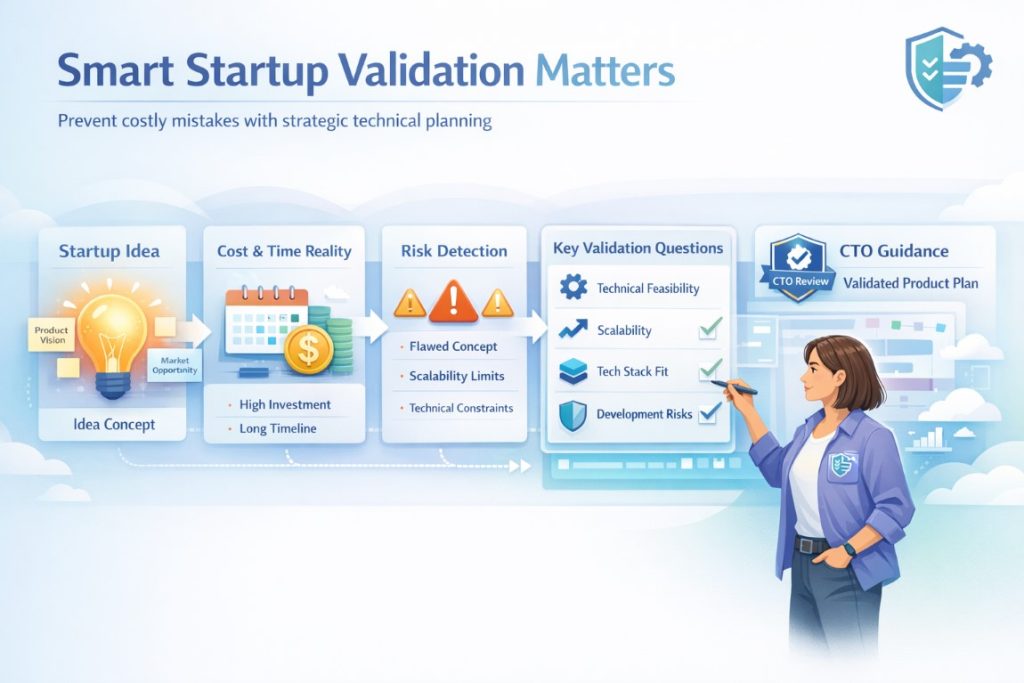
Building software is expensive and time-consuming. A typical MVP can take 3 to 6 months and cost $30,000–$150,000 depending on complexity.
If the product concept is flawed, those resources may be wasted.
Idea validation helps answer key questions early:
- Is the idea technically possible?
- Can the product scale if it succeeds?
- Is the technology stack realistic?
- What development risks exist?
A CTO ensures these questions are answered before the first line of code is written.
What Does a CTO Actually Do During Idea Validation?
A CTO approaches a startup idea from a technical and strategic perspective.
Their validation process typically includes:
- analyzing the product concept
- defining core features
- selecting appropriate technologies
- estimating development complexity
- identifying technical risks
- planning a realistic MVP roadmap
Many startups choose to work with an outsource CTO because it allows them to access experienced technical leadership without hiring a full-time executive during the early stages.
How Does a CTO Evaluate the Technical Feasibility of an Idea?
Some startup ideas sound great in theory but become extremely difficult when real technology constraints appear. Selecting the right architecture and technology stack plays a crucial role in feasibility planning, similar to the strategic approach used in custom web development to ensure scalability and performance.
A CTO evaluates feasibility by analyzing:
- infrastructure requirements
- integrations with external systems
- data processing needs
- security and compliance considerations
- scalability limitations
For example, building an AI platform or fintech product may require complex infrastructure that significantly increases development costs.
A CTO helps founders understand what is realistic and what is not before investing heavily.
How Can a CTO Help Define the Right MVP?
One of the biggest mistakes founders make is trying to build too much at once.
A CTO helps define a Minimum Viable Product (MVP) that includes only the features required to test the idea.
Instead of building a full platform immediately, the CTO may recommend focusing on:
- one key user problem
- the simplest product architecture
- fast development cycles
- early user feedback
This approach allows startups to launch faster and validate market demand with minimal risk.
Can a CTO Help Estimate Development Costs?
Related walkthrough
Chapter 9 | SuiteCRM Custom Code Architecture | Logic Hooks, Workflows & Upgrade-Safe Development

Yes, and this is one of the most valuable contributions.
Without technical leadership, founders often underestimate development costs by 50–200%.
A CTO can provide realistic estimates for:
- development timeline
- infrastructure costs
- team size requirements
- third-party services and APIs
- future scaling expenses
These estimates allow founders to plan budgets and avoid unexpected financial problems during development.
How Does a CTO Identify Technical Risks?
Every startup idea carries potential technical risks.
Examples include:
- scalability limitations
- security vulnerabilities
- unstable integrations
- performance bottlenecks
- regulatory restrictions
A CTO identifies these risks early and designs strategies to avoid them.
This process protects the startup from expensive mistakes later.
Can a CTO Help Build the First Technical Team?
Yes. Once the idea is validated, the next challenge is assembling the right development team.
A CTO helps by:
- defining the required developer roles
- evaluating candidate skills
- designing development processes
- selecting project management tools
Without this structure, early development teams can become inefficient and chaotic.
Can Technical Validation Help Attract Investors?
Absolutely.
Investors rarely fund startups that lack technical clarity.
Before committing capital, investors want to see:
- clear architecture plans
- realistic development timelines
- scalable infrastructure
- experienced technical leadership
- These factors strongly influence investor confidence.
In fact, many discussions about startup capital allocation and investment opportunities are analyzed on platforms such as https://w-co-inwestowac.pl/, where founders and investors explore where technology-driven projects may generate the strongest returns.
Having a validated technical roadmap significantly improves a startup’s credibility.
When Should a Startup Involve a CTO?
Ideally, a CTO should become involved before development begins.
The earlier technical leadership is introduced, the easier it becomes to:
- avoid architectural mistakes
- control development costs
- create a scalable product structure
- prepare the company for growth
Many successful startups involve a CTO during the idea stage, not after the product is already built.
Final Thoughts
Startup success depends on more than just a great idea. It requires strong technical planning, realistic development strategies, and careful validation before resources are invested.
A CTO plays a critical role in this process by helping founders evaluate feasibility, define the right MVP, identify risks, and build a scalable technology foundation.
For startups that are not ready to hire a full-time executive, working with an outsourced CTO can provide the expertise needed to transform an idea into a viable and scalable product.