




The public conversation around cryptocurrency still leans heavily on price. Who is up, who is down, what the charts suggest, what the next cycle might bring. But the way most
The public conversation around cryptocurrency still leans heavily on price. Who is up, who is down, what the charts suggest, what the next cycle might bring. But the way most people actually use crypto is far less dramatic. They receive a payment, top up a wallet, pay for a digital service, move money across borders, or consolidate small balances. In those everyday moments, the key question is rarely “Should I trade?” It is “How do I get the right asset to complete what I’m trying to do?”
That is why crypto conversions has become such a routine part of the crypto economy. People don’t just acquire coins; they move between them. Sometimes it is about speed and fees. Sometimes it is about a platform’s accepted payment options. Sometimes it is about budgeting. And sometimes it is about privacy.
The quiet reality: crypto is fragmented
Crypto is not one network and not one currency. It is a collection of ecosystems, each with its own technical standards, fee markets, and user communities. Businesses and online services typically accept a small list of assets because supporting more adds complexity: accounting, customer support, refunds, and volatility exposure. Users, meanwhile, tend to hold what they were paid in, what their wallet supports, or what they bought when the market was talking about it most.
That creates inevitable mismatches. A user shows up with the wrong coin for a purchase. They have a token on a chain that a merchant doesn’t support. They have the right asset but not enough of the correct fee token to move it. In theory, the solution is easy—convert. In practice, it is often where people get stuck.
Why people convert between assets
The most common reason is simple utility. If you need to pay a service that accepts only a certain asset, you either convert or you abandon the purchase. That friction is why payment-oriented crypto users often keep a “spending coin” that is widely accepted and cheap to move.
Another reason is risk management. Many people are comfortable holding volatile assets long-term, but prefer stablecoins for short-term spending. Converting part of a balance into a stablecoin can make budgeting more predictable, especially when paying recurring bills or contractors.
Fees and speed also matter. Different networks can have dramatically different transaction costs and confirmation times. Users doing small payments may choose lower-fee routes so that the transaction cost doesn’t overwhelm the amount being sent.
Privacy is the most misunderstood reason, but it is a real one. Public blockchains are transparent by default. That transparency can expose transaction history, counterparties, and behavioral patterns. Some users prefer to reduce how easily their activity can be profiled. In those cases, crypto conversions into privacy-oriented assets become a practical choice rather than a political statement.
The privacy and practicality intersection
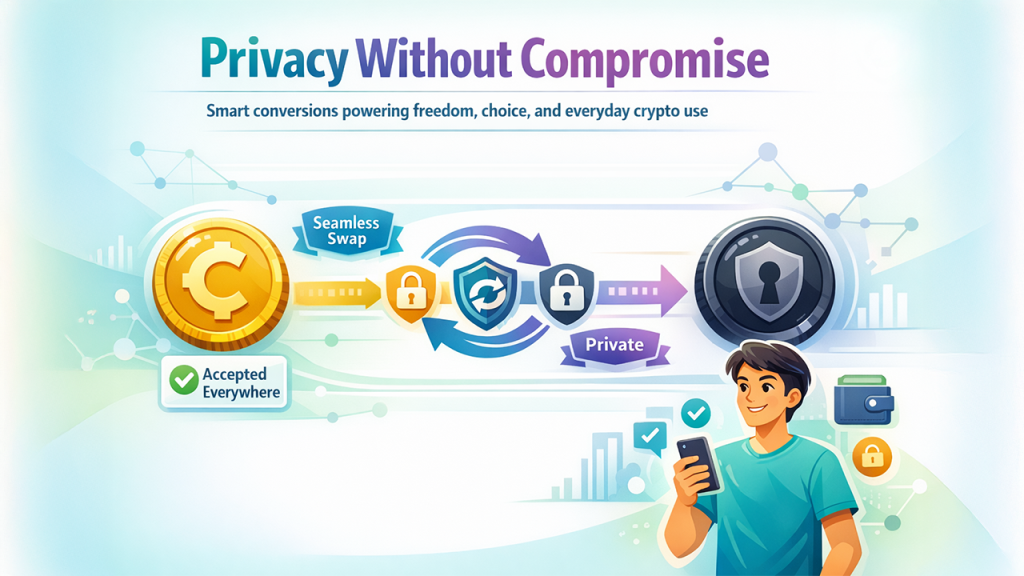
Privacy coins exist because not everyone wants their transaction history to be permanently public and easily searchable. For users who care about privacy, the challenge is that privacy-oriented assets are not always accepted everywhere. Many merchants still prioritize mainstream options. That means privacy-focused users often have to move between “accepted” assets and “private” assets depending on what they are doing.
This is one reason conversion routes between widely used coins and privacy coins appear so often in the ecosystem. A conversion page like https://stealthex.io/exchange-pairs/litecoin-to-monero/ illustrates the kind of wallet-to-wallet swap flow people use when they want to move between different parts of the crypto economy without treating the process like full-scale trading.
The point here is not the specific route. The point is the broader behavior: conversion is now part of normal crypto usage, and privacy preferences are one of the factors shaping it, just as much as fees, speed, or even long-term Crypto Prediction narratives.
Where most problems happen: operational details
The biggest risks in everyday crypto use are not dramatic hacks. They are small operational mistakes that become expensive because crypto transactions are irreversible.
Address and network mismatches are the classic example. The same asset name can exist on multiple chains, and not all address formats are interchangeable. If a user sends funds to an incompatible address or selects the wrong network, recovery can be difficult or impossible.
Timing creates confusion as well. People expect “instant,” but blockchain settlement still depends on confirmations. Congestion can slow things down, making a normal transaction feel “stuck.” In payment scenarios, this can trigger panic behavior: users retry, refresh, or send again, which creates more confusion.
Rate mechanics matter too. Some conversions use floating rates that can change during the processing window, especially when markets are volatile. Fixed-rate options reduce uncertainty but may involve different fee structures. Neither approach is inherently superior; the risk is not understanding which one applies.
Finally, compliance checks can appear unexpectedly. Some conversion services do not require account registration for typical use, but still have policies that may flag certain transactions for review. Most users never encounter this, but it is worth knowing it can happen so you are not surprised if a conversion takes longer than expected.
A simple routine that makes crypto smoother
Everyday crypto becomes much less stressful when users adopt a few habits:
- Double-check the destination address and the network before sending
- Confirm minimum amounts and avoid converting tiny “dust” balances without checking thresholds
- Keep the transaction hash so you can track progress if delays occur
- Expect confirmations to take time during congestion and avoid impulsive resends
- For larger transfers, send a small test amount first
These steps are not complicated, but they prevent a large share of real-world problems.
The bigger takeaway
Crypto is no longer only about buying and holding. It is about moving value through a fragmented ecosystem where different networks, assets, and preferences coexist. Crypto conversions has become the bridge that keeps everyday use possible—whether the goal is paying for services, managing volatility, reducing fees, or improving privacy.
As more people treat crypto as a tool rather than a gamble, the conversation will shift. The most important innovations won’t just be new coins or faster chains. They will be the practical systems and habits that make everyday crypto reliable, understandable, and usable without surprises.
Respond to this article with emojis